A difficult health insurance renewal can leave you wondering whether a traditional group plan still fits your company. Sumter employers can compare several options, including ICHRA, group health insurance, QSEHRA, level-funded plans, and PEO-sponsored coverage.
Each option handles employer contributions, employee choice, administration, and financial risk differently. This guide is for Sumter business owners and HR teams who want to compare those differences, spot possible problems, and make a more informed decision before their next renewal.
Key Takeaways
- ICHRA reimburses eligible individual health insurance expenses, but it is not an insurance policy.
- Traditional group insurance may still work better when employees value one plan, a shared network, and a familiar enrollment process.
- QSEHRA, level-funded plans, and PEO coverage follow different rules, costs, and administrative structures.
- Health stipends and supplemental benefits usually do not replace major medical coverage.
- Sumter employers should compare plans by employee ZIP code, including doctors, hospitals, prescriptions, and premiums.
- The right choice depends on your workforce, contribution budget, current renewal, and ability to support employees during enrollment.
What Is ICHRA?
ICHRA stands for Individual Coverage Health Reimbursement Arrangement. Instead of choosing one group insurance plan for the company, the employer sets a reimbursement allowance. Employees then obtain their own qualifying individual health insurance or Medicare coverage. The basic process works like this:
- The employer creates the ICHRA and sets an allowance.
- Eligible employees enroll in qualifying individual coverage.
- Employees submit proof of eligible premiums or medical expenses.
- The employer reimburses approved expenses under the plan’s rules.
ICHRA is not an insurance policy. It is an employer-funded reimbursement arrangement that can be integrated with qualifying individual coverage or Medicare when federal requirements are met.
The employer controls how much it contributes. Employees usually have more choice over the insurer, plan type, deductible, and network they select. That choice can be useful, but it adds another question: Will employees be comfortable comparing and enrolling in their own plans?
How ICHRA Compares With Traditional Group Health Insurance
Traditional group insurance and ICHRA can both help employers provide health benefits, but they take different approaches.
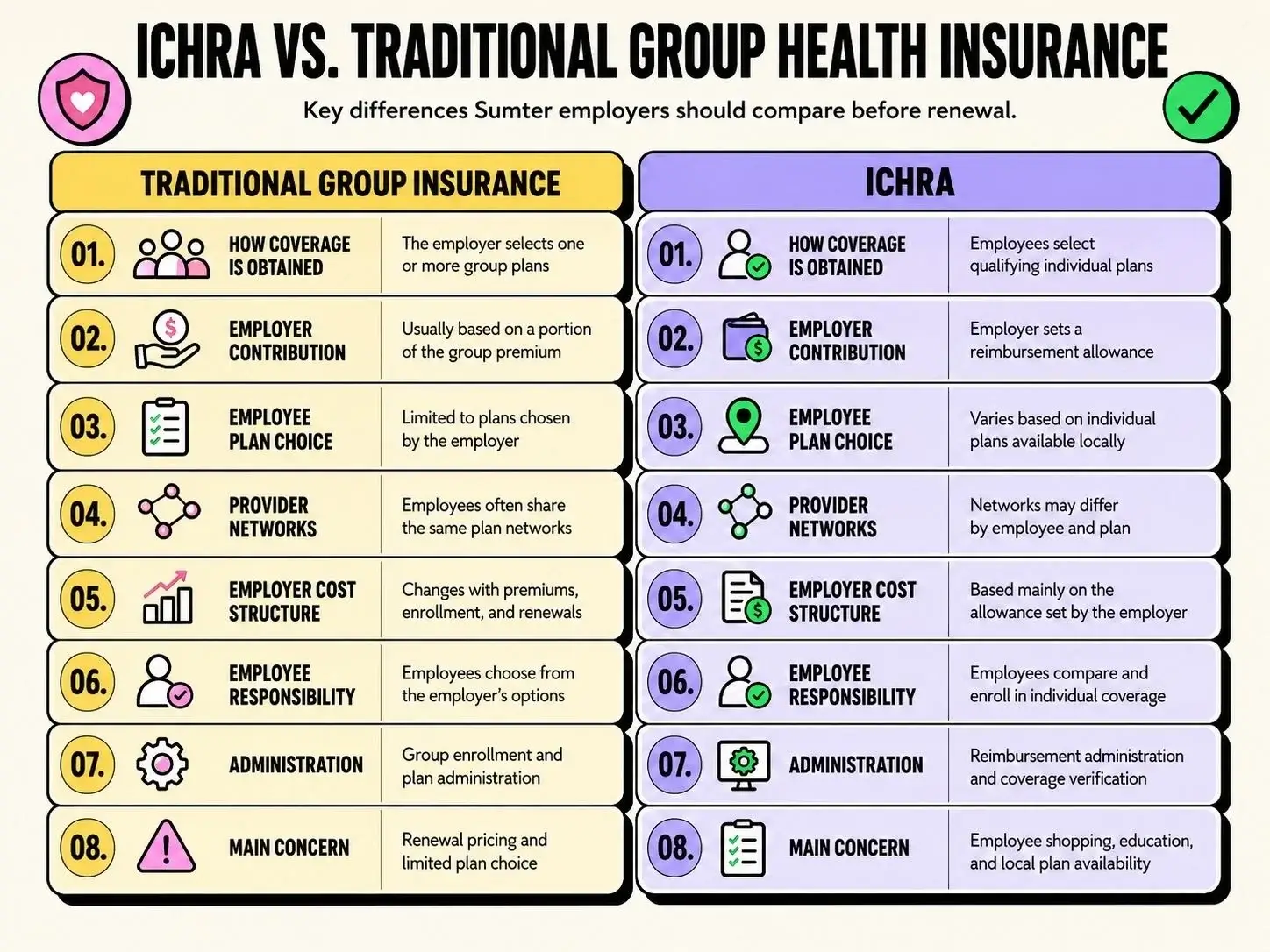
Neither approach is automatically better. A group plan may give employees a simpler and more consistent experience. ICHRA may offer more individual choice and allow the employer to set a defined contribution. The better fit depends on what your company and employees actually need.
When ICHRA May Fit
ICHRA may be worth comparing when:
- Employees live in several counties or insurance rating areas.
- One group network does not work equally well for everyone.
- Group participation requirements are difficult to meet.
- The company wants to set a more predictable contribution.
- Employees want different deductibles, insurers, or plan types.
- Suitable individual plans are available where employees live.
For example, a Sumter company may employ people who live in Sumter County as well as nearby areas. Those employees may not all have the same individual plan choices or provider networks.
ICHRA can let them shop within their local markets. That advantage matters only when the available plans provide reasonable access to their doctors, hospitals, and prescriptions.
When a Group Plan May Fit Better
A traditional group health plan may remain the better choice when:
- Most employees prefer one shared plan.
- A common provider network works well for the workforce.
- The company has favorable group pricing.
- Employees expect the employer to select and explain the plan.
- The business wants a more consistent enrollment experience.
- Employees may struggle to shop for individual coverage without close support.
A group plan can also make it easier for employees to compare benefits with coworkers or understand which providers accept the company’s coverage. Do not assume that replacing group insurance will fix every problem. It may reduce one challenge while creating another, such as more employee questions or greater differences in provider access.
Other Health Insurance Alternatives Sumter Employers Can Consider
ICHRA and traditional group insurance are not the only arrangements available. Other options include QSEHRA, level-funded plans, PEO-sponsored coverage, taxable stipends, and supplemental benefits. These choices are not interchangeable, so employers need to understand what each one does.
QSEHRA
QSEHRA stands for Qualified Small Employer Health Reimbursement Arrangement. It allows an eligible small employer to reimburse employees for qualifying healthcare expenses, including individual health insurance premiums. An employer generally must:
- Have fewer than 50 full-time employees and full-time equivalents.
- Not offer a group health plan.
- Fund the arrangement without employee contributions.
- Follow an annual reimbursement limit that is adjusted over time.
These requirements make QSEHRA different from ICHRA. ICHRA is available to employers of different sizes and provides more options for using employee classes. QSEHRA is limited to eligible small employers and does not allow the employer to offer a group health plan to its employees.
QSEHRA may fit a small business that wants to contribute toward individual coverage without operating a traditional group plan.
Level-Funded Health Plans
A level-funded plan is a type of employer-sponsored group arrangement. The employer generally pays a fixed monthly amount covering:
- Expected employee claims
- Plan administration
- Stop-loss insurance
- Other plan expenses
If claims are lower than expected, the contract may provide a refund or credit. If claims are higher, stop-loss coverage may limit certain risks based on the policy terms. Level funding may appeal to employers looking for another way to finance group benefits. It is not risk-free, and lower initial pricing does not guarantee lower long-term costs. Before choosing this option, review:
- Stop-loss limits
- Contract terms
- Claims reporting
- Potential refunds
- Renewal calculations
- Maximum employer exposure
PEO-Sponsored Coverage
A professional employer organization, or PEO, may provide access to health benefits as part of a wider relationship that can include:
- Payroll
- HR administration
- Workers’ compensation
- Benefits support
- Certain compliance services
A PEO arrangement is more than a health insurance purchase. It can change how several employment and administrative responsibilities are handled. Employers should compare the full cost, available plans, service responsibilities, technology, contract terms, and level of control. A lower health plan rate may not represent a lower total cost after other PEO fees are included.
Health Stipends and Supplemental Benefits
Some employers consider providing employees with additional taxable pay to help with healthcare costs. This is often called a health stipend.
A stipend may be simple to understand, but it does not work the same way as an ICHRA or QSEHRA. Employers should not assume they can informally reimburse individual insurance premiums outside a compliant arrangement. The IRS warns that certain employer payment plans can fail to meet Affordable Care Act market requirements. Other benefits may include:
- Dental insurance
- Vision insurance
- Accident coverage
- Critical illness coverage
- Telehealth
- Direct primary care
- Prescription-discount programs
These benefits can strengthen a package, but they usually do not replace comprehensive major medical coverage. Employees need to understand what each benefit covers and where gaps remain.
What Sumter Employers Should Check Before Choosing
Plan design is only part of the decision. Sumter employers should look closely at how each option would work for their actual workforce. Start with these questions:
- Where do employees live?
- Which doctors and hospitals do they use?
- Do employees rely on specific prescriptions?
- How much can the company contribute consistently?
- Do employees want one common plan or more personal choice?
- How much enrollment support will they need?
- Can the internal HR team manage the required administration?
- What does the current group renewal show?
The answers may point toward one arrangement or show that several options deserve a closer comparison.
Review Individual Plans by ZIP Code
Individual insurance options can vary by location, so employee ZIP codes should be part of any ICHRA review. Before choosing an ICHRA, employers should confirm that employees can find suitable individual plans where they live. Compare:
- Monthly premiums
- Deductibles and out-of-pocket limits
- Provider networks
- Hospital access
- Prescription formularies
- Plan documents
Plan availability and coverage details can change each year. Employers should review the current individual market during every benefits renewal rather than assuming the same choices will remain available.
Check Doctors, Hospitals, and Prescriptions
A plan can look affordable on paper but create problems if it does not cover the providers or medications employees use. Before comparing costs, ask employees to consider:
- Whether their doctors appear in the plan directory
- Whether their preferred hospitals participate
- How their prescriptions are covered
- Whether specialist referrals are required
- What they may pay before reaching the deductible
Provider directories can change and may contain errors. Employees should confirm important providers directly with both the insurer and the provider’s office before enrolling. This step matters for group plans too. A familiar insurer name does not mean every plan from that insurer uses the same network.
Consider the Employee Experience
More choice is useful only when employees can understand and use it. Under an ICHRA, employees may need help with:
- Comparing individual plans
- Understanding premiums and deductibles
- Confirming qualifying coverage
- Enrolling within the correct period
- Submitting reimbursement documents
- Understanding how the arrangement affects Marketplace assistance
Some employees may welcome the ability to choose their own plan. Others may prefer the simplicity of selecting from one or two employer-sponsored options. Think about your workforce before making the change. Who will answer employee questions during enrollment, and how much guidance will they need?
A Simple Comparison Checklist for Employers
Before choosing an arrangement, gather the information needed for a fair comparison. Use this checklist during your review:
- How many full-time and part-time employees are eligible?
- Where do eligible employees live?
- Which doctors, hospitals, and prescriptions matter most?
- What is the current group plan renewal?
- What contribution can the company sustain?
- Does the company prefer a fixed allowance or a percentage of premiums?
- Do employees want one common plan or individual choice?
- How much enrollment support will employees need?
- Can the HR team manage reimbursement and coverage verification?
- Would different employee classes need different arrangements?
- Are there tax, reporting, or employer-mandate requirements to review?
- How will the company explain the change to employees?
Compare the complete impact rather than one headline number. A lower employer contribution may increase employee costs, and a plan with more choices may require more education. The strongest option is the one that your company can afford and your employees can understand and use.
Compare the Options Before Your Next Renewal
Choosing between group health insurance, ICHRA, QSEHRA, and other arrangements usually starts with your current renewal and employee needs.
Review what the company can contribute, where employees live, which providers and prescriptions matter, and how much enrollment support the team will need. It is equally useful to identify what is working in the current plan. A traditional group plan may still be the right choice when pricing, networks, and the employee experience remain strong.
Benni can help employers compare these factors without beginning with a preferred product. That may include reviewing group coverage, reimbursement arrangements, level-funded options, and the practical work required to administer each one. Employers looking for local guidance can learn more about Benni’s Sumter benefits support before deciding what should change at the next renewal.
A side-by-side review can show whether changing the plan structure would solve the problem or simply move it somewhere else.