A work-related vehicle accident can create a coverage issue even when a business owns only one vehicle. The key is not just who owns the vehicle. It is how the vehicle is used, who drives it, what it carries, and what contracts require. A personal policy may limit or exclude some business uses, while a commercial policy may need endorsements or separate coverages for the way a business operates.
This checklist explains the South Carolina insurance minimums, the commercial auto decisions worth reviewing, and the questions to bring to a renewal discussion. This guide is for Charleston business owners, operations leaders, and anyone responsible for vehicles used in the course of work.
Key Takeaways
- Business driving may need commercial auto coverage. A personal auto policy may limit or exclude some business use.
- South Carolina has minimum auto insurance requirements, but businesses may need higher limits because contracts, leases, lenders, or clients can require more.
- Hired and non-owned auto coverage can matter when employees use personal, rented, or borrowed vehicles for work.
- Review more than just liability. Vehicle damage, UM/UIM, medical payments, tools, cargo, trailers, and equipment may also need attention.
- Prepare before renewal. Gather vehicle details, driver information, contracts, equipment information, and current policy documents before reviewing coverage.
Why Commercial Auto Insurance Deserves a Separate Review
Commercial auto is a distinct exposure from general liability. It can apply to company cars, pickups, vans, service vehicles, and other vehicles used in business operations. It may also matter when people drive rented vehicles or their own cars for business errands, client visits, deliveries, or job-site travel. For Charleston businesses, review the actual driving pattern: vehicle ownership, garaging, drivers, and whether vehicles carry equipment, inventory, or passengers. Those facts shape the coverage discussion.
South Carolina Auto Insurance Minimums
South Carolina law sets minimum automobile liability limits for a vehicle principally garaged or used in the state. The statutory minimum is commonly written as 25/50/25:
- $25,000 for bodily injury to one person in one accident
- $50,000 for bodily injury to all persons in one accident
- $25,000 for property damage in one accident
Uninsured motorist (UM) coverage is also required. It must meet at least the statutory liability minimums, including $25,000 for property damage. Underinsured motorist (UIM) coverage is different: South Carolina insurers must offer it, but it is not the same as mandatory UM coverage.
These limits are a legal floor, not a recommendation for every business. A contract, lease, lender, or client may require more. The City of Charleston’s published contractor insurance requirements, for example, list $1 million combined single-limit automobile liability for the contracts covered by that document. Requirements can vary by agreement, so use the actual bid, contract, or lease when reviewing your limits.
When to Ask About Commercial Auto or Hired and Non-Owned Auto
A commercial policy or a business-use endorsement may be appropriate when a vehicle is used regularly for work, but the answer depends on the insurer’s policy language and underwriting rules. A review is especially important if your business:
- Owns, leases, finances, or registers vehicles used for work
- Sends employees to client locations, job sites, or deliveries in their own vehicles
- Rents or borrows vehicles for business travel or operations
- Transports tools, equipment, inventory, client property, or passengers
- Has a personally titled vehicle used primarily in the business
Hired and non-owned auto (HNOA) deserves particular attention. It can address certain liability from rented, borrowed, or employee-owned vehicles used for the business. It generally does not replace an employee’s personal policy or cover physical damage to that vehicle.
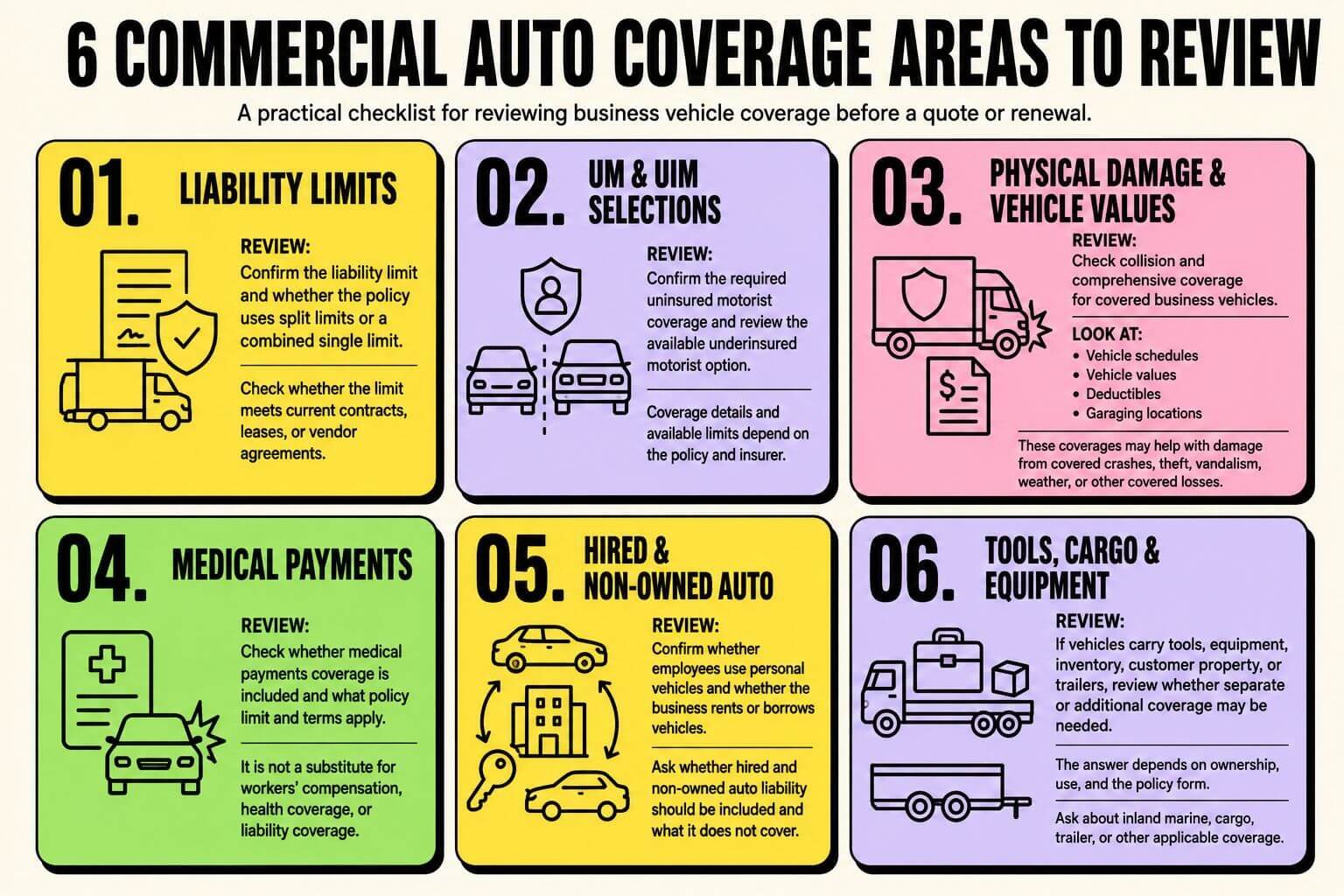
Commercial Auto Coverage Checklist
Use the items below to review a quote or renewal. Not every item belongs on every policy, but each should be a deliberate decision.
1. Liability limits and contract wording
Confirm the limit, whether it is split limits or a combined single limit, and whether it meets current contracts, leases, or vendor agreements.
2. UM and UIM selections
Confirm the required UM limits and review the UIM option. Coverage details and available limits depend on the policy and insurer.
3. Physical damage and vehicle values
Collision and comprehensive can help with damage to covered business vehicles from a crash, theft, vandalism, weather, or another covered loss. Check vehicle schedules, values, deductibles, and garaging locations.
4. Medical payments and other optional coverages
Medical payments coverage may help pay certain medical expenses after a covered accident, subject to the policy terms and limit. It is not a substitute for workers’ compensation, health coverage, or liability coverage.
5. Hired, non-owned, and rental exposure
Confirm whether employees use personal vehicles and whether the business rents or borrows vehicles. Then ask whether HNOA liability should be included and what it does not cover.
6. Tools, cargo, trailers, and equipment
If the business carries tools, equipment, inventory, or customer property, ask whether inland marine, motor truck cargo, trailer, or another coverage is needed. The answer depends on ownership, use, and the policy form.
A Contract Can Change the Answer
Review the insurance section of each current contract, not just the declarations page. Agreements may specify a limit, an “any auto” requirement, certificate format, additional-insured wording, waiver language, or proof of coverage. If a Charleston business bids on public work, do not rely on a previous project’s requirements. The City’s published contractor document is a useful example of why the requested insurance terms should be checked before pricing or signing a job.
Pre-Renewal Checklist
Before the next renewal, gather the information an advisor or insurer will need:
- A current list of owned, leased, financed, rented, and regularly used vehicles
- Vehicle values, garaging locations, driver list, and personal-vehicle business use
- Contracts, leases, or client requirements that state insurance terms
- Tools, equipment, inventory, trailers, or customer property carried in vehicles
- The current auto, general liability, umbrella, and workers’ compensation declarations pages
How Commercial Auto Fits With Other Business Coverage
Commercial auto addresses vehicle-related liability and, when selected, damage to covered vehicles. General liability usually addresses different third-party risks and does not replace commercial auto for an accident involving a company or business-used vehicle. An umbrella or excess policy may provide additional limits only according to its own terms and underlying-policy requirements.
For a broader review of how these coverages work together, see Benni Agency’s business and commercial insurance options. Charleston employers can also explore local insurance options without treating this educational checklist as a replacement for a policy review.
One thought on “Charleston Commercial Auto Insurance Coverage Checklist”
Comments are closed.