Most business owners do not expect a cyber incident to happen to them until they face a ransomware demand, fraudulent payment request, or customer data issue. Cyber liability insurance can help address certain costs after a covered event, but protection depends on the policy terms, limits, exclusions, and the risks a business actually faces.
For Summerville business owners, the biggest coverage mistakes are often simple assumptions: believing general liability automatically covers cyber losses, overlooking social engineering exposure, or failing to review how vendors and remote work affect cyber risk. This guide explains the areas worth reviewing before a claim occurs.
Key Takeaways
- General liability and business owner policies may not provide broad protection for modern cyber incidents.
- Social engineering fraud coverage often has separate limits and specific requirements.
- Third-party vendors can create cyber exposure even when a company’s own systems are not directly attacked.
- South Carolina businesses may have breach notification obligations after certain data incidents.
- Cyber insurance works best when combined with practical security controls and regular policy reviews.
Why Cyber Risk Matters for Small Businesses
Cyber threats are not limited to large corporations. Small and mid-sized businesses often rely on email, online payments, cloud software, payroll systems, and customer databases, which creates opportunities for attackers. The 2025 Verizon Data Breach Investigations Report found ransomware was present in 44% of analyzed breaches overall, with ransomware appearing in 88% of breaches involving small and medium-sized businesses in its SMB analysis.
The report also identified increased third-party involvement in breaches, highlighting the risks created by vendors and service providers. Verizon 2025 Data Breach Investigations Report For a Summerville business, cyber risk may come from a phishing email, a compromised employee account, a vendor breach, or a fraudulent request to change payment information. The specific risk depends on the company’s operations and the information it handles.
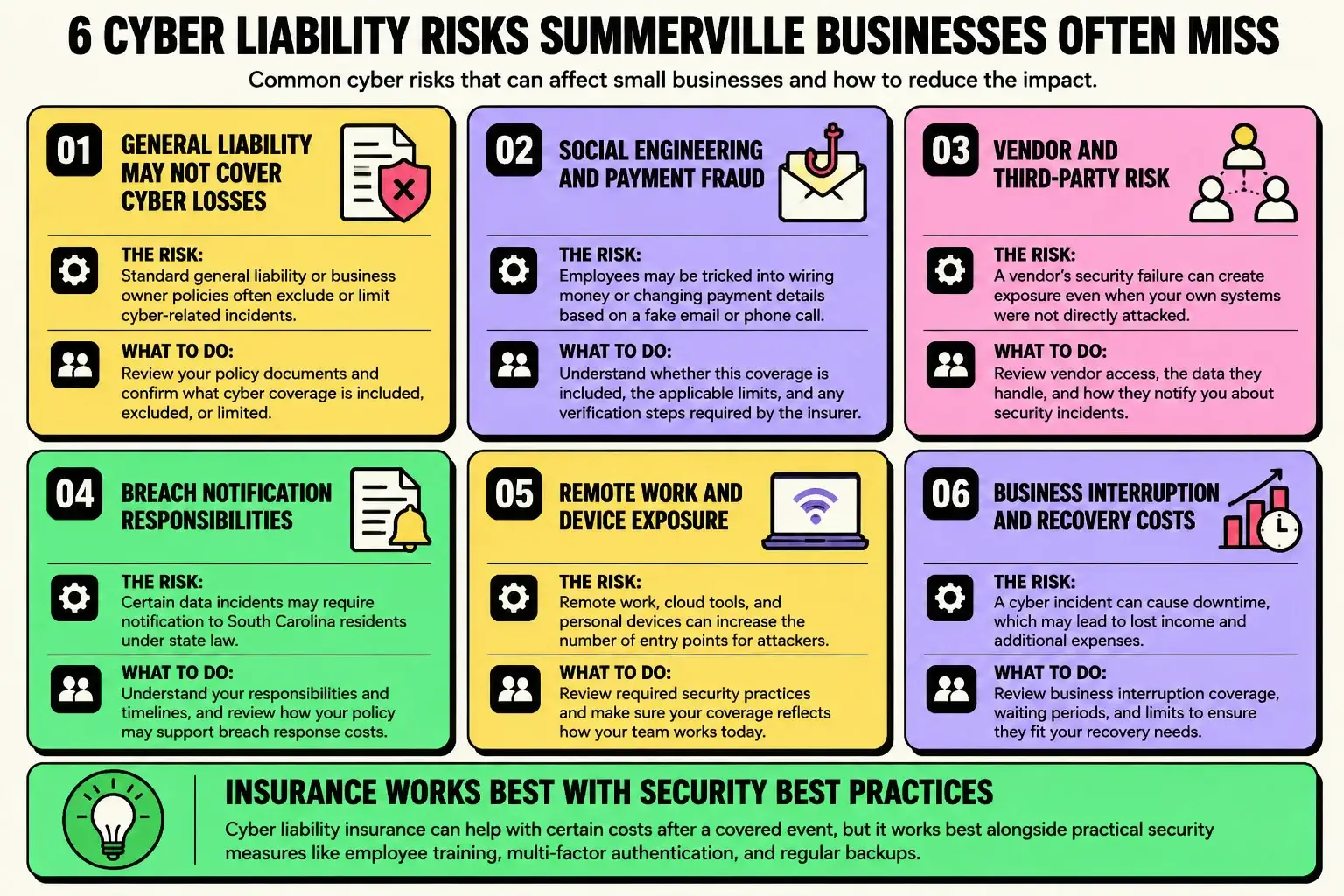
Cyber Liability Risks Business Owners Often Miss
1. Assuming General Liability Covers Cyber Losses
Many businesses carry general liability insurance or a business owner’s policy (BOP) and assume it will respond to a cyber event. Standard policies vary, and cyber-related exclusions or limitations may apply. A dedicated cyber policy is designed to address cyber-related exposures that may not be covered under other commercial insurance policies. However, coverage differs by carrier, policy form, limits, deductibles, and endorsements. Business owners should review their actual policy documents rather than assume a current policy will respond after a breach, ransomware event, or data security incident.
2. Overlooking Social Engineering Fraud
Cyber losses do not always involve stolen data. Social engineering attacks often rely on deception, such as a fake vendor email or impersonated executive asking an employee to send money or change payment details. Coverage for these events may appear through cyber insurance, crime coverage, or endorsements, depending on the policy. Limits may be lower than the overall policy limit, and insurers may require specific verification procedures before a claim is considered.
Businesses that regularly send wire transfers or vendor payments should understand:
- Whether social engineering losses are covered.
- The applicable sublimits.
- Required approval or verification steps.
3. Ignoring Vendor and Third-Party Risk
Many companies depend on outside providers for payroll, accounting, payment processing, customer management, and other services. A vendor’s security failure can create problems even when the business’s own systems were not directly compromised.
The 2025 Verizon report noted that third-party involvement in breaches doubled and accounted for about 30% of breaches analyzed. Reviewing vendor access, stored data, and notification procedures can help businesses better understand this exposure.
4. Missing South Carolina Breach Notification Responsibilities
Cyber incidents can create responsibilities beyond restoring systems. South Carolina’s breach notification law requires businesses that own or license certain personal information about South Carolina residents to provide notice after qualifying security breaches within the required timeframe.
The details depend on the type of information involved, the circumstances of the incident, and applicable legal requirements. A cyber policy may provide access to services such as breach response resources, but policy terms vary and do not replace legal guidance.
5. Failing to Review Remote Work and Recovery Needs
Remote work, cloud applications, and employee-owned devices can expand the number of systems connected to business operations. Businesses should understand what security practices their cyber policy requires and whether their coverage reflects current operations. A cyber incident may also create downtime costs. Business interruption coverage, waiting periods, and limits should be reviewed based on how long recovery could realistically take.
What Cyber Liability Insurance May Cover
Cyber insurance policies vary, but coverage commonly falls into two categories:
First-party coverage may help address costs directly experienced by the business, such as forensic investigation, data restoration, incident response, notification expenses, and certain business interruption losses.
Third-party coverage may address claims made against the business, including certain defense costs, settlements, or regulatory-related expenses where coverage applies.
Coverage is not identical across policies. Businesses should review exclusions, sublimits, deductibles, and required security practices with their insurance professional.
Questions to Ask During a Policy Review
Before renewing cyber coverage, business owners should consider:
- Does our current policy address the cyber risks specific to our operations?
- Are social engineering and fraudulent payment risks addressed?
- What security controls are required under the policy?
- Are vendor-related incidents included?
- Are business interruption limits realistic for our recovery timeline?
Practical Steps That Support Cyber Readiness
Insurance is one part of a broader risk-management approach. Businesses can also consider:
- Enabling multi-factor authentication for important accounts.
- Keeping tested backups of critical information.
- Training employees to identify phishing attempts.
- Verifying payment changes through a trusted method.
- Reviewing vendor access to company information.
Ransomware events may also involve legal and regulatory considerations. The U.S. Treasury’s Office of Foreign Assets Control (OFAC) has warned that ransomware payments can create sanctions risks in certain situations, which is why businesses should involve appropriate professionals during an incident. OFAC Advisory on Potential Sanctions Risks for Facilitating Ransomware Payments
How Benni Agency Can Help Businesses Review Coverage
Cyber liability decisions require understanding how insurance terms connect to a company’s actual operations. Benni Agency helps businesses evaluate insurance options and identify questions to discuss with an insurance professional. For employers and business owners in the area, this provides more information about local support options.