If your HR team is updating benefits in spreadsheets, fixing payroll deductions, answering the same employee questions, and checking several systems during enrollment, benefits administration can take up more time than it should. A benefits administration platform can simplify HR by putting enrollment, employee information, plan documents, payroll connections, and routine benefits tasks in a more organized system.
This article is for employers and HR teams that want to reduce manual benefits work, understand where technology can help, and make a better decision about their current setup.
Key Takeaways
- A benefits administration platform can reduce manual HR work by organizing enrollment, eligibility, employee changes, and benefits information in one place.
- Connections with payroll and HR systems can reduce duplicate entry and help keep benefit elections and payroll deductions aligned.
- Employee self-service can reduce routine HR questions by giving employees direct access to plan information, elections, and benefits documents.
- Benefits technology can make open enrollment, new-hire enrollment, and qualifying life events easier to track and manage.
- The right platform should fit the employer’s current systems, workforce, benefits structure, reporting needs, and level of support required.
What Is a Benefits Administration Platform?
A benefits administration platform is software that helps employers manage employee benefits information and related HR tasks from one place. Depending on the system, HR may use it to manage:
- Employee eligibility
- Benefit elections
- New-hire enrollment
- Open enrollment
- Dependent information
- Qualifying life events
- Plan documents
- Payroll-related benefit data
- Enrollment reports
The goal is not simply to replace a spreadsheet with another screen. A useful platform should reduce the number of times HR has to enter, check, send, or correct the same information.
How Does a Benefits Administration Platform Simplify HR?
The biggest benefit is less repetitive administration. Benefits work often involves several people and systems. An employee makes an election. HR records it. Payroll needs the correct deduction. A carrier may need updated information. The employee may also need documents or confirmation. When those steps are handled separately, small changes can create a surprising amount of work. A benefits platform can help bring those tasks into a clearer process.
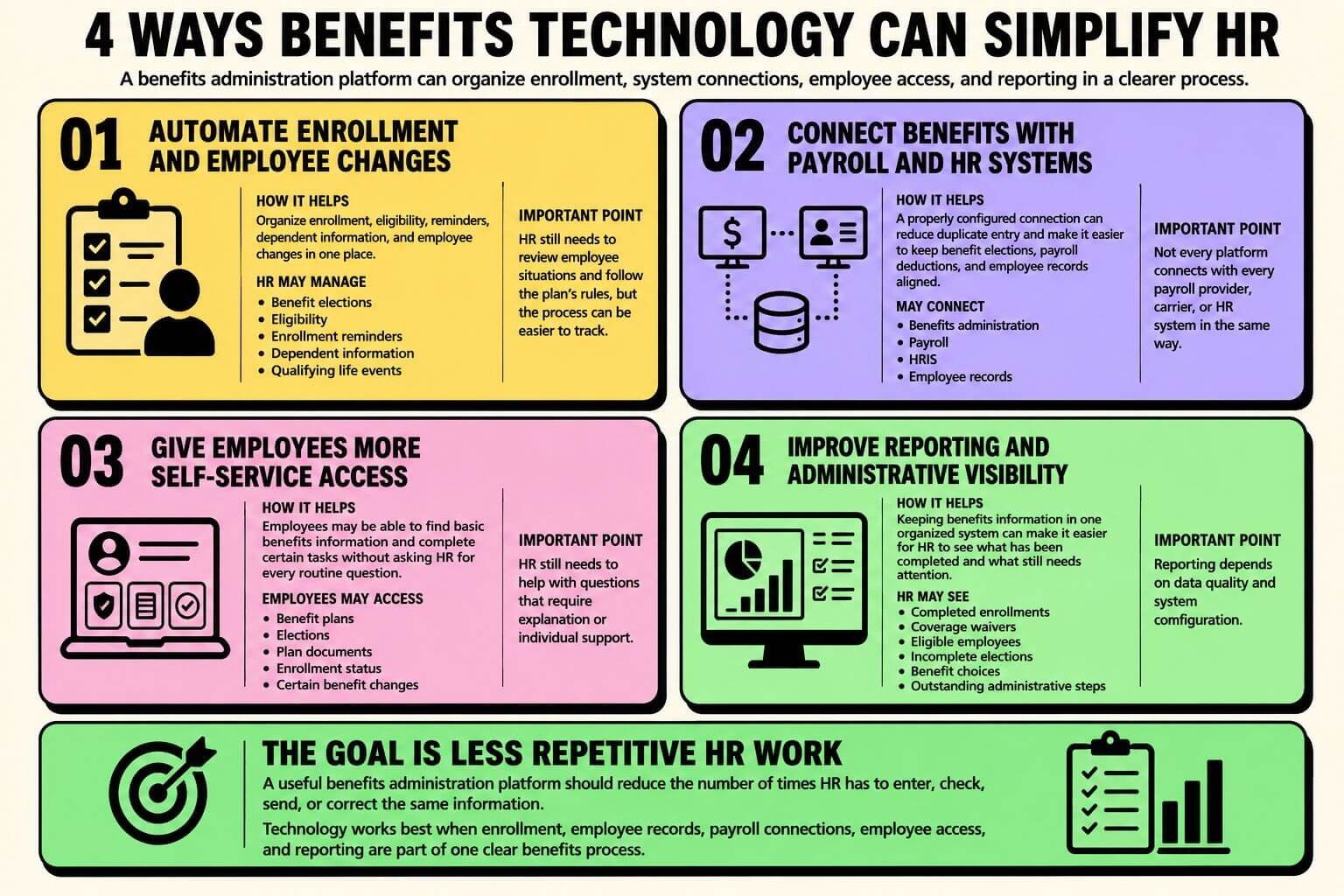
Automates Enrollment and Employee Changes
Enrollment is one of the easiest places to see the difference. Without a benefits platform, HR may collect forms, enter elections manually, check eligibility, send reminders, update dependent information, and follow up with employees who missed a deadline. A platform can help organize many of those steps in one place. The same applies during the year when an employee gets married, has a child, loses other coverage, or experiences another qualifying life event. HR still needs to review the situation and follow the plan’s rules, but the process can be easier to track.
Connects Benefits With Payroll and HR Systems
Payroll is another common source of extra work. An employee’s benefit election may change what comes out of each paycheck. If the benefits and payroll systems do not communicate, HR may have to enter the election in one system and then update the deduction somewhere else. That creates more chances for mismatches. A properly configured connection between benefits, payroll, and an HRIS can reduce duplicate entry and make it easier to keep records aligned. Employers should still confirm how a platform handles data transfers. Not every system connects with every payroll provider, carrier, or HR system in the same way.
Gives Employees More Self-Service Access
Some of the questions HR answers every week are simple:
- Where can I see my benefits?
- Which plan did I choose?
- Where are the plan documents?
- How do I add a dependent?
- Did I finish enrollment?
A good employee portal can give workers direct access to much of that information. Employees may be able to review plans, complete elections, find documents, check their choices, and start certain benefit changes themselves. HR still needs to help with questions that require explanation, but self-service can reduce routine back-and-forth.
Improves Reporting and Administrative Visibility
It is difficult to manage benefits when information is spread across spreadsheets, emails, carrier portals, and payroll records. A centralized platform can make it easier for HR to see:
- Who completed enrollment
- Who waived coverage
- Which employees are eligible
- Which elections are still incomplete
- What benefit choices employees made
- Which administrative steps still need attention
Reporting depends on the quality of the data and how the platform is configured, but having information in one place can make problems easier to spot before they turn into payroll or enrollment issues.
Where Benefits Administration Technology Helps Most
Benefits software becomes especially useful when HR is handling the same administrative steps again and again. The value is often easier to see during a few common points in the employee lifecycle.
New Hires and Eligibility
A new employee may create several benefits tasks at once. HR may need to confirm when the employee becomes eligible, explain available plans, track the enrollment deadline, record elections, update payroll deductions, and provide plan information. Keeping those steps in an organized benefits system can make it easier to see what has been completed and what still needs attention. That can be especially helpful for companies hiring regularly throughout the year.
Open Enrollment and Life Events
Open enrollment can create weeks of extra work if HR is relying on forms, spreadsheets, individual emails, and manual reminders. A benefits platform can give employees one place to review options and submit elections while giving HR a clearer view of who has completed the process. The same system can also help organize midyear changes. An employee marriage, birth, adoption, divorce, or loss of other coverage may require new elections or dependent updates. Keeping the records and steps together can make those changes easier to manage.
Growing or More Complex Workforces
Benefits administration usually becomes harder as a company adds employees, locations, benefit choices, or different employee groups. That matters in growing markets such as the Charleston area. The U.S. Bureau of Labor Statistics reported that employment in Charleston County grew 2.4% from December 2024 to December 2025, the largest increase among South Carolina’s seven largest counties. For a growing employer, more hiring can mean more eligibility dates, enrollment activity, employee questions, and payroll changes. Complexity can also increase when employers add voluntary benefit options or use arrangements that require different administrative rules. For example, employers considering ICHRA administration may need to coordinate employee classes, eligibility, reimbursements, and communication carefully.
What Technology Can Simplify and What It Cannot Replace
Benefits technology can reduce paperwork and organize routine administration, but software cannot make every benefits decision for an employer. A platform does not replace:
- Correct plan setup
- Employer oversight
- Benefits strategy
- Employee education
- Legal or tax advice when needed
- Human help with unusual employee situations
Configuration matters too. A powerful system that is set up poorly can still create payroll mistakes, confusing employee experiences, or extra work for HR. Employers may also need benefits guidance when they are reviewing plan choices, employee communication, eligibility questions, or changes to their benefits strategy. Technology works best when the people using it understand both the system and the benefits being administered.
What Should Employers Look for in a Benefits Administration Platform?
Start with the problems your HR team is already dealing with. A platform with a long feature list is not automatically the right choice. It needs to work with the way your company handles employees and benefits. Ask questions such as:
- Does it connect with our payroll system?
- Can it work with our current HRIS?
- How are carrier updates handled?
- Is enrollment simple for employees?
- Can employees access benefits information without asking HR?
- What reporting can HR actually use?
- How are new hires and life events handled?
- What implementation help is included?
- Who helps if an enrollment or data issue appears?
- Can the system support the benefits we may add later?
It also helps to look beyond the software itself. Employers comparing benefits administration technology should consider implementation, employee communication, system connections, and ongoing support alongside the platform’s features.
Is Your Current Benefits Process Creating Extra HR Work?
A new platform is not automatically the answer every time benefits administration feels difficult. Start by looking at where your HR team is spending unnecessary time. Are employees entering the same information in more than one place? Does HR have to update payroll manually after enrollment? Are benefit records spread across email, spreadsheets, carrier portals, and separate systems? Does open enrollment require repeated follow-up just to confirm who has finished? Those problems can come from the technology, weak system connections, the initial setup, or the way the process is being handled.
Benni Agency helps employers review how their current benefits administration works and where better technology or a different setup may reduce manual work. Sometimes the existing system can stay. Sometimes another approach makes more sense. A useful first step is identifying which benefits tasks are taking the most time from your HR team.