Small and midsize employers are being asked to offer competitive benefits while healthcare costs rise and HR teams have limited time to manage them. The future of employee benefits for SMBs will center on flexible funding, more employee choice, better benefits technology, and closer control over costs and administration.
That does not mean every business needs the newest benefit or plan model. The goal is finding what fits your workforce and budget. This article is for business owners, employers, and HR teams deciding which changes deserve attention and which ones can wait.
Key Takeaways
- Healthcare costs will keep shaping benefit decisions, making plan and funding comparisons more important.
- Employees will expect more choice, but SMBs do not need to offer every available benefit.
- ICHRA, level funding, and voluntary benefits give employers more ways to structure coverage.
- Benefits technology will matter more as enrollment, payroll, eligibility, and reporting become more connected.
- Employee education will become more important because benefits have limited value when employees do not understand them.
- The right strategy depends on cost, workforce needs, administration, and compliance, not the latest benefits trend.
What Does the Future of Employee Benefits Look Like for SMBs?
The future is not one new insurance product. It is a shift toward benefit programs that give smaller employers more control over healthcare spending, employee choice, administration, and how employees use their coverage. A company with 15 employees does not need to build benefits the same way as a company with 5,000 employees. Smaller businesses usually have tighter budgets and fewer people handling HR, so each benefit needs a clear purpose.
That matters in markets such as South Carolina. The South Carolina Department of Employment and Workforce reported that 69.4% of the state’s 194,411 establishments had fewer than five employees in the first quarter of 2025. Another 56,580 employed between five and 99 people. Small employers make up a large part of the state’s business community, which makes practical SMB benefit strategies especially relevant.
Rising Healthcare Costs Will Keep Changing Benefit Decisions
Health coverage will remain one of the biggest parts of an employee benefits budget. As costs change, employers will have more reason to review how they fund coverage instead of renewing the same structure year after year without comparing alternatives. The question is not simply, “How do we spend less?” Employers also need to ask what employees receive for that spending. A useful review can look at:
- Employer and employee premium contributions
- Deductibles and out-of-pocket costs
- Plan participation
- Employee locations
- Claims experience where applicable
- Administrative workload
- Other funding arrangements available to the group
The best answer can change as a company grows, hires in new locations, or faces a difficult renewal.
Employers Will Compare More Funding Options
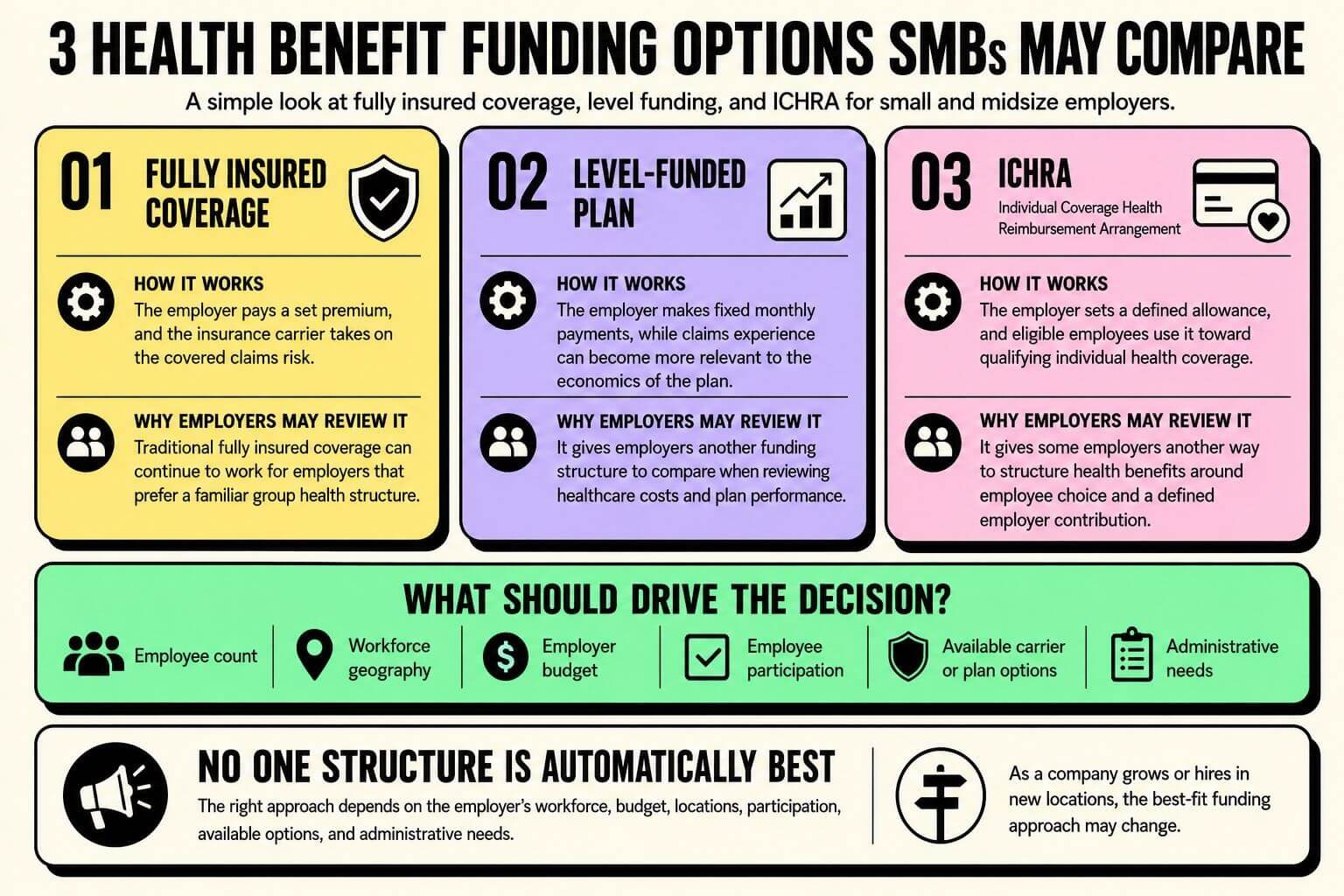
Traditional fully insured coverage will continue to work for many employers, but it is no longer the only structure worth reviewing. A fully insured plan generally gives the employer a set premium while the carrier takes on the claims risk. A level-funded plan uses fixed monthly payments but can make claims experience more relevant to the economics of the plan.
For some businesses, ICHRA reimbursement provides another option. The employer sets a defined allowance, and eligible employees use it toward qualifying individual health coverage. None of these approaches is automatically best. Employee count, geography, budget, participation, carrier options, and administrative needs all affect the decision.
Employees Will Expect More Choice Without More Confusion
Employees do not all value benefits in the same way. A younger employee may care about accident coverage or mental health access, while someone supporting a family may place more value on life insurance, disability coverage, or hospital protection. That does not mean employers should fill enrollment with every product available.
A better approach is choice with structure. Employers can look at employee questions, workforce demographics, enrollment data, and direct feedback to decide which options deserve a place in the package. Too many choices can make enrollment harder. A smaller group of relevant benefits, explained clearly, is often easier for employees to understand and use.
Voluntary Benefits Can Expand Choice
Voluntary benefits give SMBs another way to expand coverage choices without requiring the employer to pay the entire cost of every additional benefit. Depending on the plan structure, voluntary benefit options may include:
- Accident insurance
- Critical illness coverage
- Hospital indemnity
- Life insurance
- Disability coverage
These products work best when employees understand what they cover and how much they cost. Simply adding another option to enrollment does not guarantee employees will see value in it.
Benefits Technology Will Become Part of the Strategy
For a small HR team, benefits administration can take a surprising amount of time. New hires, terminations, eligibility changes, payroll deductions, enrollment questions, and reporting all create work throughout the year. That is why technology is becoming part of the benefits decision itself. Good benefits administration technology can help employers handle tasks such as:
- Enrollment
- Eligibility updates
- Payroll coordination
- Employee self-service
- Plan information
- Reporting
- Benefit elections
AI may also become more common in decision-support tools and routine employee questions. The useful test is simple: does the technology make the process easier and more accurate for employees and HR? If not, adding another platform solves very little.
Employee Education Will Matter as Much as Adding More Benefits
An employer can offer a strong benefits package and still hear employees say, “I don’t know what we have.” That is usually not a product problem. It is an education problem. Employees need to understand what a benefit covers, what it costs, when they can enroll, who qualifies, and how to use it. Those questions matter during enrollment, but they also come up throughout the year.
Clear employee benefits education can help employees make more informed choices and understand the value of benefits they already have. For employers, this is worth watching closely. Adding another benefit may not improve the employee experience if existing options are poorly explained.
Compliance and Administration Cannot Be an Afterthought
A benefits package can look good on paper and still become difficult to manage. Eligibility changes need to reach the right systems. Payroll deductions need to match elections. Required notices need to go out correctly. Employee records need to stay current.
Growth can make those problems more noticeable. Consider a company that originally had employees working from one office but later hires remote workers in several states. The benefits process that worked for one location may become harder to manage as carrier availability, employee eligibility, payroll, and state requirements enter the picture. Administration should be reviewed alongside plan design, not after the plan has already been selected.
What SMB Employers Should Do Now
Preparing for the future does not require rebuilding the entire benefits program every year. Start by checking whether your current setup still works. A practical review can include:
- Review current costs. Look at what the company and employees are paying.
- Ask employees what they value. Do not assume participation means understanding.
- Compare funding options. Review fully insured, level-funded, and reimbursement approaches when appropriate.
- Check voluntary benefits. Look at participation before adding more products.
- Review administration. Find enrollment, payroll, eligibility, or communication problems.
- Check compliance responsibilities. Growth or hiring in new locations can change what needs attention.
- Review the plan again next year. Employee needs and available options do not stay fixed.
Employers reviewing pre-tax deductions may also want to check whether a Section 125 plan fits their benefits structure.
When Your Benefits Strategy Needs a Second Look
A benefits plan does not need to change every time a new trend appears. It does deserve another look when the current setup stops working well for the company or its employees. You may be at that point if renewal costs keep stretching the budget, employees regularly ask what their coverage includes, enrollment takes too much HR time, or workers in different locations have trouble with the same plan structure.
It can also make sense to compare options if your company has grown since the current program was selected. Group health options can work differently depending on employee count, location, contribution strategy, and budget. Benni Agency can help employers compare plan structures and understand how the choices affect cost, employee access, and administration.