Benefits may have worked well when your company was smaller, but growth can expose problems fast. Costs become harder to predict, enrollment takes more time, and employees expect clearer answers. A Mount Pleasant benefits broker can support business growth by helping you plan contributions, compare coverage, reduce manual work, and build a benefits program that can handle more employees.
Mount Pleasant business owners and HR leaders can use this article to plan benefits for future hiring while keeping costs, confusion, and administrative work under control.
Key Takeaways
- A benefits broker can make costs easier to forecast as your employee count changes.
- Better plan design and communication can strengthen your overall employment offer.
- Year-round broker support can reduce the benefits work handled by HR and payroll.
- Benefits technology should remove manual steps instead of adding another disconnected system.
- Mount Pleasant employers should judge a broker by service, execution, and workforce fit, not location alone.
How a Mount Pleasant Benefits Broker Supports Business Growth
A benefits broker does more than collect insurance quotes once a year. For a growing company, the broker should help connect benefits decisions to hiring plans, operating costs, employee needs, and administrative capacity.
That support matters because growth changes the numbers. Adding employees affects employer contributions, enrollment volume, payroll deductions, employee questions, and compliance responsibilities. A plan that was manageable with a small team may become difficult to fund or administer as the company expands.
Makes Benefit Costs Easier to Plan
Benefits are a major expense, and the impact grows with every new hire. A broker should help leadership understand what different plan and contribution decisions could mean before those decisions reach the payroll system.
That may include:
- Comparing employer contribution amounts
- Reviewing several plan structures
- Estimating costs at different employee counts
- Looking at employee affordability
- Preparing for possible renewal increases
- Identifying options that fit the company’s budget
The goal is not to choose the least expensive plan without considering the employees. It is to understand the trade-offs before making a decision. For example, a company preparing to grow from 25 to 40 employees may need to know how its current contribution strategy will affect the budget at the higher headcount. Waiting until renewal arrives leaves less time to compare those options carefully.
Helps Benefits Compete for Employees
Salary gets attention, but candidates also look at health coverage, employer contributions, paid time off, disability protection, and other benefits when comparing jobs. A broker can help an employer decide which parts of the benefits package matter most to its workforce. That may involve looking at employee feedback, participation, family coverage needs, work locations, and the types of positions the company is trying to fill. More benefits are not always better. Adding several programs that employees do not understand or use may create cost without improving the employment offer. A stronger approach is to ask:
- Which benefits do employees value most?
- Are employees struggling to afford their share of coverage?
- Do candidates regularly ask about a benefit the company does not offer?
- Are current benefits explained clearly during recruiting and onboarding?
- Would voluntary benefits fill a real gap without increasing the employer’s core plan cost?
The broker should help the company make those decisions with a clear reason behind each recommendation.
Reduces Work for HR and Payroll
Growth creates more benefits activity. New employees need to enroll, dependents must be added, payroll deductions change, and carrier records need to stay accurate. Without a clear process, HR may spend hours moving information between forms, spreadsheets, payroll, and insurance carrier systems. Small mistakes can lead to missing coverage, incorrect deductions, and frustrated employees.
The right benefits administration setup can reduce duplicate data entry and give employees a clearer way to review and select coverage. It may also help HR manage onboarding, eligibility changes, reporting, and enrollment records from one process rather than several disconnected ones. Technology alone does not fix a poor process. The broker should first identify where work is getting stuck, then recommend tools that solve those specific problems.
Signs Your Company Has Outgrown Its Current Broker
Many companies begin with a simple benefits setup. That can work for a while, especially when the employee count is low, and the same plan renews without major changes. Problems often appear as the company grows. You may have outgrown the current broker relationship if:
- The broker only reaches out close to renewal
- Plan alternatives arrive too late for a careful review
- HR handles most employee questions without help
- Enrollment still depends on paper forms or spreadsheets
- No one reviews whether employees understand or use the plans
- Carrier problems take too long to resolve
- The same recommendation appears every year
- Adding employees makes administration noticeably harder
- Leadership cannot see how benefits costs may change with hiring
One warning sign does not automatically mean the broker is a poor fit. A pattern of late communication, limited analysis, and weak service is more concerning. A growing employer needs a broker that can look ahead. That includes discussing workforce changes before renewal, reviewing what is not working, and preparing options before leadership is under pressure to decide.
What Year-Round Broker Support Should Look Like
Benefits problems do not begin and end during open enrollment. Employees have questions throughout the year, new hires need coverage, and carrier records can be wrong. A broker’s service model should explain who handles those issues and how quickly the employer can expect a response.
Before Renewal
Renewal planning should begin early enough for the employer to make a thoughtful decision. Before the renewal arrives, the broker should review:
- Expected hiring or staffing changes
- Current plan participation
- Employer and employee contribution levels
- Employee feedback and common questions
- Administrative problems from the past year
- Changes in company locations or employee groups
- Goals for the next plan year
Once renewal information becomes available, the broker should explain what changed and why. If the cost increased, leadership needs more than a spreadsheet with new rates. The review should make it easier to compare options, understand trade-offs, and communicate the final decision to employees.
During Enrollment and Throughout the Year
During enrollment, employees need plain explanations. They should understand what each plan covers, what it costs, and how to compare their options. After enrollment, support should continue through:
- New-hire enrollment
- Qualifying life events
- Dependent changes
- Eligibility corrections
- Carrier service problems
- Employee coverage questions
- Payroll deduction issues
- Preparation for the next renewal
Clear responsibilities matter. The employer should know which issues go to HR, which go to the broker, and who follows up with the carrier. A broker who stays involved throughout the year also gains a better view of recurring problems. That information can guide the next plan and administration review.
How Plan Design and Technology Work Together
A company can have reasonable insurance options and still struggle with benefits because the administration process is difficult. Consider a growing employer that asks employees to complete enrollment forms by email. HR then enters the same information into a spreadsheet, sends it to the carrier, and updates payroll separately. The plan itself may not be the main problem. The workflow is creating extra work and more chances for mistakes. A broker should review both sides:
- Plan design: coverage, deductibles, contributions, networks, and employee choice
- Administration: enrollment, onboarding, payroll updates, eligibility, reporting, and employee access
Before recommending a platform, the broker should ask where the current process breaks down. Does HR enter the same information several times? Are payroll deductions often corrected after enrollment? Do employees know where to find plan documents? The technology should solve those problems instead of giving the employer another system to manage.
When ICHRA May Fit a Growing Employer
An Individual Coverage Health Reimbursement Arrangement, or ICHRA, allows an employer to provide eligible employees with a set allowance for individual health coverage rather than offering one traditional group health plan. For some growing companies, this can make employer contributions easier to define and give employees more plan choice. It may also help businesses with employees in different geographic areas. Still, ICHRA is not the right answer for every workforce. Employers should compare ICHRA options with traditional group coverage based on:
- Employee locations
- Provider access
- Employee ages and family needs
- Recruiting expectations
- Budget goals
- Employee education needs
- Administrative readiness
Employees may need more help comparing individual plans, understanding reimbursement rules, and completing enrollment. The broker should explain those responsibilities before recommending a change.
What Mount Pleasant Employers Should Look for in a Broker
Local knowledge can help a broker understand the area’s employers and workforce. Still, location alone does not guarantee good service. The U.S. Census Bureau estimated Mount Pleasant’s population at 95,469 in July 2025, up 4.9% from the April 2020 estimate base. It also reports that 68.4% of residents age 25 and older held a bachelor’s degree or higher during the 2020 to 2024 period. Those figures do not tell an employer which benefits to offer, but they do provide useful context for companies recruiting within a growing, highly educated community. When comparing brokers, ask questions that reveal how the service works in practice.
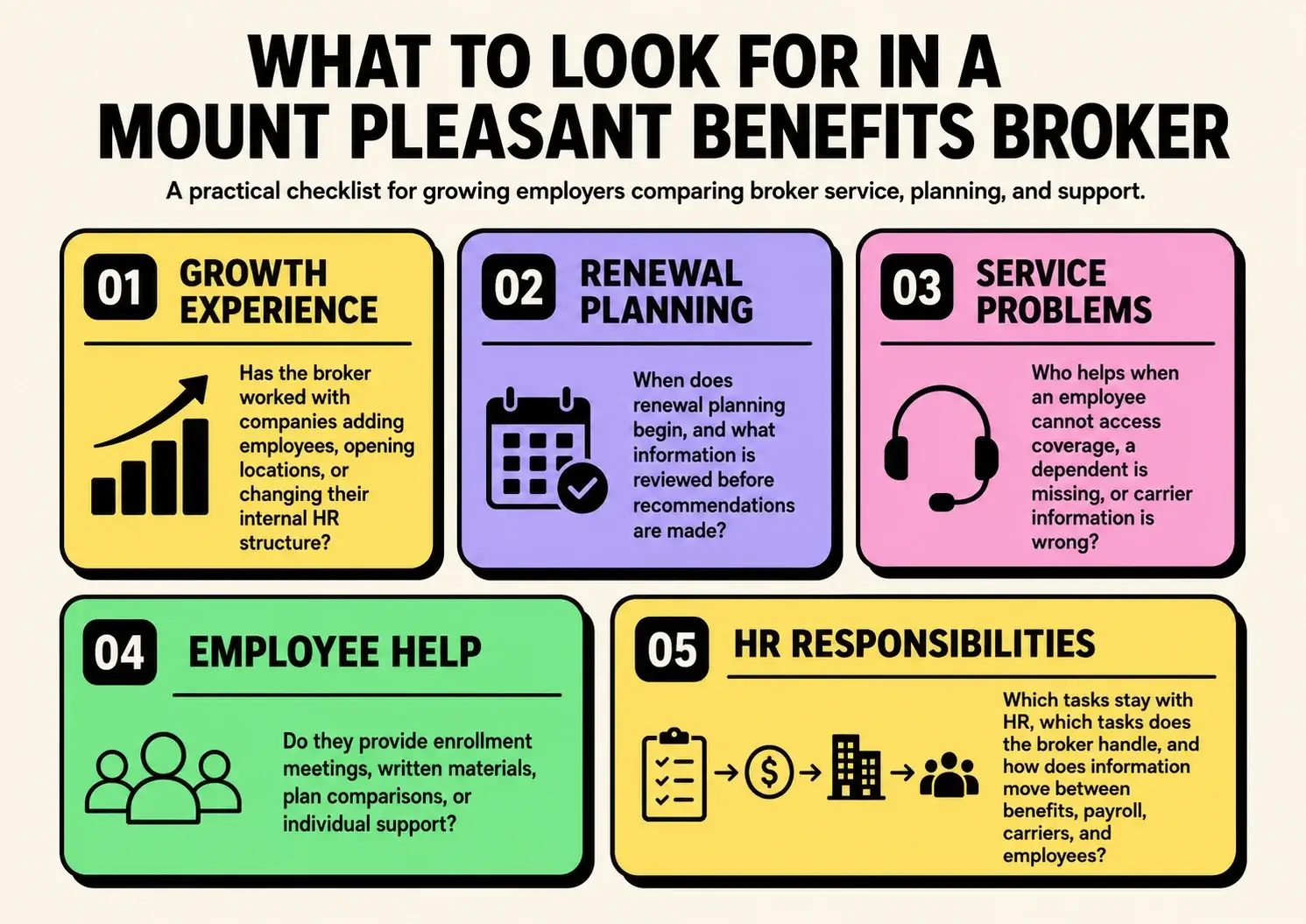
Ask About Growth Experience
Has the broker worked with companies adding employees, opening locations, or changing their internal HR structure? The broker should be able to explain how benefits decisions may change as the company grows. A plan for 15 employees may not be the right plan or process for 75.
Ask When Renewal Planning Begins
Do not ask only how many carrier quotes the broker can provide. Ask when the review begins and what information is examined before recommendations are made. A useful renewal process should include cost, contributions, participation, workforce changes, employee feedback, and administrative problems.
Ask Who Handles Service Problems
Find out who helps when an employee cannot access coverage, a dependent is missing, or the carrier has incorrect information. The sales contact may not be the person handling daily service. Employers should know who owns those issues and how updates are communicated.
Ask How Employees Receive Help
A plan has less value when employees do not understand it. Ask whether the broker provides enrollment meetings, written materials, plan comparisons, or individual support. The answer should fit the workforce. A team working different shifts may need a different communication plan than an office where everyone can attend one meeting.
Ask What Work Remains With HR
A broker may provide technology and employee support, but the employer will still have responsibilities. Ask which tasks stay with HR, which tasks the broker handles, and how information moves between the benefits platform, payroll, carriers, and employees. Clear ownership prevents important work from falling between teams.
Is Your Benefits Setup Ready for the Next Stage?
Growth usually exposes benefits problems before leadership expects them. A plan that worked for 15 employees may become harder to fund, explain, and administer at 40. Renewal decisions may take longer, new-hire enrollment may create more manual work, and employees may need clearer help choosing coverage. Before the next hiring push or renewal, review how well your current setup handles:
- Cost forecasting
- Eligibility changes
- Employee questions
- Payroll coordination
- Enrollment and onboarding
- Carrier service issues
- Year-round broker communication
Also ask whether your broker provides options early enough for your team to make a careful decision instead of rushing through renewal. Employers reviewing their next step can explore Benni Agency’s Mount Pleasant benefits support for a closer look at local plan options, administration, and employee guidance. A practical next step is to identify the two or three benefits problems creating the most work now and review whether the current broker model can support the company’s next stage.