A Human Resources Information System(HRIS) can make payroll, employee records, benefits, and reporting easier to manage. But when the data, settings, or processes inside that system do not support applicable requirements, small mistakes can become larger compliance problems. HRIS compliance affects everything from accurate payroll records to employee data security and benefits administration.
For employers and HR teams, these issues can lead to frustrated employees, repeated corrections, and missed deadlines. This guide explains what HRIS compliance means, what can go wrong, and how employers can improve their systems and processes.
Key Takeaways
- HRIS compliance depends on both technology and process. Good software can still create risks when data, permissions, integrations, or retention settings are poorly managed.
- Bad HRIS data can spread quickly. Payroll, tax reporting, benefits eligibility, and employee records may all be affected.
- Regular reviews help catch problems early. Data, permissions, reports, integrations, and historical records should be checked periodically.
- Software does not make a company compliant automatically. Employers remain responsible for following applicable requirements.
- HRIS and benefits data should stay aligned. Reliable integrations can reduce enrollment errors, duplicate work, and inconsistent records.
What Does HRIS Compliance Mean?
HRIS compliance means configuring and using your Human Resources Information System in a way that supports the employment, payroll, tax, recordkeeping, benefits, and privacy requirements that apply to your organization. A compliant process involves more than choosing software with security and reporting features. Employers also need accurate employee data, appropriate permissions, reliable integrations, proper record retention, and clear internal procedures.
Requirements can vary by workforce size, location, benefits offered, and other factors. An HRIS should therefore help your team maintain reliable, accessible records. Simply having an HRIS does not automatically make an organization compliant. How it is configured and used matters just as much as the technology itself.
Why Can HRIS Noncompliance Put Your Business at Risk?
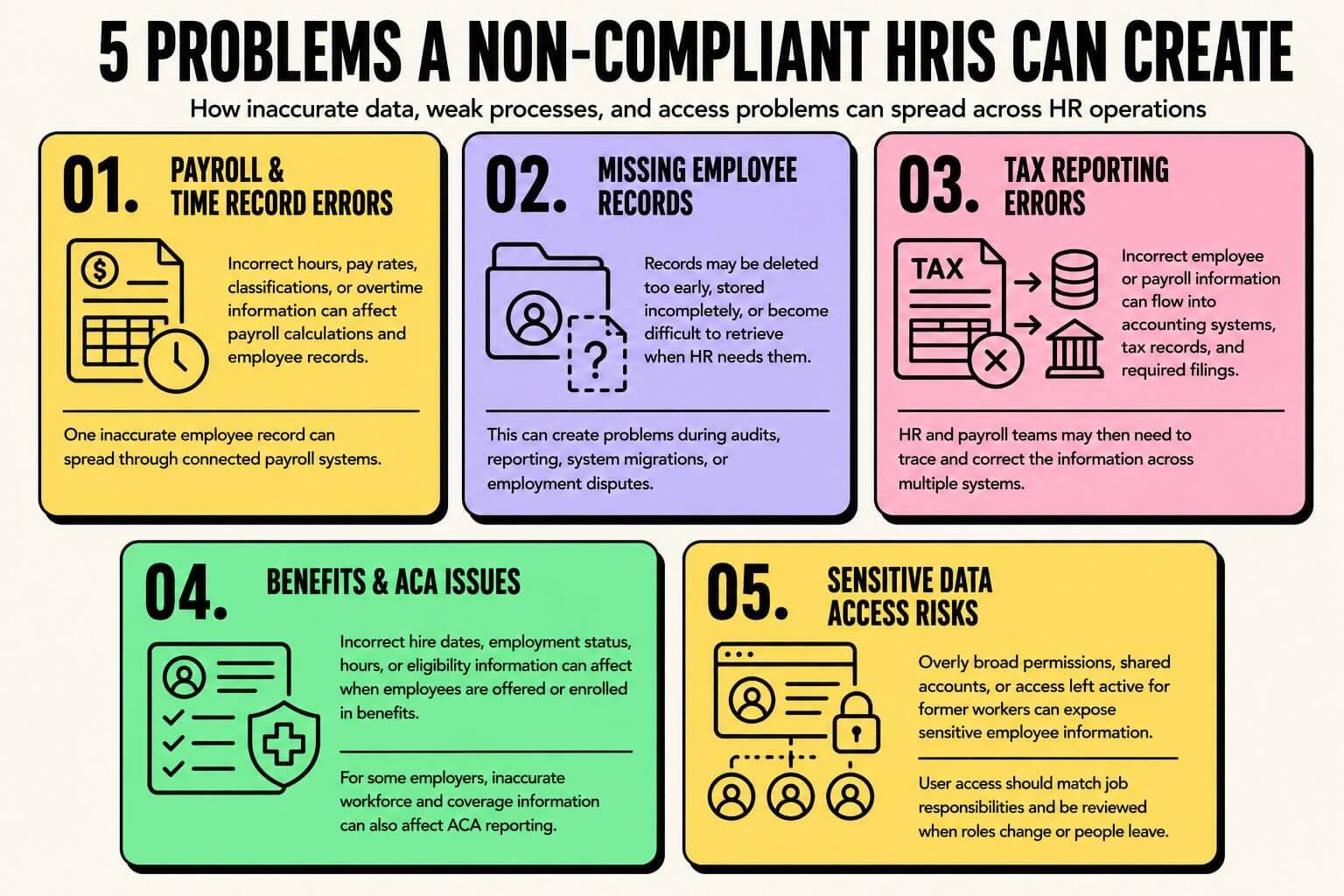
When an HRIS contains inaccurate information or does not support required processes, the problem can spread into payroll, benefits, reporting, and recordkeeping. A small administrative error may eventually require corrections across several systems. Common consequences include incorrect payroll records, missing documentation, inaccurate tax information, benefits eligibility errors, and inappropriate access to sensitive employee data. These problems can also make audits or required reporting harder because HR may need to reconstruct information manually.
Payroll and Time Records Can Become Inaccurate
Incorrect hours, pay rates, employee classifications, or overtime information can create payroll and recordkeeping problems. If an HRIS feeds payroll software, one inaccurate employee record can affect multiple calculations. The U.S. Department of Labor’s recordkeeping requirements explain that covered employers must maintain certain wage and hour records. Payroll records generally must be kept for at least three years, while certain wage-calculation records generally require two years. Errors can become especially stressful when employees notice an incorrect paycheck first and expect HR to resolve it quickly.
Required Employee Records May Be Missing or Unavailable
Problems can occur when an HRIS deletes information too soon, stores incomplete records, or makes historical data difficult to retrieve. This becomes especially important during system migrations, audits, employment disputes, or regulatory reporting. Clear retention procedures and reliable access to historical information can reduce that risk.
Tax Reporting Errors Can Follow Bad HRIS Data
Incorrect names, addresses, wages, withholding details, or payroll information can move from the HRIS into payroll or accounting systems and eventually appear in tax records. HR and payroll teams may then need to correct forms and compare records across systems to find where the problem started. Keeping employee and payroll data consistent across connected systems can reduce mismatches and make tax reporting easier to review.
Benefits Eligibility and ACA Reporting Can Be Affected
HRIS data often helps determine benefits eligibility and when coverage should begin or end. Incorrect hire dates, employment status, hours worked, or eligibility information can cause enrollment delays or other coverage problems. For some employers, inaccurate workforce information can also affect Affordable Care Act reporting. The IRS guidance for Applicable Large Employers explains reporting requirements involving Forms 1094-C and 1095-C. Administrative mistakes may also raise questions about employee benefits liability insurance and risks tied to errors or omissions in benefits administration.
Poor Access Controls Can Put Sensitive Employee Data at Risk
HRIS platforms often contain personal, financial, payroll, and benefits information. Problems can arise when permissions are too broad, shared accounts are used, or former employees continue to have access. Role-based permissions can limit access according to job responsibilities, especially when employees change roles or leave. Not every employee record is automatically subject to HIPAA, but sensitive workforce information still needs appropriate safeguards.
Which HRIS Compliance Gaps Cause the Most Problems?
Many HRIS compliance problems start with ordinary administrative gaps rather than one major system failure. Common examples include:
- Outdated employee data that affects payroll or reporting.
- Weak user permissions that expose unnecessary information.
- Missing audit history that makes changes difficult to trace.
- Poor record retention that removes information too early.
- Disconnected systems that contain different employee data.
- Unreliable reporting that requires extensive manual cleanup.
- Incomplete migrations that lose or alter historical records.
- Inactive users with access after employment ends.
Clear ownership matters. HR teams should know who maintains data, reviews permissions, manages integrations, and oversees record retention. Without that accountability, small errors may continue for months.
How Can You Tell If Your HRIS Has a Compliance Problem?
You do not need to wait for an audit to spot warning signs. Frequent manual corrections, inconsistent records, and difficulty retrieving historical information can indicate that the system or its processes need attention. Warning signs include payroll or benefits data that needs repeated correction, conflicting employee information across systems, former employees with active access, reports requiring extensive spreadsheet work, and missing fields in data exports. One isolated error does not always mean the HRIS itself is the problem. Repeated inconsistencies are a stronger reason to investigate.
How Do You Fix HRIS Compliance Gaps?
Start by finding the source of the problem instead of assuming the entire HRIS must be replaced. The issue may be outdated data, incorrect settings, weak procedures, or a poorly configured integration. A practical review can include:
- Identify applicable requirements for employment, payroll, tax, benefits, privacy, and recordkeeping.
- Audit employee data such as status, pay rates, work locations, hire dates, and eligibility.
- Review user access and remove unnecessary permissions.
- Check retention settings for required records.
- Test integrations between HRIS, payroll, and benefits systems.
- Review reports and exports for missing information.
- Correct outdated or duplicate records.
- Assign responsibility for ongoing reviews.
When several problems appear at once, HR teams may worry that fixing one setting will create another issue.
“One customer shared that the team took the time to explain everything clearly and in a way that was easy to understand, and they appreciated the support and expertise. Clear guidance can make complicated administrative changes feel more manageable.”
What Should a Compliance-Friendly HRIS Be Able to Do?
A compliance-friendly HRIS should make employee information easier to manage, protect, retrieve, and review. Useful capabilities include:
- Role-based access controls
- Audit logs
- Customizable reporting
- Reliable data exports
- Record-retention controls
- Payroll and benefits integrations
- User-access management
- Historical data preservation
Technology cannot replace strong HR procedures, but useful features should make those procedures easier to follow consistently.
Does HRIS Software Make Your Company Compliant?
No. HRIS software can support compliance, but it cannot make an organization compliant on its own. Employers remain responsible for maintaining accurate information, following applicable rules, reviewing permissions, retaining required records, and correcting errors. A system with strong compliance features can still create problems if it is configured incorrectly or employees enter bad data. The same applies to automation. Payroll feeds, benefits eligibility rules, and automated reports can reduce manual work, but they still need review. If incorrect information enters an automated workflow, the system may simply process the error faster. Think of an HRIS as a tool for supporting compliant processes, not a substitute for them.
When Should You Review or Replace Your HRIS?
An HRIS deserves a deeper review when recurring problems begin affecting payroll, benefits, reporting, employee records, or access to information. Common triggers include repeated payroll or enrollment errors, expansion into new states, changes in benefits programs, difficult reporting, heavy spreadsheet use, inaccessible historical data, failed integrations, weak access controls, or a planned system migration. A review does not automatically mean replacement. Better configuration, training, or integrations may solve the problem. If the system still cannot support essential requirements, replacement may become more practical.
How Can Better HRIS and Benefits Administration Work Together?
HRIS and benefits administration often rely on the same employee information, including hire dates, employment status, dependents, eligibility changes, and payroll deductions. When systems communicate reliably, HR teams can reduce duplicate entry and identify inconsistencies sooner. When they do not, employees may experience delayed enrollment updates, incorrect eligibility information, or deductions that do not match their elections. Benefits administration technology can help connect employee records, enrollment activity, eligibility information, and HR workflows more consistently.
“One customer described the team as knowledgeable, responsive, and genuinely invested in helping find the right solutions. They also shared that the team made a process that could feel overwhelming much smoother and more manageable.”
Employers should still review integrations regularly and confirm that important changes reach every connected system. Benni Agency can help organizations simplify enrollment, eligibility management, and ongoing benefits administration.