Bar insurance is not a single policy. A Charleston bar may need liquor liability, general liability, property, business income, workers’ compensation, and other coverage based on its license, hours, staff, property, events, and contracts. The most immediate legal issue is South Carolina’s liquor liability requirement for certain businesses that sell alcohol for on-premises consumption after 5 p.m. This guide explains the 2026 rules, the coverages worth reviewing, and the questions to ask before accepting a proposal.
Key Takeaways
- South Carolina generally requires qualifying on-premises alcohol sellers open after 5 p.m. to maintain liquor liability coverage.
- The standard requirement is a $1 million annual aggregate, subject to permitted mitigation reductions and minimum floors.
- General liability does not automatically replace liquor liability coverage for a business that sells or serves alcohol.
- Policy exclusions, sublimits, and underlying-policy requirements can matter as much as the headline limit.
- Compare proposals using the same operations, limits, deductibles, valuations, and endorsements.
Does a Charleston Bar Need Liquor Liability Insurance?
Under South Carolina Code Section 61-2-145, a person licensed or permitted to sell alcohol for on-premises consumption and remaining open after 5 p.m. generally must maintain a liquor liability policy or a general liability policy with a liquor liability endorsement. The South Carolina Department of Revenue’s current guidance states that the standard requirement is a $1 million annual aggregate limit, unless the licensee qualifies for mitigation reductions. Per-occurrence coverage must be at least 50% of the applicable aggregate limit.
The rule applies to listed beer, wine, and liquor licenses and permits, not only to businesses serving distilled spirits. SCDOR recommends submitting an ACORD 25 certificate, listing SCDOR as the certificate holder and the licensee as the insured. A lapse can put the alcohol license or permit at risk, so renewal dates and certificate delivery should be tracked carefully.
South Carolina also requires alcohol servers and managers covered by the law to complete approved training. A new worker without a current certificate generally must receive training within 30 calendar days of employment in that role. Certificates are valid for three years, and the business must keep physical or electronic copies available at the licensed premises.
How the 2026 Mitigation Reductions Work
Qualifying permanent licensees may combine applicable mitigation factors, but their required annual aggregate generally cannot fall below $300,000. These reductions change the statutory minimum. They do not establish the limit a particular bar should select after considering its actual exposure, lease, contracts, and umbrella requirements.
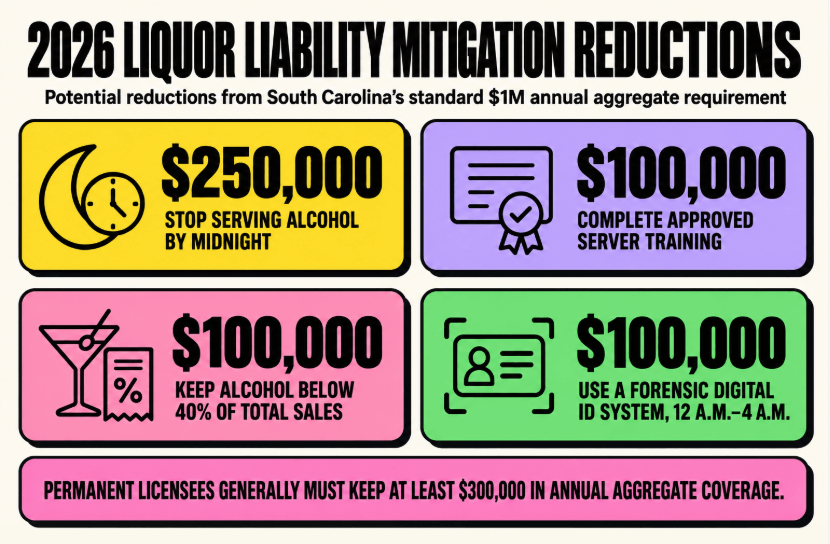
| Mitigation factor | Potential reduction |
| Stop serving alcohol by midnight for the full policy period | $250,000 |
| Have all qualifying alcohol-serving employees complete approved training | $100,000 |
| Keep alcohol below 40% of total sales, calculated under the statute | $100,000 |
| Use a qualifying forensic digital ID system between midnight and 4 a.m. | $100,000 |
A bar selling alcohol between midnight and 4 a.m. must use the qualifying ID system even if it does not claim that mitigation reduction. Keep operating hours, training records, sales reports, and system purchase or subscription records ready for SCDOR and underwriting review.
What Other Insurance Should a Bar Review?
Liquor liability addresses only part of a bar’s risk. A coordinated business and commercial insurance review may include:
- Commercial general liability: May respond to covered customer injuries, property damage, and certain personal or advertising injury claims. Review the liquor, assault and battery, and security-related exclusions.
- Commercial property: Can address covered damage to furniture, equipment, inventory, improvements, and the building when owned. Confirm valuation, wind or named-storm deductibles, water exclusions, and flood treatment.
- Business income and extra expense: May help when a covered property loss interrupts operations. Check the waiting period, restoration period, limits, and dependent-property provisions.
- Workers’ compensation: South Carolina generally requires coverage for businesses that regularly employ four or more workers, including part-time employees and family members, subject to stated exceptions. The South Carolina Workers’ Compensation Commission provides the current employer rule.
- Commercial auto or hired and non-owned auto: Relevant when the business owns vehicles or employees use rented or personal vehicles for business tasks. Coverage for the employee’s own vehicle damage is a separate question.
- Cyber and crime coverage: Worth reviewing when the bar accepts cards, stores customer or employee data, uses online ordering, or faces theft and funds-transfer exposure.
- Umbrella or excess liability: Can add limits above scheduled underlying policies. Confirm that liquor liability is eligible underlying coverage and that exclusions do not create a gap.
What Affects the Cost of Bar Insurance?
Premiums depend on the operation and the policy structure. Underwriters may consider annual sales, the percentage from alcohol, hours of alcohol service, venue capacity, live entertainment, dancing, security arrangements, prior claims, staff training, and documented incident procedures.
Property pricing can also reflect building construction, roof and system updates, fire protection, cooking exposure, equipment values, business-income estimates, and catastrophe exposure. A lower quote may use a higher deductible, lower valuation, narrower assault and battery protection, or more restrictive entertainment terms. Compare the forms, not only the total premium.
Questions to Ask When Comparing Proposals
Use the same exposure information for every quote, then ask:
- Is liquor liability written separately or added by endorsement?
- What are the aggregate and per-occurrence limits after any approved mitigation reductions?
- Are defense costs inside or outside the liability limit?
- Is assault and battery covered, excluded, or subject to a sublimit?
- Are employees, bouncers, and third-party security treated differently?
- Are live music, DJs, dancing, patios, rooftops, and private events disclosed and covered?
- Which policies sit beneath the umbrella or excess layer?
- How are property values and business income calculated?
- What documentation is required for mitigation credits and renewal underwriting?
How Benni Agency Can Help
Benni Agency helps Charleston businesses review commercial insurance options such as property, general liability, workers’ compensation, commercial auto, and umbrella or excess coverage. For a bar, that review should also identify questions about how liquor liability coordinates with the rest of the program. Owners can use the Charleston business insurance page to explore the broader commercial relationship. Availability and final decisions depend on the issued policy, endorsements, exclusions, underwriting, and current business facts.