When an employee cannot work because of a covered illness or injury, disability benefits may replace part of their income, but payments usually do not begin immediately. The employee must first satisfy the policy’s waiting period, also called an elimination period. Its length affects how soon benefits may begin, how employees bridge an unpaid gap, and what the plan may cost. This guide explains how waiting periods work and what Mount Pleasant employers should compare before selecting or renewing short-term disability (STD) or long-term disability (LTD) coverage.
Key Takeaways
- A disability elimination period is the time an employee must remain disabled before benefits become payable under the policy.
- Elimination periods differ from new-hire eligibility waiting periods and pre-existing condition limitations.
- Shorter waiting periods may reduce an employee’s income gap but generally increase the cost of coverage.
- Employers should coordinate disability coverage with paid leave, salary continuation, and applicable job-protected leave.
- The policy’s definitions, schedule of benefits, exclusions, and recurrent-disability provisions control how a specific claim is handled.
What Is a Disability Insurance Waiting Period?
A waiting period is the required period between the start of a qualifying disability and the date benefits may become payable. Insurers often call it an elimination period. Completing it does not guarantee payment. Eligibility still depends on the policy’s disability definition, documentation, limitations, and exclusions. The term “business income waiting period” can cause confusion. In commercial property insurance, business income coverage generally concerns income lost when operations are interrupted by covered property damage. In employee benefits, the relevant term is usually a disability insurance waiting or elimination period. This article addresses employee disability coverage.
Employers should also distinguish an elimination period from two other timelines:
- Eligibility waiting period: Time a new employee must complete before becoming eligible for a benefit.
- Pre-existing condition limitation: A policy provision that may restrict benefits connected to certain conditions based on the contract’s look-back and treatment rules.
Common Waiting Periods for STD and LTD Coverage
Waiting periods are plan-specific. STD plans often use a period measured in days, while LTD plans commonly use a longer period measured in months. Examples frequently seen in plan designs include 7 or 14 days for STD and 90 or 180 days for LTD. These are examples, not universal standards.
| Coverage | Illustrative elimination periods | What employers should verify |
| Short-term disability | 7 or 14 days | Whether illness and injury use the same period, how days are counted, and when payments are issued |
| Long-term disability | 90 or 180 days | Whether the period aligns with the maximum STD benefit duration or another source of income |
The schedule of benefits and policy certificate should confirm the actual period. Employers should also ask how days are counted and how the policy treats a return of the same or related condition.
For a broader comparison of benefit duration, disability definitions, and plan purpose, see Benni Agency’s short-term versus long-term disability insurance guide.
What Happens During the Elimination Period?
The disability policy generally pays no benefit for the elimination period. Employees may need to rely on available paid time off, sick leave, an employer salary-continuation program, or personal savings. Whether those resources are available and whether they can run concurrently depends on the employer’s policies and the disability plan. Consider a plan with a 14-day elimination period. If a qualifying disability begins on June 1, benefits could become payable after that period under the policy’s rules.
That does not mean money necessarily arrives on day 15. The insurer may still need claim forms, medical support, earnings information, and claim approval. Disability benefits and job-protected leave are separate. The federal Family and Medical Leave Act may provide eligible employees of covered employers with unpaid, job-protected leave for qualifying reasons. Coverage and employee eligibility depend on specific conditions, so employers should check the U.S. Department of Labor’s FMLA guidance and obtain plan-specific or professional guidance when needed. An employee’s FMLA leave and disability elimination period may overlap, but one does not automatically establish eligibility for the other.
How Waiting Periods Affect Cost and Plan Design
A shorter elimination period generally exposes the insurer to earlier and potentially more frequent benefit payments, so it commonly costs more than a longer period within an otherwise comparable plan. Actual premiums depend on carrier underwriting, workforce characteristics, occupations, benefit amount, benefit duration, participation, funding arrangement, and other plan terms.
Employers should weigh the following factors:
- Available paid leave: A long waiting period may create a larger income gap when employees have limited PTO or sick leave.
- STD and LTD coordination: The LTD elimination period should be compared with the period during which STD benefits may be payable. Misaligned dates can create a gap.
- Affordability: Compare the cost difference between waiting-period options without treating the lowest premium as the only measure of value.
- Employee communication: State when benefits may become payable, what documentation is required, and what other leave or pay policies may apply.
- Policy definitions: Review disability definitions, exclusions, recurrent-disability rules, and return-to-work provisions alongside the waiting period.
A Practical Review Checklist for Employers
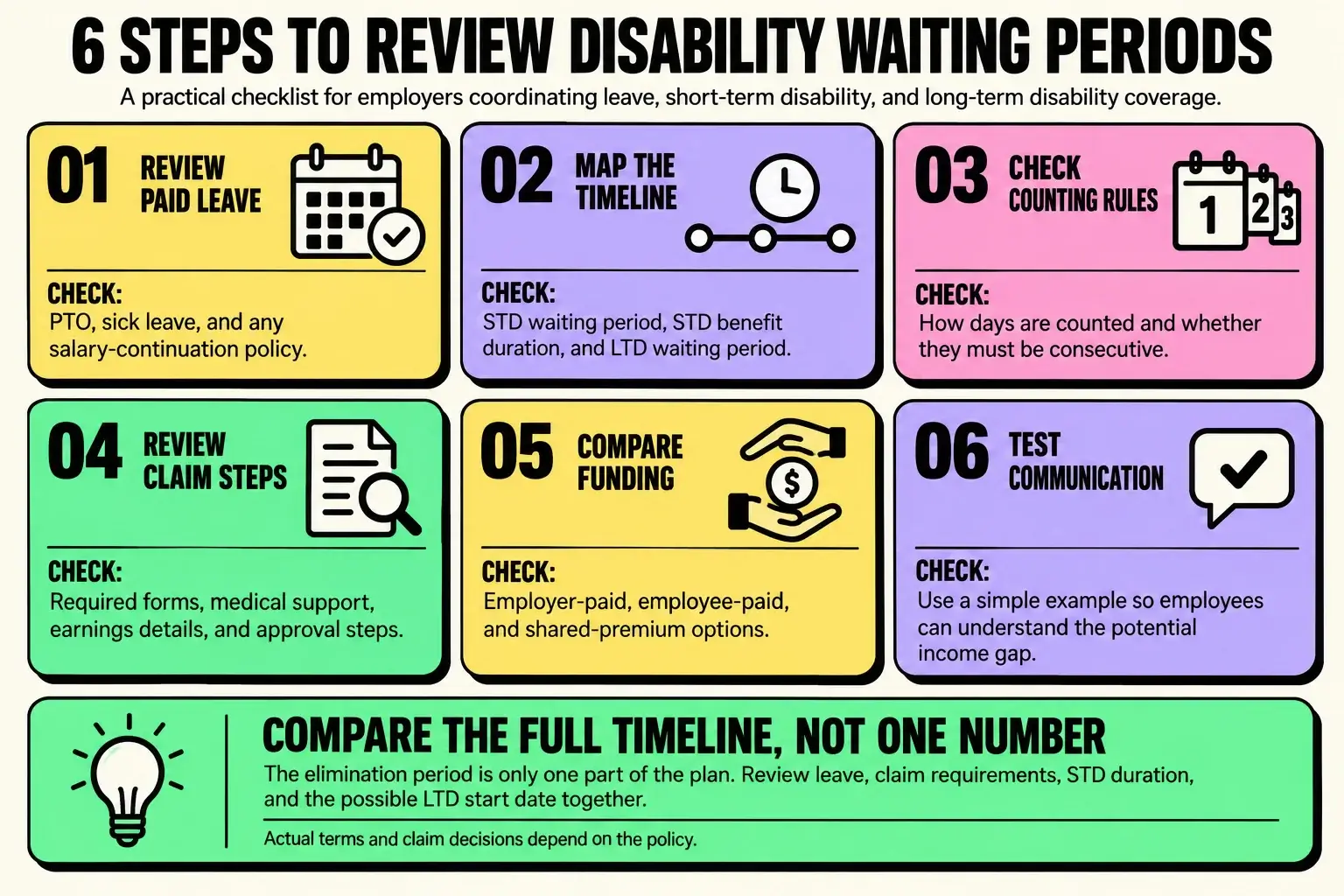
Before choosing or renewing a plan, HR and benefits decision-makers can work through this sequence:
- Inventory PTO, sick leave, and any salary-continuation policy.
- Place the STD elimination period, STD maximum benefit period, and LTD elimination period on one timeline.
- Review how the carrier counts days and handles recurrent or related disabilities.
- Confirm which documents employees and the employer must submit for a claim.
- Compare employer-paid, employee-paid, and shared-premium options, including the tax implications.
- Test employee-facing materials with a simple scenario so the income gap is easy to understand.
This timeline can reveal a possible uncovered interval and help HR avoid promising a payment date the policy does not guarantee.
How Disability Benefit Taxation Affects Take-Home Income
Once benefits begin, tax treatment can affect the amount an employee keeps. Under IRS Publication 525, disability payments are generally taxable when an employer paid the premiums and did not include those premiums in the employee’s income. Benefits are generally not taxable when the employee paid the entire premium with after-tax dollars. When both parties paid premiums, only part of the benefit may be taxable. Because individual circumstances differ, employers should not present a replacement percentage as guaranteed take-home pay. Plan documents, payroll records, and qualified tax guidance should inform employee communications.
Reviewing Disability Coverage in Mount Pleasant
For a Mount Pleasant employer, the decision should begin with its actual leave policies, workforce, budget, and plan documents rather than assumptions about local businesses. Benni Agency’s Mount Pleasant insurance and employee benefits page outlines the broader local service relationship. Employers comparing waiting periods can also review Benni Agency’s Income Protection & Disability service for help evaluating STD and LTD plan design and employee education.