A Charleston business may carry the liability insurance required for its vehicles and still have no coverage for damage to those vehicles. Commercial auto physical damage coverage is the part of a policy designed to address covered loss to the business’s own autos. The main decisions involve collision, comprehensive or another limited form, vehicle valuation, deductibles, and optional endorsements. Those choices should reflect each vehicle’s value, financing, use, and importance to daily operations, especially where flooding and severe weather are concerns.
Key Takeaways
- Commercial auto liability does not pay to repair or replace the business’s own vehicle.
- Collision and comprehensive cover different causes of physical damage and are usually subject to separate deductibles.
- A lender or lessor may require physical damage coverage even though South Carolina law does not.
- The declarations, covered-auto symbols, valuation terms, endorsements, and exclusions determine how coverage applies.
- Charleston businesses should confirm how flood, wind, rented vehicles, equipment, and downtime are handled before a loss.
What Commercial Auto Physical Damage Coverage Includes
Physical damage is not one all-purpose coverage. It normally combines separate options for different causes of loss. Coverage applies only to autos treated as covered for physical damage under the policy’s declarations, symbols, schedule, and endorsements.
Collision Coverage
Collision generally addresses covered damage caused when an insured vehicle hits another vehicle or object, or overturns. For example, it may respond when a delivery van strikes a loading-dock post or a truck rolls over. The policy’s deductible and valuation provisions still apply.
Comprehensive Coverage
Comprehensive, sometimes called other-than-collision coverage, generally addresses covered causes such as theft, vandalism, fire, falling objects, flooding, severe weather, and contact with an animal. It does not cover every non-collision loss, so exclusions and endorsements matter.
Specified Perils or Fire and Theft With Combined Additional Coverage
Some insurers offer a narrower option, often for eligible commercial trucks, that covers only the causes named in the form. It may cost less than comprehensive, but an event outside the listed perils will not be covered. Availability and terminology vary by insurer, vehicle type, and state. For a broader review of liability, uninsured motorist coverage, vehicle damage, hired autos, cargo, and other decisions, use Benni Agency’s Charleston commercial auto coverage checklist.
Why Flood and Storm Damage Need Special Attention in Charleston
Charleston’s coastal location makes water and storm damage a practical review point, but the city name does not change the policy language. Comprehensive coverage may cover vehicle damage from flooding, wind, or falling debris when the cause is insured and no exclusion applies. Do not assume a property flood policy covers road vehicles. The National Flood Insurance Program lists cars and most self-propelled vehicles among property that is not covered. A business should therefore verify whether each vehicle carries comprehensive coverage and how the commercial auto policy handles flood-related damage. Before severe weather, confirm that the vehicle schedule, garaging information, stated values, and permanently attached equipment are current. Coverage changes may also be restricted once a storm is approaching, so the time to review the policy is before a watch or warning.
How Vehicle Valuation Affects a Total-Loss Payment
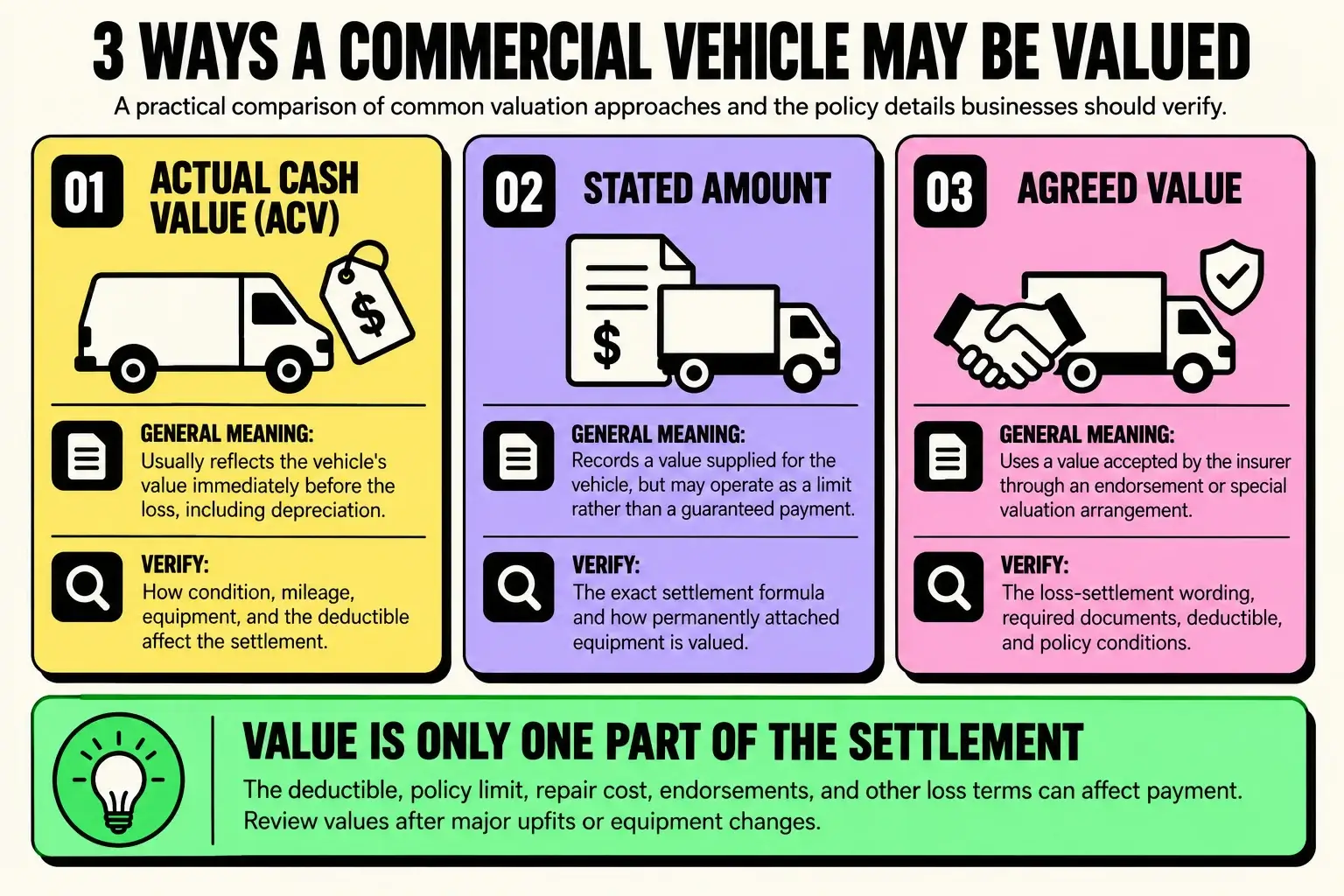
Collision or comprehensive determines whether the cause of loss may be covered. The valuation provision helps determine the payment when repair is not economical. The deductible, policy limit, vehicle condition, endorsements, and other settlement terms can also affect the result.
| Valuation approach | General meaning | What to verify |
| Actual cash value (ACV) | Usually reflects the vehicle’s value immediately before the loss, including depreciation. | How the insurer calculates ACV and accounts for condition, mileage, and equipment. |
| Stated amount | Records a value supplied for the vehicle, but it may operate as a limit rather than a guaranteed settlement. | Whether the form pays the lesser of stated amount, ACV, or repair cost, and how equipment is valued. |
| Agreed value | Uses a value accepted by the insurer, often through an endorsement or special valuation arrangement. | The exact loss-settlement wording, required documentation, deductible, and any conditions. |
An overstated figure does not necessarily create a larger claim payment. An understated figure may cap recovery below what the business expected. Review values at renewal and after major upfits, body changes, or permanently installed equipment.
Choosing Deductibles Vehicle by Vehicle
A higher deductible may reduce premium, but it shifts more of each covered loss to the business. A lower deductible may reduce the immediate claim expense while increasing premium. Instead of choosing one number only to lower the quote, consider:
- the current value of each vehicle;
- whether the unit is owned, financed, or leased;
- how much loss the business can absorb at one time;
- whether several vehicles could be damaged in one event;
- the vehicle’s role in revenue or essential operations; and
- recent loss history and the company’s approach to smaller claims.
Different deductibles may be available for collision and comprehensive or for different scheduled vehicles. Options depend on the insurer and policy.
Optional Coverages and Endorsements to Review
Physical damage alone may repair or replace a covered auto, but it may not address every cost created while that vehicle is unavailable.
Rental reimbursement or downtime coverage may help with eligible temporary transportation or lost operating time after a covered loss. Limits, waiting periods, covered vehicle types, and eligible expenses vary.
Towing or roadside assistance may cover specified towing and on-scene services. Mechanical repairs, parts, fuel, tires, or labor beyond the stated service may be excluded or limited.
Auto loan or lease gap coverage may address some difference between an eligible total-loss settlement and the remaining loan or lease balance. It is not automatic, and exclusions may apply to overdue payments, penalties, add-ons, or negative equity.
Hired-auto physical damage may be available for certain rented or hired vehicles. Hired and non-owned auto liability does not automatically pay for damage to the rented vehicle or an employee’s personal auto.
Tools, inventory, cargo, customer property, and detachable equipment inside or on a vehicle may need inland marine, motor truck cargo, equipment, or another policy. Insuring the vehicle does not automatically insure everything it carries.
A Practical Physical Damage Review
Start with the actual fleet rather than last year’s premium. List every owned, financed, leased, rented, and employee-owned vehicle used for work. Then check:
- Which covered-auto symbol and physical damage selection apply to each unit?
- Are the vehicle description, garaging address, use, value, and attached equipment accurate?
- Which causes of loss are covered, and what exclusions matter?
- How will a partial loss or total loss be valued?
- What deductible applies, including when one event damages several vehicles?
- Are rental, towing, gap, hired-auto, cargo, or equipment protections needed?
Benni Agency’s Business & Commercial Insurance services include commercial auto and fleet coverage. The Charleston service-area page provides the local service context. A policy review should use the current declarations, forms, endorsements, vehicle schedule, loan or lease requirements, and contracts rather than relying on the phrase “full coverage.”