Hiring creates more opportunities for a business, but it also creates more employment decisions: recruiting, pay, promotion, discipline, accommodation, leave, and termination. Employment practices liability insurance (EPLI) is designed to address certain covered claims arising from those decisions. For Mount Pleasant employers, the practical question is whether the company’s workforce, HR procedures, contracts, and existing insurance program now create an employment-practices exposure that deserves a closer review.
Key Takeaways
- EPLI can address covered claims involving discrimination, harassment, retaliation, wrongful termination, and other employment-related allegations.
- Coverage varies by policy, including who qualifies as a claimant, what conduct is covered, and which exclusions apply.
- Federal discrimination laws generally begin applying at 15 employees, while the ADEA generally starts at 20 employees.
- EPLI is different from workers’ compensation, employers liability, employee benefits liability, and fiduciary liability insurance.
- Growing employers should review HR procedures and policy terms together, especially after meaningful hiring, management, or organizational changes.
What Is Employment Practices Liability Insurance?
EPLI is liability coverage for certain claims alleging wrongful employment practices. Depending on the policy, it may help pay defense costs, settlements, or covered judgments arising from allegations made by employees, former employees, or job applicants. Common allegations include discrimination, harassment, wrongful termination, retaliation, failure to hire or promote, defamation, and some privacy-related employment claims. The Insurance Information Institute provides a useful overview of common EPLI coverage areas. EPLI may be written as a standalone policy, included within a management liability package, or added by endorsement to another commercial policy. Definitions, exclusions, limits, retentions or deductibles, defense provisions, and reporting requirements all matter.
What EPLI Usually Covers—and Where It Stops
A typical EPLI discussion starts with allegations involving:
- Discrimination based on protected characteristics
- Sexual or other workplace harassment
- Wrongful termination
- Retaliation
- Failure to hire or promote
- Wrongful discipline or demotion
- Employment-related defamation or privacy allegations
Coverage is policy-specific. Some forms may include claims from applicants, seasonal workers, temporary workers, or other defined individuals, while others may be narrower. EPLI also has important boundaries. Workers’ compensation claims, many bodily injury claims, intentional criminal acts, and liabilities addressed by other specialized policies may be excluded. Statutory exclusions can also apply. Employers should review the actual policy rather than assume every workplace dispute falls under EPLI.
When Employment Laws Start to Apply as a Business Grows
Employee count matters because several federal anti-discrimination laws apply only after an employer reaches a defined threshold. According to the EEOC, Title VII, the ADA, and GINA generally cover private employers with 15 or more employees, while the Age Discrimination in Employment Act generally applies at 20 or more employees. The counting rules generally look at employees over at least 20 calendar weeks in the current or preceding year. See the EEOC’s business-employer coverage guidance.
South Carolina’s Human Affairs Law also generally defines a covered employer as one with 15 or more employees for each working day in 20 or more calendar weeks in the current or preceding year. Crossing one of these thresholds does not mean EPLI suddenly becomes legally required. EPLI is an insurance decision, while the employment laws establish separate legal obligations. Employers below a particular threshold may also face other federal, state, contractual, or common-law claims depending on the facts.
Why EPLI Deserves Attention During Growth
The EEOC received 88,201 new discrimination charges in fiscal year 2025. That number does not mean every charge resulted in employer liability, and it is not specific to Mount Pleasant. It does show that employment disputes remain a meaningful national exposure. Growth can also change how employment decisions are made. A business that once had one owner handling every hire may later have several managers conducting interviews, documenting performance, approving leave, or terminating employees. That makes consistency and documentation more important.
For a Mount Pleasant employer, local relevance comes from the business’s actual workforce and operations, not from an assumed local claims trend. A useful review should focus on employee count, management structure, hiring activity, HR procedures, prior claims, contracts, and current policy language.
EPLI vs. Other Employer Coverages
Several policies can involve employees, but they address different risks.
| Coverage | What it generally addresses |
| EPLI | Covered allegations involving discrimination, harassment, retaliation, wrongful termination, and other employment practices |
| Workers’ Compensation | Statutory benefits for covered work-related injuries and illnesses |
| Employers Liability | Certain employee injury lawsuits that fall outside workers’ compensation benefits, subject to policy terms |
| Employee Benefits Liability | Certain administrative errors involving employee benefit plans, such as enrollment or eligibility mistakes |
| Fiduciary Liability | Certain claims alleging wrongful management or administration of employee benefit plans by fiduciaries |
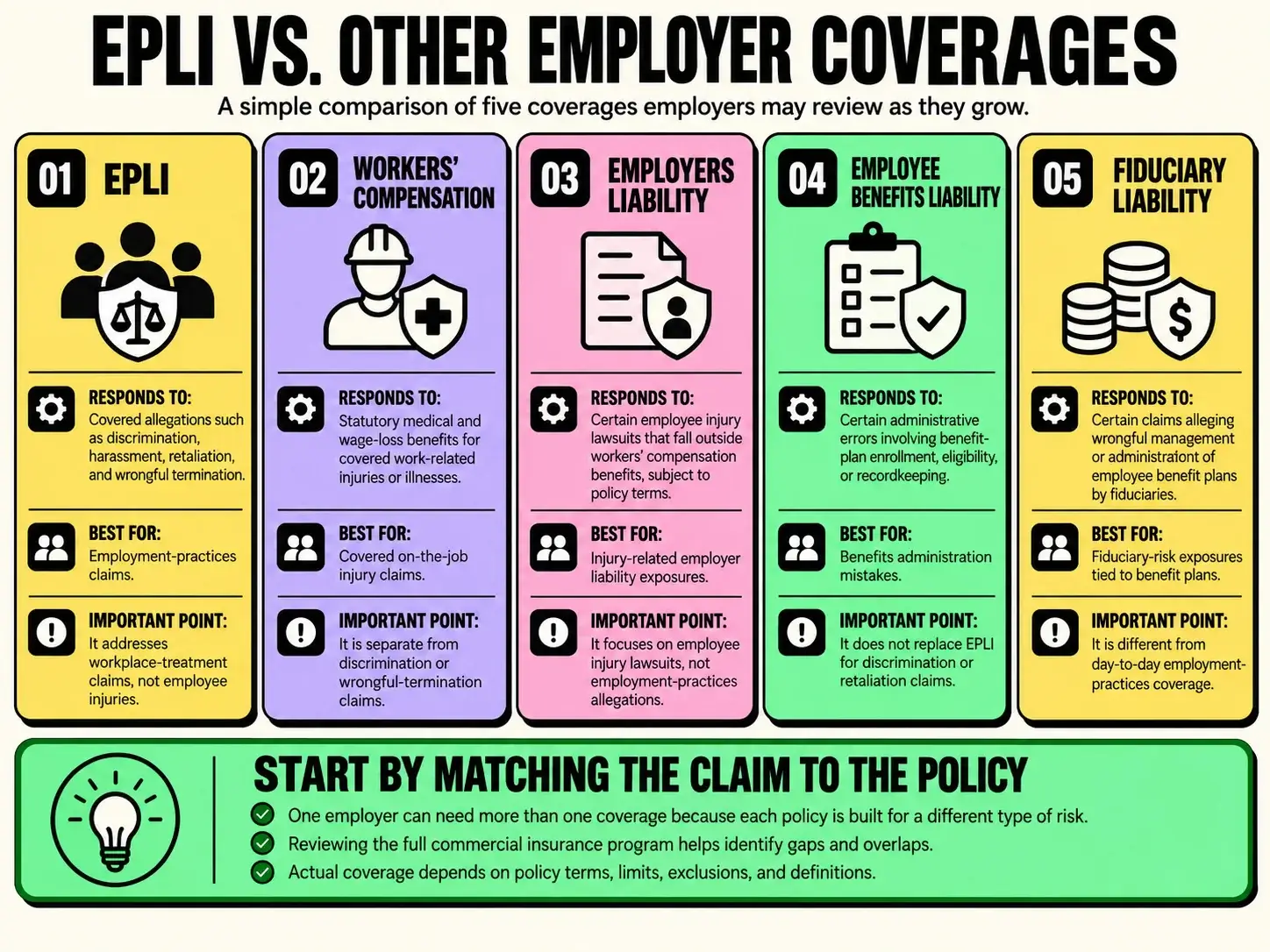
These distinctions matter because a claim may involve more than one issue. Benni Agency’s employee benefits liability insurance guide explains the separate exposure created by benefits-administration mistakes.
Policy Terms Growing Employers Should Review
Premium matters, but it should not be the only comparison point. EPLI is commonly written on a claims-made basis, so employers should understand when a claim must be made and reported, whether a retroactive date applies, and how prior acts are treated.
Other questions worth reviewing include:
- Are defense costs inside or outside the liability limit?
- What deductible or self-insured retention applies?
- Who qualifies as an insured and a claimant?
- Are third-party claims included or excluded?
- How are prior or pending matters handled?
- What notice or reporting requirements apply?
- Which employment statutes or types of damages are excluded?
These details can materially change how two policies respond even when their headline limits look similar.
Reducing Employment-Practices Risk While You Grow
Insurance responds after a covered claim arises. Day-to-day management can reduce avoidable disputes before that point. Employers can strengthen their process by using written hiring, discipline, accommodation, complaint, and termination procedures; keeping an employee handbook aligned with actual practices; training managers on documentation and escalation; maintaining organized personnel records; and reviewing workplace notices and policies with qualified HR or legal professionals when requirements change. A coverage review is also sensible after substantial hiring, a new location, a merger or ownership change, a major management reorganization, or a shift in how HR decisions are handled.
Reviewing EPLI Within a Mount Pleasant Insurance Program
EPLI should be reviewed alongside the rest of the company’s commercial insurance rather than treated as an isolated purchase. Benni Agency’s Mount Pleasant business insurance page outlines local commercial coverage support, while its business and commercial insurance services include employment practices liability among the coverage areas available for review.
The goal is to understand which policy is intended to address which exposure and where policy terms, exclusions, or limits may leave unanswered questions. This article provides general insurance and employment-law information, not individualized legal, HR, tax, or coverage advice. Policy terms and legal obligations depend on the employer’s circumstances and applicable law.