Workers’ compensation and employers liability insurance address different parts of the same workplace-injury risk. Workers’ compensation provides benefits for a covered work-related injury or occupational illness, generally without requiring the employee to prove employer negligence. Employers liability coverage may respond when an injury leads to a covered lawsuit against the employer. For Summerville employers, the practical questions are whether South Carolina law requires coverage, what Part One and Part Two of the policy do, and whether the policy’s limits and classifications still fit the business.
Key Takeaways
- Workers’ compensation pays benefits defined by South Carolina law for covered work-related injuries and occupational illnesses.
- Employers liability, commonly called Part Two or Coverage B, addresses certain covered lawsuits arising from employee injury or illness.
- South Carolina generally requires coverage when a business regularly employs four or more employees in the state, subject to statutory exemptions.
- Employers liability has stated policy limits, while workers’ compensation benefits follow applicable state law.
- Headcount, payroll, job classifications, subcontractor relationships, contracts, and policy limits all deserve review.
What Workers’ Compensation Covers
Workers’ compensation is a statutory insurance system. For a compensable injury or occupational illness, benefits may include authorized medical treatment, partial wage replacement, disability benefits, and death benefits for eligible dependents. Exact eligibility and benefit amounts depend on South Carolina law and the facts of the claim. The system is generally no-fault. An injured employee usually does not have to prove that the employer caused the incident through negligence. In return, workers’ compensation is ordinarily the employee’s exclusive remedy against the employer for a covered workplace injury, although legal exceptions and claims involving other parties can complicate that rule.
Under the current South Carolina Workers’ Compensation Act, the law generally applies to businesses that regularly employ four or more employees in South Carolina. The statute also lists exemptions, including certain casual and agricultural employment, as well as an exemption tied to less than $3,000 in payroll during the previous calendar year. Because employee status and exemptions can be fact-specific, employers should not rely on a simple headcount alone when deciding whether coverage is required.
What Employers Liability Insurance Covers
Employers liability is commonly Part Two of a standard workers’ compensation and employers liability policy. It may cover defense costs and covered damages when an employee injury or illness produces a lawsuit that is not resolved solely through statutory workers’ compensation benefits.
Common examples used to explain the coverage include:
- A third party sued by an injured employee seeks contribution from the employer.
- A spouse alleges loss of consortium because of the employee’s injury.
- An employee alleges injury involving the employer in a separate legal capacity.
- A family member alleges a consequential injury related to the employee’s injury.
These are illustrations, not promises of coverage. Whether Part Two responds depends on the allegations, governing law, policy language, limits, exclusions, and endorsements. Employers should send any demand or lawsuit to the insurer promptly rather than deciding on their own which policy applies.
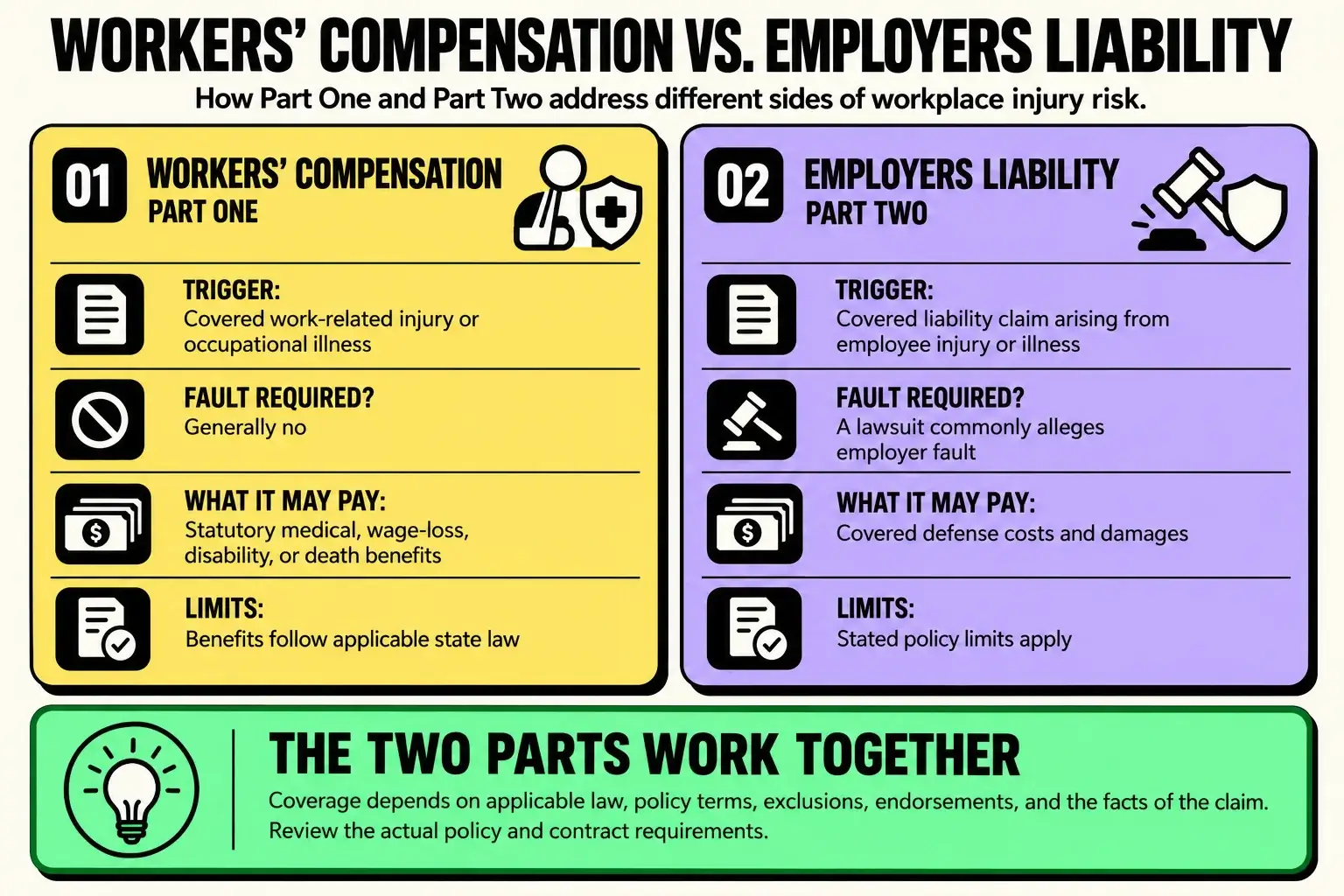
Workers’ Compensation vs. Employers Liability
| Question | Workers’ Compensation, Part One | Employers Liability, Part Two |
| What triggers it? | A covered work-related injury or occupational illness | A covered liability claim arising from an employee’s injury or illness |
| Must negligence be proved? | Generally no | The lawsuit commonly alleges employer fault or another basis for liability |
| What can it pay? | Statutory medical, wage-loss, disability, or death benefits | Covered defense costs and damages, subject to policy terms |
| Does it have a policy limit? | Benefits follow applicable law | Yes, stated limits apply |
| Is it usually a separate policy? | It is Part One of the policy | It is commonly included as Part Two |
This structure matters when reviewing certificates and contracts. Seeing “workers’ compensation” on a certificate does not, by itself, answer whether the employers liability limits satisfy a contract or whether an umbrella policy follows over Part Two. Those details need to be checked against the actual policies and endorsements.
How to Review Employers Liability Limits
Employers liability limits are commonly shown in three categories: bodily injury by accident, bodily injury by disease per employee, and bodily injury by disease policy limit. A policy may display $100,000/$500,000/$100,000, but employers should not assume that configuration is required or suitable for every organization.
The right review starts with the declarations page and any contract requirements. Consider the severity of possible injuries, workforce and operations, client agreements, subcontractor arrangements, and whether commercial umbrella or excess coverage applies over employers liability. A higher limit does not broaden every policy term or eliminate exclusions.
South Carolina Requirements and Uninsured Exposure
South Carolina law requires an employer subject to the Act to secure payment of compensation, generally through authorized insurance or approved self-insurance. An employer that is required to secure coverage but fails to do so may face statutory fines and direct exposure to an employee’s claim. The South Carolina insurance and self-insurance statutes describe the obligation and penalties, including a daily fine framework and additional consequences for willful refusal.
Subcontractor relationships also require careful review. Responsibility can depend on whether a contractor is treated as a statutory employer and whether the subcontractor maintains valid coverage. Collecting a certificate is useful, but employers should also confirm dates, named insureds, limits, and contractual requirements. Legal counsel may be needed when worker classification or statutory-employer questions are disputed.
Do Not Confuse These Employee-Related Coverages
Employers liability is different from employment practices liability insurance (EPLI), which generally addresses allegations such as discrimination, harassment, or wrongful termination. It is also different from employee benefits liability (EBL), which addresses certain errors or omissions in benefits administration. The exact protection depends on policy terms.
Employers comparing these names can use Benni Agency’s explanation of employee benefits liability insurance to keep administration mistakes separate from workplace-injury claims.
A Practical Policy Review Checklist
- Recount employees and review who may be included under South Carolina law.
- Confirm payroll and job classifications reflect current operations.
- Read all three employers liability limits on the declarations page.
- Compare those limits with leases, client agreements, and other contracts.
- Verify subcontractor certificates, dates, limits, and renewal procedures.
- Ask whether umbrella or excess coverage follows over employers liability.
- Review exclusions and endorsements with a licensed insurance professional.
For a broader review, Benni Agency’s Summerville business and commercial insurance page explains how workers’ compensation fits with other operational coverages. Employers can also review Benni Agency’s commercial insurance services when evaluating policies across property, liability, vehicles, contracts, and employees.