A company does not need to own vehicles to have business auto liability exposure. An employee might drive a personal car to meet a client, while a manager may rent a van for a short project. Hired and non-owned auto (HNOA) coverage may protect the business when an accident involving one of those vehicles leads to a third-party claim. This guide explains the two parts of HNOA, common limitations, South Carolina requirements, and the questions Mount Pleasant employers should ask during a policy review.
Key Takeaways
- Hired auto coverage generally applies to vehicles rented, leased, hired, or borrowed for business use.
- Non-owned auto coverage generally addresses the business’s liability when a personal vehicle is used for work.
- HNOA is primarily liability coverage, so it usually does not pay for damage to the vehicle being driven.
- South Carolina’s required auto limits do not create HNOA protection for a business.
- Vehicle use, policy wording, contracts, and umbrella requirements should guide the coverage review.
What Is Hired and Non-Owned Auto Coverage?
HNOA combines two related liability coverages for vehicles the business does not own. It may respond when the business is legally responsible for bodily injury or property damage caused during covered business use, subject to the policy’s terms, limits, and exclusions.
Hired Auto Coverage
Hired auto coverage generally applies when a business rents, hires, leases, or borrows a vehicle for work. Examples include renting a car for a business trip or a cargo van for a temporary project. The exact definition of a hired auto matters. A vehicle borrowed from an employee, partner, or household member may be treated differently under a particular policy.
Non-Owned Auto Coverage
Non-owned auto coverage generally applies to the business’s liability when an employee or another authorized person uses a personal vehicle for company work. Common examples include visiting a client, depositing checks, or picking up supplies. The vehicle owner’s personal policy may respond first, but that does not mean it protects the business or covers every type of business use.
What HNOA Typically Covers and Excludes
HNOA commonly addresses third-party bodily injury, third-party property damage, and the business’s legal defense for a covered claim. It does not turn a personal or rental vehicle into a business-owned vehicle under the policy.
Standard HNOA liability coverage generally does not pay for:
- Collision or comprehensive damage to the rented or personal vehicle
- The driver’s injuries or an employee’s work-related injury
- Tools, inventory, or equipment carried in the vehicle
- Personal driving that is unrelated to business activity
- Claims outside the covered drivers, uses, territory, or policy period
Separate coverage may be needed for hired-auto physical damage, property in transit, workers’ compensation, or other exposures. Because forms differ, employers should confirm what their actual endorsement says rather than relying on the coverage name alone. Travelers’ HNOA overview also notes that limitations can differ by carrier.
Is HNOA Required in South Carolina?
South Carolina does not specifically require every business to purchase HNOA coverage. The state does require drivers to carry auto liability and uninsured motorist coverage at minimum limits of $25,000 for bodily injury per person, $50,000 for bodily injury per accident, and $25,000 for property damage per accident. The South Carolina Department of Insurance explains these 25/50/25 requirements and the state’s uninsured motorist rules.
Those requirements apply to auto insurance on the vehicle. They do not automatically insure a company against liability arising from an employee’s personal vehicle or a short-term rental. A client contract, lease, lender, or vendor agreement may also require HNOA or a particular auto liability limit even when state law does not.
How HNOA Fits With Other Business Policies
HNOA is often added by endorsement to a business owners policy, commercial package policy, general liability policy, or commercial auto policy. Availability and placement vary by insurer. Employers should not assume the coverage is included simply because they have general liability or insure one company-owned vehicle.
Use this basic coverage map during a review:
- Business-owned vehicles: Usually belong on a commercial auto policy.
- Short-term rentals or borrowed vehicles: May call for hired auto liability and possibly separate physical damage protection.
- Employee-owned vehicles used for work: May create a need for non-owned auto liability.
- Property carried in a vehicle: May require inland marine, cargo, or another property solution.
- Liability above the HNOA limit: May require umbrella or excess coverage that specifically recognizes the underlying auto exposure.
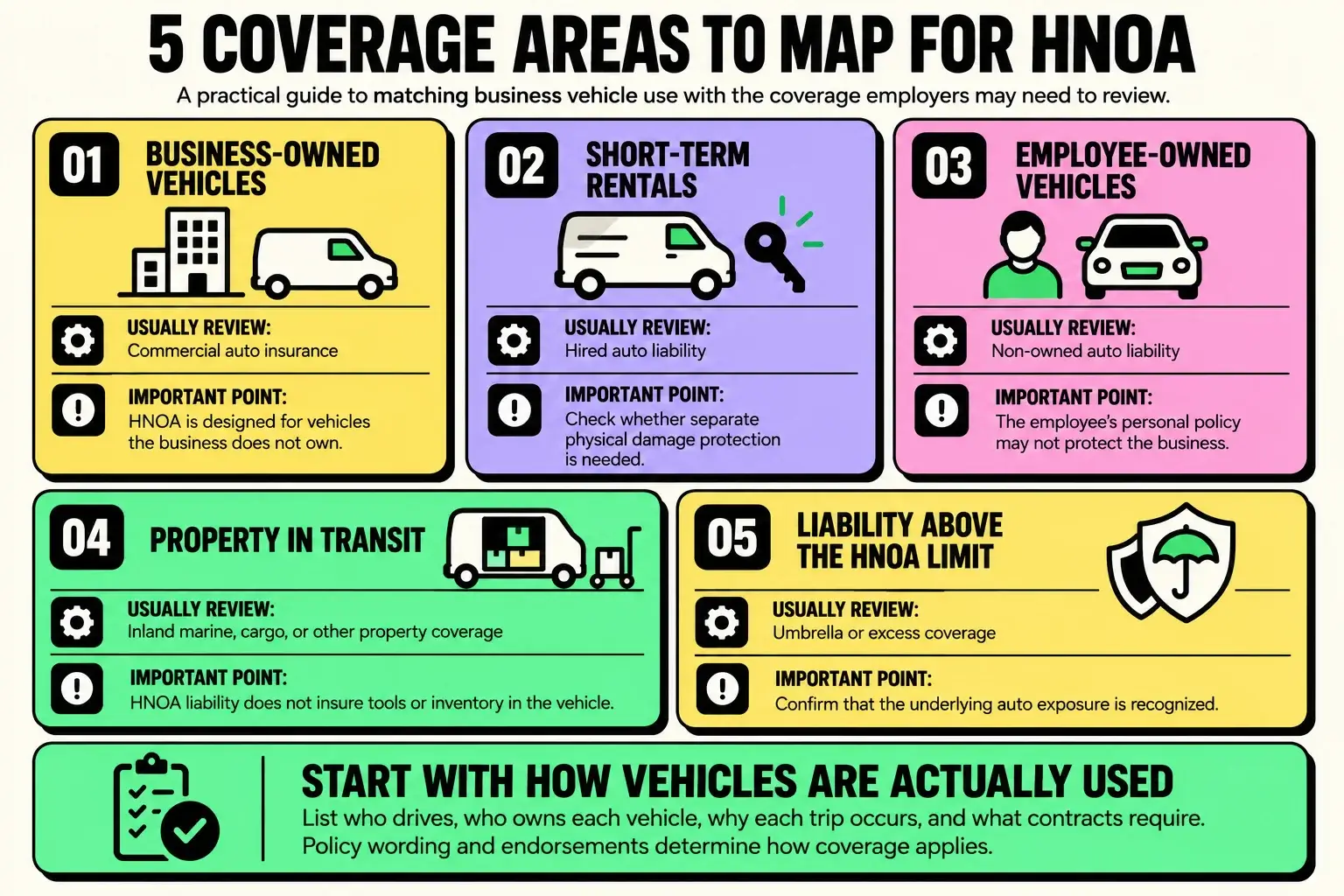
Employers reviewing several exposures together can compare the broader business and commercial insurance options Benni Agency supports. The service page should remain the primary destination for commercial coverage selection, while this article addresses the narrower HNOA question.
When Should a Mount Pleasant Employer Review HNOA?
Local employers should base the decision on actual vehicle use, not assumptions about industry or company size. A review is worthwhile when employees drive personal cars for errands or appointments, the company rents vehicles, volunteers drive on its behalf, or a contract requests proof of auto liability.
Occasional driving still deserves attention. A written vehicle-use inventory can reveal trips that do not appear in a fleet list or expense report. Employers can also use their broader Mount Pleasant insurance and benefits page to understand how local commercial support connects with other business coverage needs without duplicating this guide’s informational purpose.
How to Review Coverage and Limits
There is no universal HNOA limit for every organization. The appropriate amount depends on how often people drive, who drives, the vehicle types, trip purposes, passenger or delivery exposure, contractual requirements, and the company’s overall liability structure.
Start with these steps:
- List every business driving activity. Include personal vehicles, rentals, borrowed vehicles, volunteers, and contractors where applicable.
- Identify drivers and ownership. Confirm who owns each vehicle and whether each person is authorized to drive for work.
- Review personal and rental arrangements. Do not assume an employee’s policy or a rental agreement protects the company.
- Check current policy forms. Look for relevant symbols, endorsements, exclusions, defense provisions, limits, and deductibles.
- Compare contract requirements. Confirm whether clients or other parties require HNOA, additional insured status, or specific limits.
- Coordinate umbrella coverage. Verify that HNOA qualifies as scheduled underlying insurance when excess protection is intended.
- Set driver controls. Consider license verification, motor vehicle record reviews, distracted-driving rules, accident reporting, and rental procedures.
- Repeat the review after operational changes. New services, more travel, deliveries, or new contracts can change the exposure.
A licensed insurance professional can explain how available forms apply to the organization’s operations. Coverage decisions should be based on the issued policy and endorsements, not a general online description.