Employee benefits can do more than help you recruit and retain employees. When eligible employee contributions are deducted before certain employment taxes, they can also reduce the wages subject to employer payroll taxes.
For many employers, this happens through a properly structured Section 125 cafeteria plan. The savings depend on the benefits offered, employee participation, wages, and how the plan is administered. This guide is for employers and HR teams who want to understand where those savings come from, what qualifies, and what to check before changing their benefits or payroll setup.
Key Takeaways
- Eligible pre-tax benefit contributions can reduce taxable wages, which may lower the employer’s Social Security and Medicare tax liability.
- The standard employer FICA rate is 7.65%, made up of 6.2% Social Security and 1.45% Medicare, although the Social Security wage limit affects actual savings.
- A payroll deduction alone is not enough. A Section 125 arrangement needs proper plan documentation and consistent administration.
- Medical, dental, vision, FSAs, certain HSA contributions, and other qualified benefits may receive pre-tax treatment, but not every benefit is taxed the same way.
- Actual savings depend on employee participation, contribution amounts, wages, benefit type, and how payroll is set up.
How Employee Benefits Can Lower Payroll Taxes
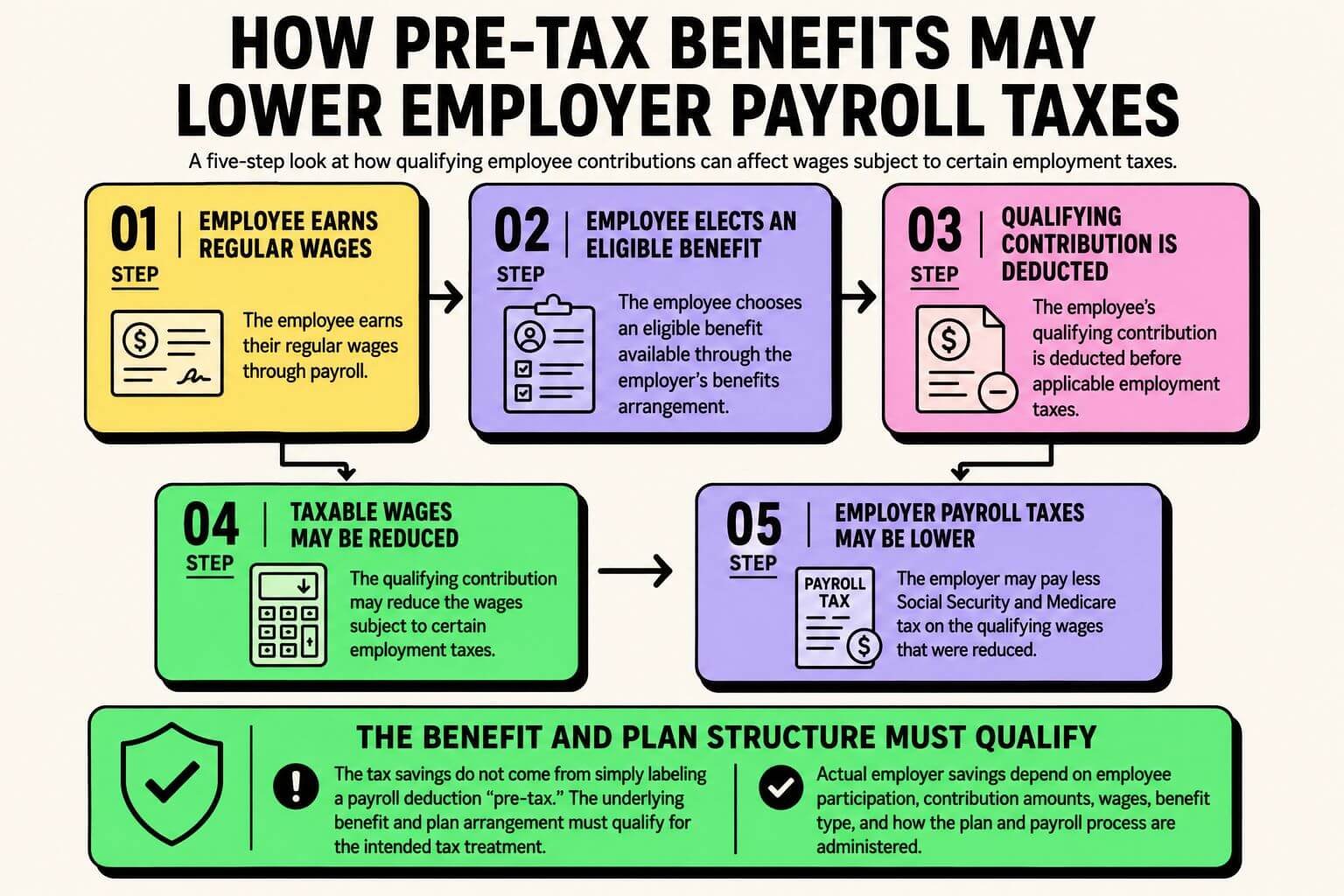
The basic idea is fairly simple. If an employee pays $200 toward an eligible benefit with after-tax money, their payroll taxes are generally calculated before that $200 is deducted. If the contribution qualifies for pre-tax treatment under a Section 125 arrangement, that amount may instead be excluded from wages subject to certain employment taxes. The process often looks like this:
- The employee earns their regular wages.
- They elect an eligible benefit.
- Their qualifying contribution is deducted before applicable employment taxes.
- Their taxable wages are reduced.
- The employer may pay less Social Security and Medicare tax on those wages.
The IRS explains that qualifying salary-reduction contributions through cafeteria plans generally aren’t treated as wages for FICA or FUTA purposes.
Employers who need more detail about eligibility, elections, documentation, and plan rules can review this Section 125 plan guide.
Where the 7.65% Employer FICA Rate Comes From
You’ll often see 7.65% used when discussing employer payroll-tax savings. For 2026, the employer portion of FICA consists of:
- 6.2% Social Security tax
- 1.45% Medicare tax
Together, those rates equal 7.65%. There is an important limit to remember. Social Security tax applies only up to the annual wage base, which is $184,500 for 2026. Medicare tax has no wage-base limit. So an employer shouldn’t assume that every dollar moved into a qualified pre-tax benefit will always produce a full 7.65% reduction. The employee’s wages and the type of benefit matter.
Which Employee Benefits May Qualify for Pre-Tax Treatment?
The tax savings don’t come from simply labeling a payroll deduction “pre-tax.” The underlying benefit and plan arrangement must qualify. Common benefits that may receive favorable treatment include:
- Medical insurance premiums
- Dental insurance premiums
- Vision insurance premiums
- Health flexible spending accounts
- Dependent care assistance
- Certain health savings account contributions
- Certain accident and health benefits
- Group-term life insurance, subject to applicable rules and limits
The IRS lists accident and health benefits, dependent care assistance, group-term life insurance, HSAs, and other qualifying benefits among those that may be offered through a cafeteria plan. Some benefits have separate tax rules or exceptions. For employers reviewing medical, dental, or vision coverage, current health benefit options are often a logical place to start.
Common Benefits Employers Should Review
You don’t have to redesign the entire benefits package to find possible payroll-tax issues. Start with what’s already coming out of employee paychecks. For each deduction, ask:
- Is this benefit currently treated as pre-tax or after-tax?
- Is that treatment appropriate for this benefit?
- Is the benefit included in the plan document?
- Does the payroll deduction match the employee’s election?
- Are changes during the year being handled correctly?
Medical, dental, and vision premiums are common starting points. Employers may also need to review FSAs, HSA salary-reduction contributions, dependent care benefits, and other deductions included in the plan.
Not Every Voluntary Benefit Gets the Same Tax Treatment
Voluntary benefits can give employees more choices without requiring the employer to pay the full premium. That doesn’t mean every voluntary benefit should automatically be processed as pre-tax. Accident, critical illness, hospital indemnity, disability, life insurance, and similar products can have different tax consequences based on how the coverage and premiums are structured.
If your company offers voluntary benefit options, confirm the tax treatment of each deduction rather than assuming that employee-paid means pre-tax. That distinction matters because the way premiums are taxed can also affect how certain benefits are taxed when a claim is paid.
How Much Could an Employer Save?
There isn’t one savings number that applies to every company. A simple starting calculation is: Reduction in applicable FICA-taxable wages × employer FICA rate = estimated employer FICA reduction
Suppose qualifying pre-tax benefit contributions reduce applicable FICA wages by $40,000 during the year. If the full 7.65% employer rate applies to those wages: $40,000 × 7.65% = $3,060
That would represent an estimated $3,060 reduction in employer Social Security and Medicare taxes. This is only a simplified example. Actual results can change based on employee wages, the Social Security wage base, employee participation, benefit type, and other tax rules. For a larger example using employee counts and annual contributions, see this payroll tax example.
What Has to Be Set Up Correctly?
The tax advantage depends on more than payroll software. A Section 125 cafeteria plan is a written employer plan. The IRS states that the written plan must describe the benefits available and establish rules for eligibility and employee elections. Employers should make sure several pieces agree:
- The written plan document
- Employee eligibility
- Benefit elections
- Payroll deduction codes
- Pre-tax and after-tax settings
- Enrollment effective dates
- Carrier or administrator records
- Qualifying life-event changes
- Applicable nondiscrimination requirements
A mismatch can happen even when the benefits themselves haven’t changed. A company might switch payroll providers, add a new benefit at renewal, change employee contribution amounts, or replace an insurance carrier without updating every connected record. That’s why administration matters just as much as the benefit selection.
Check the Plan Document and Payroll Together
One practical way to review the setup is to compare the plan document with a current payroll deduction report. Ask:
- Is every pre-tax deduction supported by the plan?
- Are deductions coded correctly in payroll?
- Do the amounts match current employee elections?
- Did deductions begin on the right effective date?
- Were terminated employees stopped at the correct time?
- Are midyear election changes supported by the plan rules?
If those records don’t match, fix the underlying issue before relying on an estimated tax savings number.
Does ICHRA Reduce Payroll Taxes the Same Way?
Not exactly.
An Individual Coverage Health Reimbursement Arrangement, or ICHRA, is an employer-funded arrangement that reimburses eligible employees for individual health insurance premiums and, depending on the plan design, other qualified medical expenses. That is different from the common Section 125 setup where an employee elects an eligible benefit and has part of their pay deducted on a pre-tax basis.
Employers comparing group health coverage with ICHRA options should evaluate the tax treatment separately instead of treating the two approaches as interchangeable. The right question isn’t simply which option creates the largest tax reduction. You also need to look at employee eligibility, employer contribution strategy, administration, coverage choices, and how the arrangement fits your workforce.
What Employers Should Review Before Making Changes
Before changing benefits because of a potential payroll-tax advantage, review the current setup first. A useful check includes:
- List every employee-paid benefit. Include both pre-tax and after-tax deductions.
- Identify the current tax treatment. Don’t rely only on the name of the payroll code.
- Review the Section 125 document. Make sure current eligible benefits and elections are covered.
- Compare payroll and enrollment records. Contribution amounts and effective dates should match.
- Look at employee participation. Low enrollment will affect the size of any potential tax savings.
- Review voluntary benefits separately. Don’t assume they all follow the same tax rules.
- Check changes made during the year. New hires, terminations, qualifying events, and benefit changes can create errors.
- Use actual payroll data for estimates. A company-wide average can hide important differences between employees.
There is also a relevant example close to Benni Agency’s home market. The South Carolina Public Employee Benefit Authority’s 2026 Flexible Benefits Plan states that it is intended to qualify as a Section 125 cafeteria plan, with eligible benefits elected instead of cash excluded from taxable income where permitted. That is a governmental plan, so private employers don’t follow PEBA’s exact plan document. It does show how the Section 125 structure is used in South Carolina. For Summerville employers and companies elsewhere in South Carolina, the federal tax rules are the same, but the right setup still depends on the company’s workforce, benefits, ownership structure, and payroll process.
Review Your Benefits and Payroll Setup Together
Many employers already have pre-tax deductions running through payroll. The question is whether the benefits, plan document, employee elections, and payroll codes still match. Start with a list of every employee-paid benefit. Check which deductions are marked pre-tax, confirm that each qualifying benefit is supported by the appropriate plan documentation, and compare payroll amounts with current enrollment records.
Pay extra attention after a renewal, carrier change, payroll migration, or eligibility change. Those are common times for information in one system to stop matching another. The goal isn’t to change benefits just to reduce taxes. It’s to make sure the benefits you already offer are being handled correctly and that legitimate tax advantages aren’t being missed. Benni Agency can help employers look at how their benefits and payroll processes fit together before making plan changes. If you’re unsure about the current setup, review the existing deductions and documentation first rather than changing coverage based only on a projected tax number.