Using a personal vehicle for work does not automatically mean you need a commercial auto policy, but regular business use can change the type of coverage you need. Vehicle ownership, who drives it, what it carries, how often it is used for work, and the terms of the actual policy all matter.
For a Summerville business, the key question is not simply whether a vehicle is personally or commercially titled. It is whether the insurance matches how the vehicle is actually being used.
Key Takeaways
- Personal and commercial auto policies can contain similar coverage types, but they are designed for different kinds of vehicle use.
- A business-owned or business-leased vehicle generally calls for commercial auto coverage.
- Some personal policies permit limited business use, while other activities may be restricted or excluded.
- Employee-owned and rented vehicles can create a separate hired and non-owned auto liability exposure.
- South Carolina requires minimum liability and uninsured motorist coverage of 25/50/25; underinsured motorist coverage must be offered but is not required.
- Policy wording, endorsements, vehicle use, contracts, and the facts of a claim ultimately determine how coverage applies.
What Separates Commercial Auto From Personal Auto Coverage?
Personal auto insurance is primarily designed for individuals and households using vehicles for personal activities such as commuting, errands, and ordinary travel. Commercial auto insurance is designed for vehicles used in business operations. Depending on the policy, that can include company cars, vans, pickup trucks, service vehicles, delivery vehicles, and vehicles driven by employees. The distinction is important because two policies can contain familiar coverage types, including liability, collision, comprehensive, medical payments, and uninsured motorist coverage, while applying them to very different risks. Vehicle ownership is also an important signal. A vehicle owned or leased by a business generally needs coverage written for that business. A personally owned vehicle may still need a commercial policy or an appropriate business-use endorsement when work-related driving becomes significant.
Can Personal Auto Insurance Cover Any Business Use?
Sometimes. It is too broad to say that personal auto insurance never covers business driving. Some personal policies permit certain incidental or limited business uses. Others restrict particular activities or may not accept the risk when the vehicle is used primarily for business.
Activities that deserve closer review include:
- Regular deliveries
- Traveling between job sites
- Carrying tools, materials, or inventory
- Transporting people or property as part of the business
- Regular sales or client visits
- Employees routinely using a personally insured vehicle for work
Ordinary commuting to and from a regular workplace is generally treated differently from using the vehicle to perform work.
Because policy forms, endorsements, underwriting rules, and business activities vary, business owners should review the actual policy rather than assuming that a personal policy either definitely covers or definitely excludes a particular trip. Industry insurance guidance similarly notes that some personal policies can accommodate limited business use, while primarily commercial use may require a commercial policy.
Signs a Business Should Review Commercial Auto Coverage
There is no single test that applies to every company, but several situations should trigger a closer commercial-auto review:
- The vehicle is owned or leased by the business.
- Employees regularly drive it as part of their jobs.
- Driving includes deliveries, service calls, job-site travel, or hauling business property.
- A customer, general contractor, lender, lessor, or other agreement requires particular insurance.
- Business use has changed from an occasional trip to a routine part of operations.
- The type or size of vehicle creates risks that no longer fit a personal-auto arrangement.
The important step is documenting actual vehicle use rather than relying on the name shown on the registration alone. Businesses reviewing several insurance lines can also compare these vehicle exposures with their broader business and commercial insurance program so that auto coverage is not evaluated in isolation.
What About Employees Using Their Own Cars?
A company can have an auto exposure even when it owns no vehicles. Hired and non-owned auto liability, commonly shortened to HNOA, may address liability involving vehicles the business does not own, including certain employee-owned vehicles used for company business and vehicles rented for work. For example, an employee might use a personal car to:
- Pick up supplies
- Visit a customer
- Make a bank deposit
- Travel between work locations
The employee’s personal policy may apply first depending on the circumstances and policy terms, but that does not necessarily prevent the business from being included in a liability claim arising from work-related driving. HNOA is primarily a liability issue and should not be assumed to pay for damage to an employee’s own vehicle. The exact protection depends on how the business’s coverage is structured.
South Carolina Minimum Auto Insurance Requirements
South Carolina requires motorists to carry at least:
- $25,000 of bodily injury liability per person
- $50,000 of bodily injury liability per accident
- $25,000 of property damage liability per accident
These limits are commonly written as 25/50/25.
South Carolina also requires uninsured motorist coverage at the state’s minimum liability limits. Underinsured motorist coverage is different: insurers must offer it, but drivers are not required to buy it. Those minimums establish a legal floor. They do not determine what liability limit is appropriate for an individual business. Contract requirements, vehicle type, business assets, operations, and other insurance arrangements can affect the limits a company chooses.
Do Federal Commercial-Vehicle Insurance Rules Apply?
Not to every vehicle used for business. Certain interstate motor carriers are subject to separate federal financial-responsibility requirements under 49 CFR Part 387. For example, federal guidance lists a $750,000 minimum public-liability requirement for certain for-hire interstate property carriers operating vehicles with a gross vehicle weight rating of 10,001 pounds or more and transporting nonhazardous property. Different limits or rules can apply depending on cargo, passenger capacity, vehicle size, operating authority, and the type of operation. A local service truck should therefore not be assumed to fall under a federal motor-carrier insurance requirement simply because it is used commercially. Businesses subject to DOT or FMCSA rules should verify their specific obligations rather than applying a general commercial-auto rule.
Commercial Auto vs. Personal Auto: Side-by-Side
| Feature | Personal Auto Insurance | Commercial Auto Insurance |
| Primary purpose | Personal and household driving | Business-related vehicle use |
| Typical ownership | Individually owned vehicle | Often business-owned or business-leased |
| Business use | Some limited uses may be allowed; restrictions vary | Designed for covered business use |
| Drivers | Usually named insureds and other covered drivers under the policy | Can be structured around the business and eligible/authorized drivers |
| Liability limits | Must satisfy applicable state requirements | Limits can be selected around business exposures and contractual requirements |
| Tools or business property | Should not be assumed covered | Also should not be assumed covered by the auto policy |
| Employee-owned vehicles | Employee’s personal policy may be relevant | Business liability may require HNOA or another appropriate arrangement |
| Pricing factors | Vehicle, driver, location, use, limits, deductibles, and other rating factors | Vehicle type, business use, drivers, industry, mileage, limits, claims history, and other underwriting factors |
Actual policy terms, exclusions, endorsements, limits, underwriting requirements, and claim circumstances control coverage.
Commercial Auto Does Not Automatically Cover Tools and Equipment
One common mistake is assuming that everything inside a commercially insured vehicle is automatically insured by the auto policy. Tools, materials, inventory, or mobile equipment may require separate property, inland marine, contractors’ equipment, or other coverage depending on the property and policy structure. This matters for contractors who may have significant equipment in or around a work truck. If tools or equipment are stolen, the Summerville contractor equipment theft claim checklist explains what to document after a loss and why the applicable policy should be identified rather than assuming the vehicle policy responds.
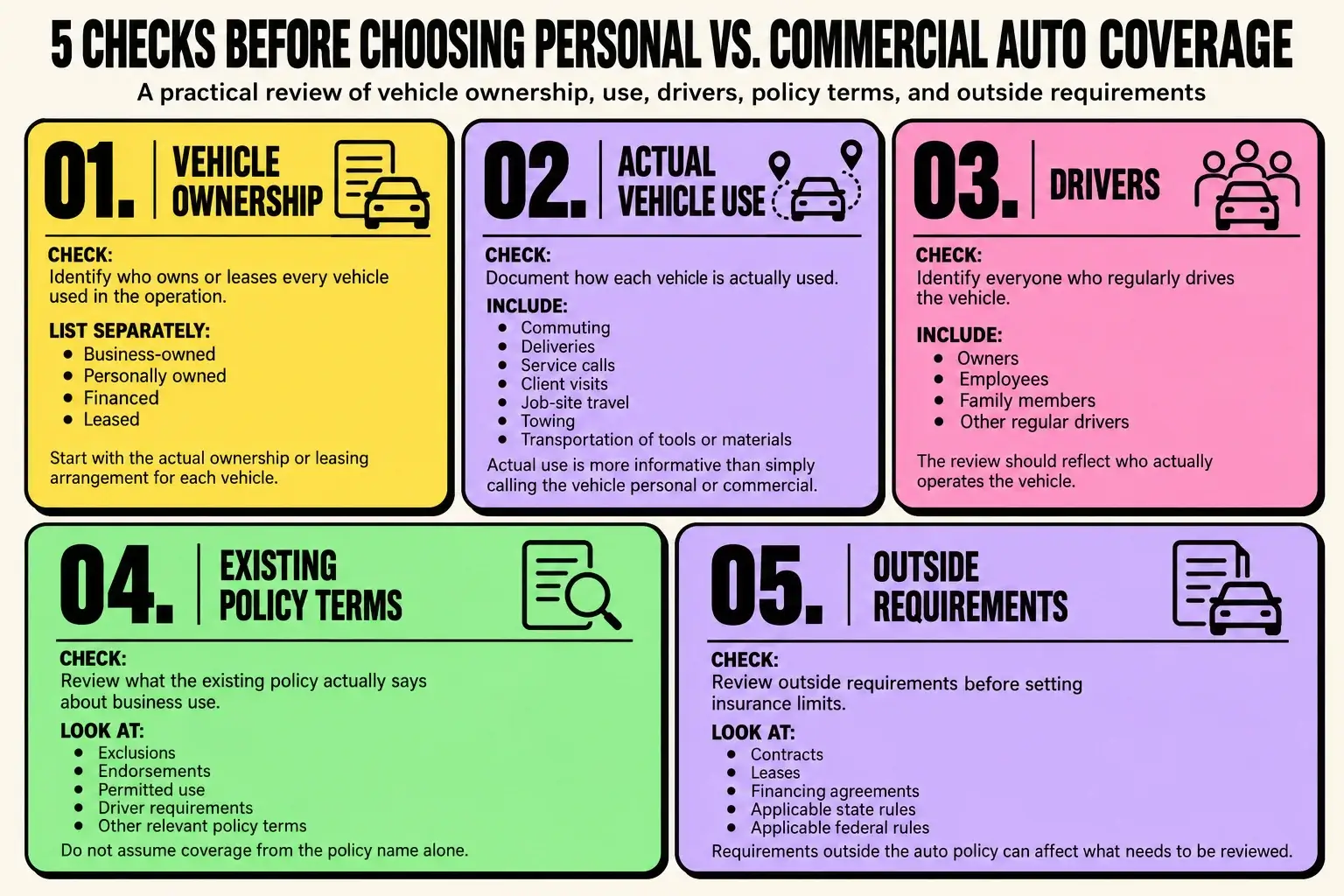
A Five-Step Commercial vs. Personal Auto Check
Before changing coverage, work through these questions:
- Who owns or leases each vehicle?
List business-owned, personally owned, financed, and leased vehicles separately. - How is each vehicle actually used?
Record commuting, deliveries, service calls, client visits, job-site travel, towing, and transportation of tools or materials. - Who drives it?
Identify owners, employees, family members, and any other regular drivers. - What does the existing policy say about business use?
Review exclusions, endorsements, permitted use, driver requirements, and other relevant terms. - Are there outside requirements?
Check contracts, leases, financing agreements, and any applicable state or federal rules before setting limits.
If the business has already determined that commercial auto coverage is appropriate and needs a broader review of liability, physical damage, driver management, vehicle schedules, and fleet issues, Benni Agency’s commercial auto insurance basics for Summerville businesses covers those topics in more detail.
Reviewing Vehicle Coverage in Summerville
The right policy depends on the operation rather than the city name alone. A business should consider vehicle ownership, frequency of use, drivers, contracts, what is being transported, and the terms of its current insurance. Benni Agency’s Summerville insurance and business-services page provides the local commercial context, while this article remains focused on the narrower question of commercial versus personal vehicle coverage. When the answer is unclear, reviewing the actual vehicle use and policy language with the insurer or a licensed insurance professional is more reliable than assuming every kind of business driving is treated the same way.