Renewal season can reveal every weak point in an employee benefits program. Premiums increase, employees struggle to compare plans, and HR spends more time answering questions and correcting enrollment problems. A Charleston benefits broker adds value by helping employers make better plan decisions, control costs, reduce administrative work, and support employees throughout the year. The job should involve much more than collecting quotes from insurance carriers.
This article is for Charleston business owners and HR leaders who want to evaluate their current broker, improve how benefits are managed, and prepare for renewal with fewer surprises.
Key Takeaways
- A Charleston benefits broker should provide year-round guidance, not only insurance quotes during renewal.
- Strong broker support can improve plan design, employee education, claims help, and daily benefits administration.
- Cost control may come from better plan structure and fewer errors, not simply choosing the lowest premium.
- Charleston’s growing and varied workforce makes affordability, communication, and plan flexibility important.
- Employers should measure broker value through service, transparency, reduced HR work, and clearer decisions.
How Does a Charleston Benefits Broker Add Value?
A benefits broker should help an employer build a program that works for both the company and its employees. That starts with understanding the workforce, budget, hiring needs, and current administrative problems. The broker can then compare plan structures, explain trade-offs, coordinate enrollment, and help employees use their benefits after coverage begins.
The lowest premium is not always the best result. A plan may look affordable for the employer but place deductibles, payroll deductions, or other costs beyond what employees can reasonably manage. A useful broker looks at the entire program, including:
- Employer and employee costs
- Coverage options
- Provider networks
- Employee communication
- Enrollment and payroll processes
- Claims and service support
- Compliance responsibilities
- Renewal planning
The goal is to help the employer make informed decisions instead of reacting to a new rate increase every year.
Better Plan and Funding Decisions
There is no single benefits structure that works for every Charleston employer. A fully insured group plan may suit a company that values predictable administration. A level-funded arrangement may appeal to an employer looking for greater claims visibility and possible cost control. An Individual Coverage Health Reimbursement Arrangement, or ICHRA, may work for certain companies that want defined employer contributions and individual plan choice.
The broker should explain the advantages, limits, and administrative requirements of each option. Plan design also involves more than major medical coverage. Dental, vision, life, disability, accident, critical illness, and hospital indemnity plans may help employees manage expenses that medical insurance does not fully cover. Adding more options is not automatically better. The package needs to fit the workforce, and employees need clear information before they enroll.
Less Work for HR
Benefits administration can take up a large amount of HR time, especially when enrollment depends on spreadsheets, PDF forms, and long email threads. A broker should help improve routine processes such as:
- New-hire enrollment
- Employee eligibility changes
- Qualifying life events
- Payroll deduction updates
- Carrier enrollment corrections
- Plan document access
- Open enrollment tracking
- Compliance notices
Technology can help, but software alone does not solve every problem. The broker should also support implementation, explain who is responsible for each task, and help resolve issues when information does not transfer correctly. When the process is organized, HR spends less time chasing forms and correcting avoidable errors.
Better Support for Employees
Employees often judge a benefits program by how easy it is to understand and use. A broker should help employees compare coverage, understand deductibles, review payroll deductions, and know where to go when they have a question. That support may include group education sessions, individual enrollment help, digital materials, phone assistance, or virtual meetings.
Support should continue after open enrollment. Employees may need help with:
- Coverage questions
- Claims problems
- Finding the correct carrier contact
- Adding dependents after a life event
- Understanding voluntary benefits
- Locating plan documents
Clear guidance can help employees make more informed choices while reducing the number of questions that fall back on HR.
Why Charleston Market Knowledge Matters
Charleston employers compete for workers across hospitality, healthcare, technology, logistics, manufacturing, administrative services, maritime industries, and professional roles. These employees may have very different wages, schedules, family needs, and access to workplace technology. A benefits strategy for an office-based company may not work as well for a hospitality team, a distributed workforce, or employees working different shifts.
Charleston’s workforce is also expanding. The South Carolina Department of Employment and Workforce reported that employment in the Charleston-North Charleston metro grew 4.1% from June 2024 to June 2025, adding approximately 17,600 workers. Growth creates hiring opportunities, but it can also increase competition for experienced employees. Benefits need to remain affordable for the employer while still making sense to the people the company wants to recruit and retain. Employers reviewing their Charleston benefits options should consider provider access, employee affordability, communication needs, and the level of administrative support their HR team requires.
What a Broker Should Do Throughout the Year
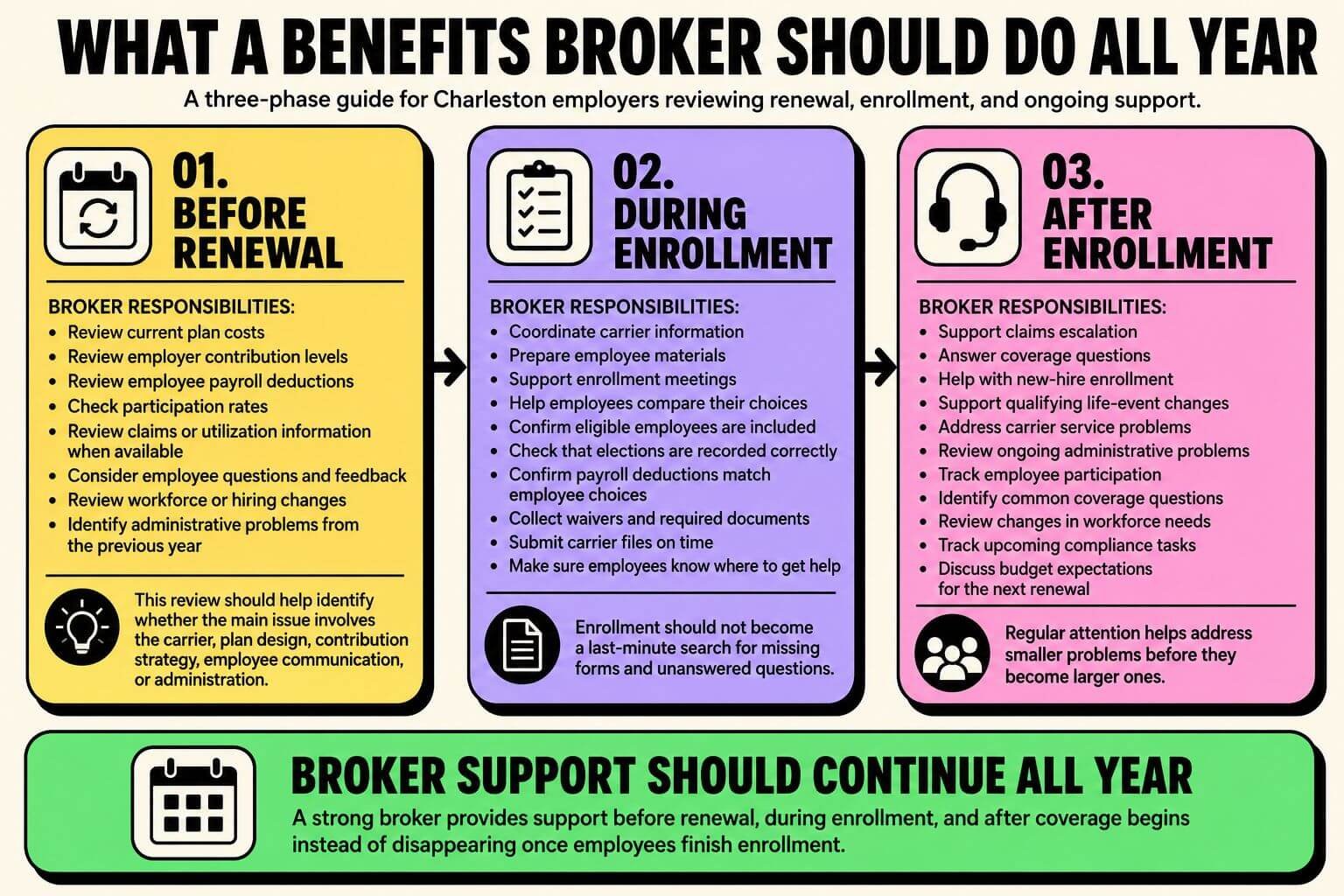
A broker relationship should not disappear after employees finish enrollment. Benefits problems can arise at any point in the year. Companies hire new employees, workers experience qualifying life events, claims require attention, and business goals change. A good broker provides support before renewal, during enrollment, and after coverage begins.
Before Renewal
Renewal planning should begin early enough for the employer to review the current program before making a decision. The broker should examine:
- Current plan costs
- Employer contribution levels
- Employee payroll deductions
- Participation rates
- Claims or utilization information, when available
- Employee questions and feedback
- Workforce or hiring changes
- Administrative problems from the previous year
This review helps identify whether the main problem is the carrier, plan design, contribution strategy, employee communication, or administration. Waiting until renewal rates arrive can limit the employer’s options and create rushed decisions.
During Enrollment
Once the employer selects a plan, the broker should help put it into place. That may include coordinating carrier information, preparing employee materials, supporting enrollment meetings, and helping employees compare their choices. The broker should also work with HR or payroll teams to confirm that:
- Eligible employees are included
- Elections are recorded correctly
- Payroll deductions match employee choices
- Waivers and required documents are collected
- Carrier files are submitted on time
- Employees know where to get help
Open enrollment should not become a last-minute search for missing forms and unanswered questions.
After Enrollment
Employees continue to need support after their coverage becomes active. A broker should remain involved with claims escalation, coverage questions, new-hire enrollment, life-event changes, and carrier service problems. The broker should also review how the program is performing instead of waiting until the next renewal meeting. Year-round meetings can help the employer track:
- Ongoing administrative problems
- Employee participation
- Common coverage questions
- Changes in workforce needs
- Upcoming compliance tasks
- Budget expectations for the next renewal
Regular attention makes it easier to address small problems before they become larger ones.
How Better Benefits Planning Can Control Costs
Controlling benefits costs does not always mean changing carriers or selecting a plan with a lower premium. A broker may find that the employer contribution strategy needs attention. One plan may receive low participation because employees cannot afford the payroll deduction. Another may have a lower premium but expose employees to deductibles they are unlikely to manage comfortably.
Cost planning may involve reviewing:
- Employer contribution amounts
- Employee-only and dependent costs
- Plan tiers
- Provider networks
- Deductibles and out-of-pocket limits
- Voluntary benefit options
- Fully insured and alternative funding arrangements
- Administrative errors
- Employee participation
ICHRA can be useful for some employers. It allows a company to set contribution amounts while eligible employees choose individual health insurance plans. However, ICHRA requires careful setup, employee communication, compliance coordination, and ongoing administration. It should be evaluated alongside other options rather than treated as the automatic answer for every company.
Voluntary benefits can also help employees prepare for expenses related to accidents, serious illnesses, hospital stays, disability, dental care, or vision needs. These plans need clear explanations so employees understand what they cover and what they do not. A broker adds value by showing the employer the trade-offs instead of recommending a product without enough context.
How to Know Whether Your Broker Is Delivering Value
Broker value should be visible in the way the benefits program operates throughout the year. Look beyond the renewal quote and consider whether the broker provides timely service, clear explanations, and practical help for both HR and employees. Useful signs include:
- Renewal planning starts several months in advance
- Recommendations connect to company goals
- Employees receive clear enrollment guidance
- HR knows who handles service problems
- Claims issues have an escalation process
- Administration and payroll problems are addressed
- Broker compensation is clearly explained
- Plan performance is reviewed during the year
- The broker discusses both advantages and drawbacks
The broker should also be able to explain what has improved. That may include fewer enrollment corrections, better communication, faster issue resolution, clearer reporting, or less manual work for HR.
Questions to Ask Your Current Broker
A few direct questions can reveal how much support the broker is prepared to provide:
- When will we begin preparing for renewal?
- Who will support our employees during and after enrollment?
- How do you handle claims or carrier service problems?
- How are you compensated?
- What services or technology involve additional fees?
- How will you help reduce manual HR work?
- What reports or reviews will we receive during the year?
- How will we measure whether the plan is working?
The answers should be specific. A general promise of good service does not explain who will perform the work, how quickly issues will be handled, or what the employer should expect.
Warning Signs the Relationship Is Not Working
Some employers stay with the same broker because changing feels difficult. However, recurring problems may show that the current relationship needs a closer review. Possible warning signs include:
- The broker contacts you mainly during renewal
- Meetings focus only on carrier rates
- Employees receive little education
- HR handles most claims and coverage questions
- Enrollment requires repeated manual corrections
- Alternative funding options are mentioned but not explained
- Broker compensation is unclear
- No one reviews results after enrollment
One problem does not always mean the broker should be replaced. A direct service discussion may solve the issue. When the same problems continue each year, the employer should decide whether the current broker has the service model, technology, and experience the company now needs.
Is Your Current Benefits Process Working?
A benefits program can look fine on paper while still creating problems for HR and employees. Renewal may begin too late. Employees may struggle to understand their options. Payroll deductions may require repeated corrections, or the broker may be difficult to reach once enrollment ends. Look at what happens throughout the year. Does your broker schedule regular reviews, help resolve claims questions, explain funding choices, and support employees after enrollment? Can the broker show what has improved since the previous renewal?
A few recurring problems do not always mean the entire plan needs to be replaced. The issue may be communication, administration, contribution strategy, or a lack of year-round support. Benni Agency helps Charleston-area employers review how their benefits program is structured, managed, and explained to employees. A practical review can show what is working, where avoidable problems remain, and what may need attention before the next renewal. Reviewing the process early gives your team more time to make informed changes before renewal decisions become urgent.