Manufacturing in North Charleston combines property, equipment, workforce, transportation, product, and contractual exposures that can make a basic commercial policy insufficient for some operations. A precision machine shop, component supplier, fabricator, or manufacturer supporting larger aerospace or automotive programs may need to protect expensive machinery, raw materials, finished inventory, employees, customer contracts, and products after they leave the facility.
This guide explains the core insurance coverages North Charleston manufacturers should review, what South Carolina requirements may apply, and how to build a program around the way the operation actually works. It provides general educational information, not legal, tax, compliance, or individualized insurance advice.
Key Takeaways
- Manufacturing insurance usually requires more than general liability because machinery, inventory, products, employees, vehicles, contracts, and production interruptions create separate exposures.
- Product liability and product recall are different risks, so manufacturers should confirm whether recall expenses are covered separately from third-party injury or property-damage claims.
- South Carolina generally requires workers’ compensation for employers regularly employing four or more people, subject to statutory exemptions and fact-specific classification issues.
- Equipment breakdown, cyber, pollution, commercial auto, and umbrella or excess liability may deserve separate review depending on equipment, materials, systems, vehicles, and contracts.
- A coordinated manufacturing insurance review should compare actual operations, replacement values, workforce classifications, contracts, limits, exclusions, and policy forms rather than relying on coverage names alone.
Why Manufacturing Insurance Needs Are Different in North Charleston
North Charleston’s industrial economy includes major aerospace and automotive operations along with suppliers involved in machining, fabrication, packaging, specialty materials, and component production. The Charleston Regional Development Alliance major employers data provides broader context for the region’s industrial and manufacturing base. For manufacturers, insurance needs are driven less by the city name itself and more by the way the plant operates. Heavy machinery may represent a large share of business property value. Raw materials, work in progress, and finished goods may need protection both on-site and while moving between locations.
Employees may work around presses, conveyors, forklifts, welding equipment, automated systems, or other machinery. Customer or supplier agreements may also require specific insurance limits, certificates, or endorsements. Products create another exposure because an alleged defect can result in a liability claim after the product has already left the facility. That combination means manufacturers should build coverage around their actual operations rather than relying on a generic commercial insurance package.
Core Insurance Coverages Every Manufacturer Should Review
Most manufacturing insurance programs begin with property and liability coverage, then add specialized protection based on equipment, materials, transportation, workforce, products, and contractual requirements.
| Coverage | What It Generally Addresses | Why Manufacturers Review It |
| General liability | Covered third-party bodily injury, property damage, and certain advertising injury claims | Visitors, vendors, delivery drivers, and operational liability |
| Product liability | Covered injury or property-damage claims caused by manufactured products | Products can create liability after leaving the facility |
| Commercial property | Buildings, machinery, inventory, and other insured property against covered causes of loss | Equipment and inventory may represent substantial asset values |
| Business income | Lost income and continuing expenses following certain covered interruptions | Production shutdowns can disrupt deliveries and contracts |
| Workers’ compensation | Covered employee work injuries and occupational illnesses | Required for many South Carolina employers |
| Equipment breakdown | Certain mechanical or electrical equipment breakdown losses | Production may depend on specialized machinery |
| Commercial auto | Covered vehicle-related liability and selected physical-damage exposures | Delivery, sales, and between-site transportation |
| Cyber liability | Certain data breach, ransomware, privacy, and cyber-event costs | Production and customer systems may be digitally connected |
| Pollution liability | Certain cleanup costs and third-party pollution claims | Relevant when regulated or hazardous materials are involved |
| Umbrella or excess liability | Additional liability limits above qualifying underlying policies | Contracts may require limits above primary policies |
Benni Agency’s business and commercial insurance resources provide a broader look at how these commercial coverage categories can fit into a coordinated program.
General Liability Insurance
General liability insurance commonly addresses covered third-party bodily injury and property-damage claims arising from business operations. For a manufacturer, that could involve a delivery driver injured at the loading dock, a visitor hurt on the premises, or damage to another party’s property during business operations. General liability may also include products-completed operations coverage, depending on the form. The policy should be reviewed for limits, exclusions, covered operations, contractual provisions, additional insured requirements, and how product-related claims are addressed.
Product Liability Insurance
Product liability deserves separate attention because a manufacturer’s exposure does not end when a product leaves the facility. A defective, improperly manufactured, mislabeled, or allegedly unsafe product may result in a claim for bodily injury or property damage. The policy should reflect the products actually manufactured, their intended use, where they are sold, and the potential severity of a claim. Product liability should also be distinguished from product recall coverage. A liability policy may respond to a covered third-party injury or property-damage claim without paying the manufacturer’s own costs to recall, remove, replace, ship, dispose of, or repair products. Manufacturers with meaningful recall exposure should therefore ask directly how recall expenses are treated.
Commercial Property, BOP, and CPP Structures
Commercial property insurance can cover buildings, machinery, equipment, inventory, and other insured business property against covered causes of loss. Manufacturers should pay particular attention to equipment values because machinery can be expensive to repair or replace. Some operations with relatively straightforward exposures may qualify for a Business Owners Policy, or BOP, which can combine property, general liability, and business income coverage.
Manufacturers with more complex equipment, processes, property values, locations, or contractual requirements may need a Commercial Package Policy, or CPP, that allows greater customization. Neither structure is automatically better. The important question is whether the available limits, property valuation, deductibles, causes of loss, endorsements, exclusions, and business-income provisions match the operation. For a deeper comparison, see Benni Agency’s Charleston BOP vs. CPP guide.
Business Income and Interruption Coverage
A production shutdown can create financial consequences beyond physical property damage. Business income coverage may replace certain lost income and continuing expenses when operations are interrupted by a covered event, subject to policy terms. Manufacturers should review the period of restoration, waiting periods, covered causes of loss, payroll treatment, extra expense provisions, and any limits or extensions that may apply. Contractual delivery obligations deserve separate attention. A customer penalty or missed-delivery consequence is not automatically covered simply because the underlying shutdown qualifies for business-income coverage.
Workers’ Compensation and Employers’ Liability
South Carolina generally requires businesses that regularly employ four or more workers to carry workers’ compensation coverage, subject to statutory exemptions. Part-time employees and family members can count toward the general employee threshold. The South Carolina workers’ compensation coverage requirements provide additional state guidance. Manufacturers also need accurate job classifications because workers performing production, warehouse, maintenance, driving, and administrative duties may be classified differently for workers’ compensation rating. Payroll and job-duty records should be reviewed as staffing changes. Employers’ liability, typically included with the workers’ compensation policy, addresses certain employer liability claims outside the workers’ compensation benefits system, subject to policy terms. For additional audit preparation, Benni Agency’s workers’ comp payroll audit checklist explains the records employers may need to organize.
Commercial Auto and Fleet Insurance
Manufacturers using vehicles for deliveries, sales visits, service work, or transportation between facilities should review commercial auto coverage. Company-owned vehicles are separate from employees’ personal auto policies. Businesses should also consider whether employees use personal, rented, leased, or borrowed vehicles for business purposes and ask how those exposures are addressed.
Forklifts and similar mobile equipment used primarily on-site may be treated differently from licensed road vehicles.Review the applicable commercial auto, general liability, and property forms rather than assuming every movable piece of equipment belongs under the auto policy.
Equipment Breakdown Coverage
Commercial property insurance should not automatically be assumed to cover every mechanical or electrical equipment failure. Equipment breakdown coverage can address certain sudden mechanical, electrical, pressure-system, or related breakdown losses, depending on the form. This can be particularly important when production depends on a limited number of specialized machines. A manufacturer should consider not only the physical repair cost but also whether a breakdown could interrupt production, spoil materials, damage other property, or require temporary replacement equipment. Coverage terms, deductibles, waiting periods, and business-income provisions should be reviewed together.
Cyber Liability Insurance
Modern manufacturing can depend on networked production systems, vendor portals, electronic data interchange, cloud applications, and customer systems. Cyber liability insurance can address certain expenses associated with data breaches, ransomware, privacy events, cyber business interruption, and related claims. The appropriate review should reflect the systems actually used, the information stored, customer requirements, and the potential consequences of a production-system outage. Insurance should also be coordinated with cybersecurity controls because policy requirements, exclusions, and security representations can affect coverage.
Environmental and Pollution Liability
Manufacturers handling solvents, fuels, coatings, chemicals, waste products, or other regulated materials may have pollution exposures that are not fully addressed by general liability or commercial property insurance. Environmental or pollution liability coverage may address certain cleanup expenses and third-party claims arising from a pollution condition. Not every manufacturer needs the same environmental policy. The need depends on materials, processes, waste handling, storage practices, property conditions, contracts, and applicable environmental requirements.
Employment Practices Liability
Employment practices liability insurance, or EPLI, can address certain covered allegations involving discrimination, harassment, wrongful termination, retaliation, and other employment practices. The need is separate from workers’ compensation. Workers’ compensation focuses primarily on covered occupational injuries and illnesses, while EPLI addresses employment-related allegations subject to its own terms and exclusions. Manufacturers should review workforce growth, supervisory responsibilities, employment procedures, and any contractual employment exposures when considering this coverage.
Commercial Umbrella and Excess Liability
Commercial umbrella and excess liability can add limits above qualifying underlying policies such as general liability, commercial auto, and employers’ liability. Supply contracts may require higher liability limits than primary policies provide. However, the terms umbrella and excess liability should not be treated as interchangeable guarantees of coverage. Attachment points, scheduled underlying insurance, exclusions, defense-cost treatment, and contract wording all matter. Benni Agency’s guide to commercial umbrella vs. excess liability explains these distinctions in more detail.
South Carolina Compliance Considerations for Manufacturers
Insurance decisions should be reviewed alongside applicable South Carolina requirements. Workers’ compensation is one of the most important examples. Employee count, family employment, exemptions, and worker classification can affect whether coverage requirements apply. South Carolina also operates its own OSHA-approved workplace safety program. The OSHA South Carolina State Plan explains the state-administered occupational safety and health framework covering most private-sector workplaces.
Contracts create another layer of requirements. Aerospace, automotive, construction, government, or other supply agreements may establish insurance limits, additional insured wording, certificates, waivers, or specialized coverage obligations. Those requirements should be taken directly from the signed contract rather than assumed from general industry practice.
Building a Coordinated Manufacturing Insurance Program
A manufacturing insurance review should begin with the operation itself. First, document current building, machinery, equipment, raw-material, work-in-process, and finished-goods values. Replacement cost deserves particular attention because original purchase prices may no longer reflect replacement expenses. Next, compare workforce roles with the workers’ compensation classifications and payroll information being reported. Contracts should then be reviewed for required insurance limits, additional insured provisions, certificates, and other risk-transfer obligations.
Product exposures deserve their own review, including what is manufactured, where products are used, potential post-sale claims, and whether recall expenses require separate protection. Finally, compare property, liability, auto, cyber, pollution, equipment breakdown, and umbrella coverage against current operations rather than reviewing each policy in isolation. The program should be revisited at renewal and whenever equipment, locations, payroll, products, processes, or major contracts change materially.
Common Coverage Gaps to Watch
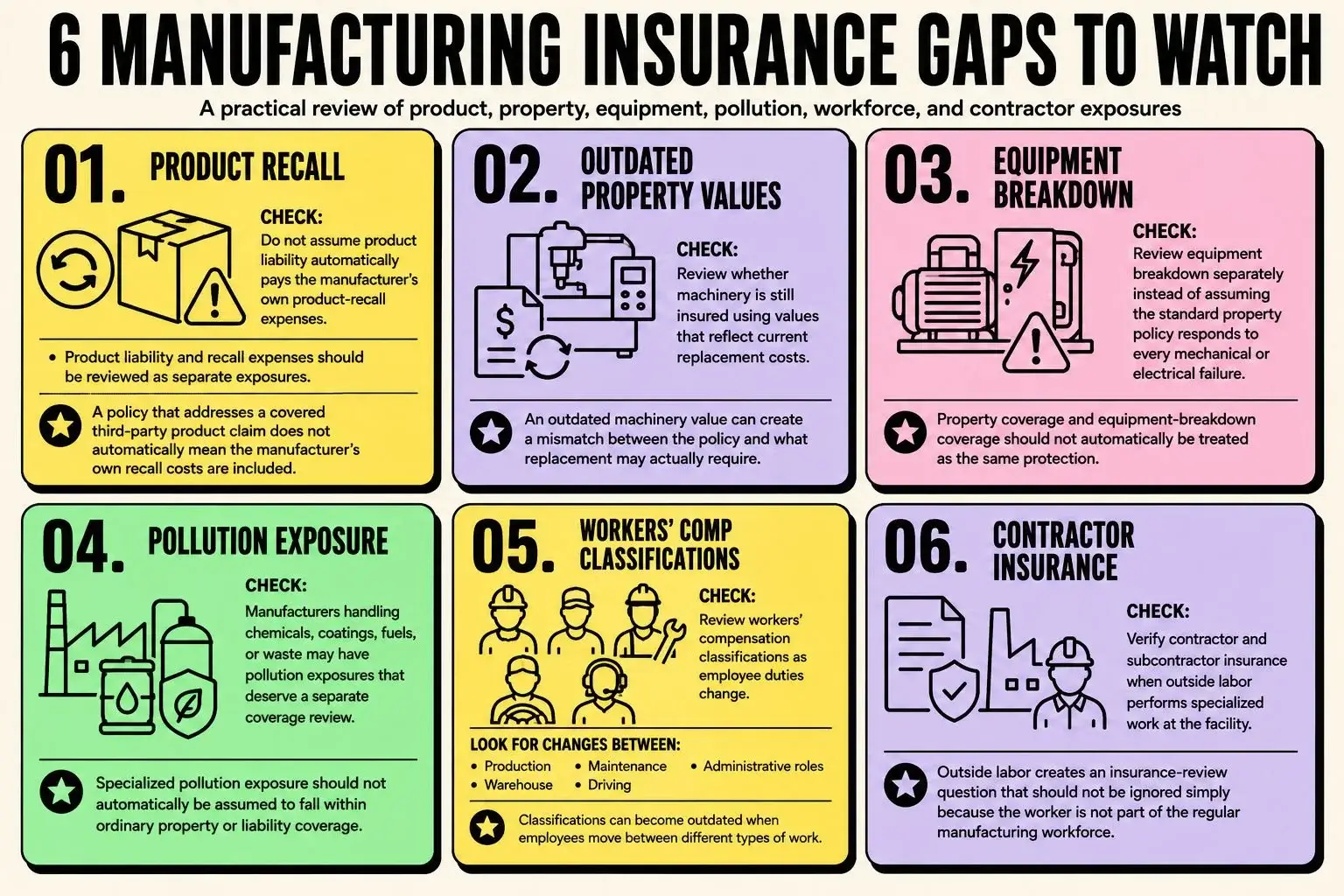
One common mistake is assuming product liability automatically pays the manufacturer’s own recall expenses. Those exposures should be reviewed separately. Property valuation can create another gap when machinery remains insured at an outdated value that no longer reflects replacement costs. Equipment breakdown also deserves a specific review because a standard property policy may not respond to every mechanical or electrical failure. Manufacturers handling chemicals, coatings, fuels, or waste can have pollution exposures that require specialized coverage. Workers’ compensation classifications can become outdated as employees move between production, warehouse, maintenance, driving, and administrative roles.Contractor and subcontractor insurance should also be verified when outside labor performs specialized work at the facility.
Where Employee Benefits Fit Into the Picture
Commercial insurance protects the organization’s property, liability, operations, and financial exposures. Employee benefits address a different part of the business: the workforce. For manufacturers, health, disability, voluntary benefits, and related benefit programs may form part of the broader employee recruitment and retention strategy. The two areas should remain distinct. Commercial insurance decisions should be based on operational risk and policy terms, while employee benefit decisions should reflect workforce goals, plan design, cost structure, eligibility, and applicable benefits rules.
Reviewing Manufacturing Insurance With Benni Agency
A useful manufacturing insurance review should begin with the actual plant rather than a standardized package. That means reviewing machinery and property values, products, workforce classifications, transportation, cyber systems, environmental exposures, contracts, current policies, and loss history together. North Charleston manufacturers can review Benni Agency’s North Charleston business insurance resources for the local service path. Coverage recommendations should reflect the actual business, available insurer terms, and issued policy forms rather than assumptions based only on company size, industry label, or location.