Mount Pleasant medical malpractice insurance should be reviewed for more than the headline liability limit. Practice owners should also check the policy form, insured providers and entities, retroactive dates, reporting requirements, defense-cost treatment, tail or prior-acts options, telehealth activity, and contract requirements.
South Carolina claim rules matter as well, including pre-suit notice requirements and annually adjusted limits on noneconomic damages. This guide is for Mount Pleasant physicians, practice administrators, and healthcare employers preparing for a renewal, carrier change, provider transition, or broader coverage review.
Key Takeaways
- Claims-made and occurrence policies use different coverage triggers, so retroactive dates, reporting terms, prior acts, and tail coverage require careful review.
- South Carolina does not impose one universal malpractice insurance limit on every physician through its general physician-licensing chapter.
- The 2026 noneconomic-damages limits are $596,001 per claimant against one provider or institution and $1,788,002 across all providers and institutions, subject to exceptions.
- South Carolina malpractice claims generally involve a Notice of Intent, expert affidavit, and prelitigation mediation before a civil action begins.
- A useful renewal review should match the policy to the current provider roster, services, locations, telehealth activity, contracts, reporting duties, and practice entity.
What Medical Malpractice Insurance Covers
South Carolina law defines medical malpractice insurance as protection against an insured’s legal liability and related loss, damage, or expense arising from negligence or malpractice in professional services. The South Carolina medical malpractice insurance law provides the statutory framework. In practice, the issued policy controls which claims, defense expenses, settlements, judgments, providers, practice entities, and professional services fall within coverage.
A policy may insure individual clinicians, the practice entity, or both. Do not assume a physician’s individual policy automatically covers the clinic, every employed clinician, locum tenens providers, contractors, supervising physicians, or related entities. Compare the named insureds, professional-services definitions, schedules, endorsements, exclusions, limits, and reporting terms with the way the practice operates today.
Is Medical Malpractice Insurance Required in South Carolina?
South Carolina’s general physician-licensing chapter does not state one universal medical malpractice insurance minimum for every physician. That does not mean every practice faces the same requirements. A hospital, employer, payer, facility, credentialing agreement, procedure-specific rule, or other contract may establish its own insurance requirements.
The South Carolina physician and telemedicine law is useful for reviewing physician licensing requirements, but practices should also confirm every applicable contractual or facility requirement in writing. The familiar $1 million per claim / $3 million annual aggregate figures should not be presented as a universal South Carolina physician-licensing requirement. South Carolina Code Section 38-79-130 uses those figures in connection with the policy authority of the state’s medical malpractice association, not as a statewide minimum applying to every physician.
Claims-Made vs. Occurrence Policies
The NAIC medical malpractice insurance guidance describes two basic malpractice policy forms: claims-made and occurrence.
| Review Point | Claims-Made Policy | Occurrence Policy |
| Coverage trigger | Claim is reported during the active policy term or applicable extended reporting period, subject to policy dates and terms | Incident occurs during the policy period, subject to policy terms |
| Retroactive date | A key date to review; work before it may fall outside coverage | Incident date is the main timing trigger |
| After policy ends | Later claims may require tail coverage or acceptable prior-acts coverage | A later claim can still fall under the policy if the covered incident occurred during the policy period |
| Before switching | Confirm retroactive date, prior acts, reporting rules, ERP options, and tail responsibility | Confirm policy dates, notice obligations, and contract requirements |
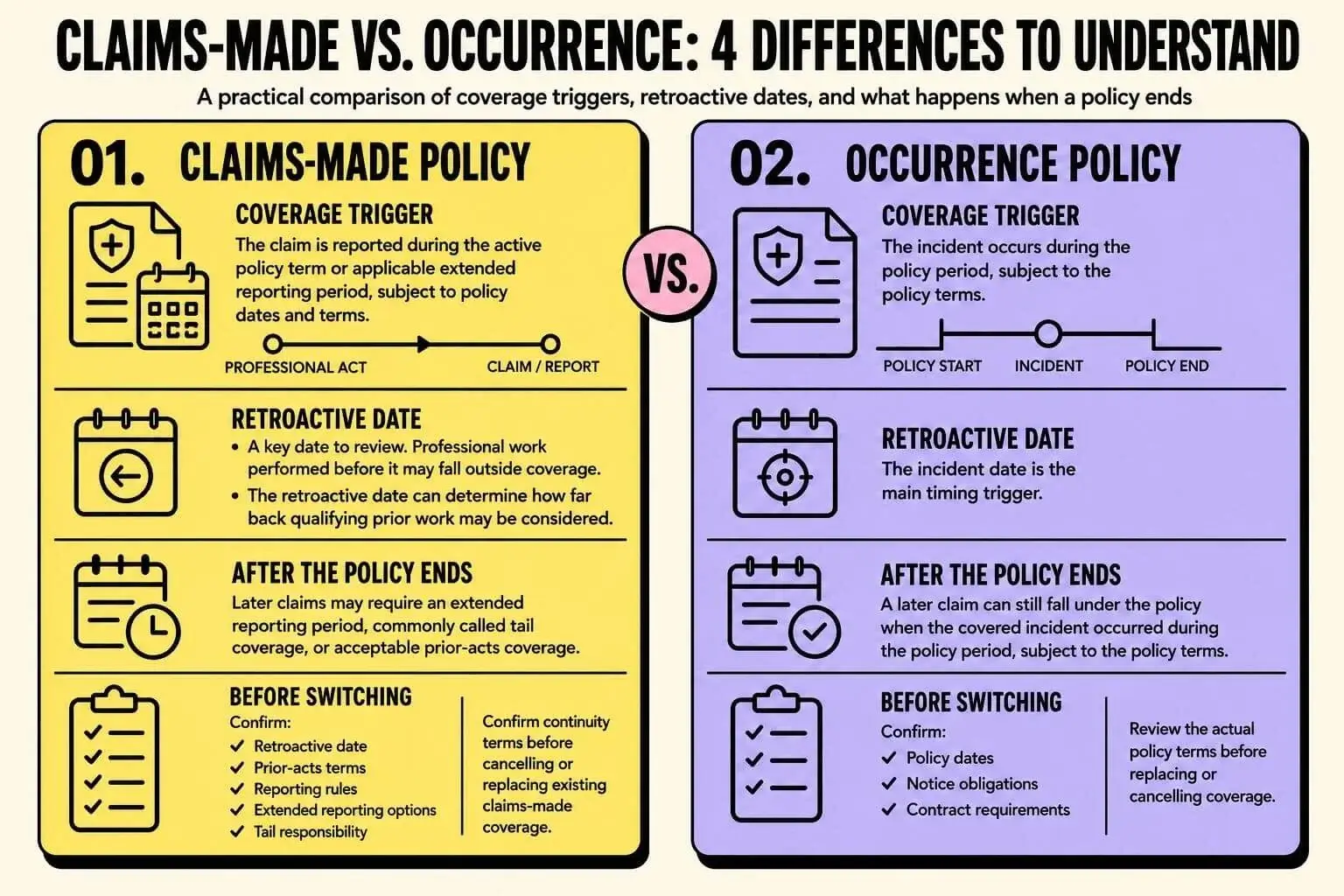
A claims-made policy generally depends on both when the alleged act occurred and when the claim is first made and reported. The retroactive date is especially important because professional services performed before that date may fall outside coverage, even when the claim is reported during the current policy term. An occurrence policy is generally tied to when the covered incident happened. If the incident occurred during the policy period, a later claim may still fall under that policy, subject to the actual terms and conditions.
For a claims-made policy, confirm the retroactive date before changing carriers or employment. An extended reporting period, commonly called tail coverage, can preserve a reporting window after the policy ends. Prior-acts coverage from a new insurer may provide another continuity option when the new carrier accepts the needed retroactive date. Before cancelling a prior policy, get the retroactive date, prior-acts terms, tail availability, reporting requirements, and replacement coverage dates in writing.
South Carolina Malpractice Rules That Affect a Coverage Review
2026 Noneconomic-Damages Limits
The South Carolina noneconomic-damages statute establishes the framework for malpractice noneconomic-damages limits and requires annual Consumer Price Index adjustments. The 2026 South Carolina State Register adjustment published the current figures. For 2026, the adjusted limits are $596,001 per claimant against a single health care provider or institution and $1,788,002 per claimant across all health care providers and institutions.
These statutory limits apply to noneconomic damages and are subject to statutory exceptions. Economic damages are not limited by the same provision. These figures are legal context, not a formula for choosing malpractice insurance limits. Coverage decisions should also consider contract requirements, specialty, services performed, practice entity structure, available limits, defense-cost treatment, and credentialing requirements.
Filing Deadlines
The South Carolina medical malpractice filing deadlines include a general three-year limitations framework and a six-year outer limit in the main rule. The statute also contains separate provisions for certain circumstances, including discovery issues, foreign objects, minors, and other tolling situations.
A practice should rely on qualified legal counsel for a specific statute-of-limitations question. The insurance review should focus on making sure policy reporting obligations are understood well before a legal filing deadline becomes relevant.
Notice of Intent, Expert Affidavit, and Mediation
South Carolina Code Section 15-79-125 requires a plaintiff, before starting a medical malpractice civil action, to file a Notice of Intent to File Suit. The law also requires an expert witness affidavit subject to applicable statutory provisions and calls for prelitigation mediation.
Review the South Carolina prelitigation mediation requirements alongside the policy’s notice provisions. A malpractice policy should make clear when the insured must report an incident, patient complaint, written demand, subpoena, Notice of Intent, lawsuit, or other circumstance that may reasonably lead to a claim. Do not wait for formal litigation before checking whether an earlier reporting obligation exists.
South Carolina Medical Malpractice Association
South Carolina law maintains the South Carolina Medical Malpractice Association as a market-of-last-resort mechanism. Licensed health care providers may apply, subject to underwriting standards, premium requirements, eligibility conditions, and other applicable association rules.
The current structure followed the January 1, 2020 merger described in South Carolina law. This option should be understood as part of the state’s medical malpractice insurance framework, not as a universal policy source for every practice.
How to Review Limits and Policy Terms
A per-claim limit is generally the maximum available for one covered claim, subject to the policy. An aggregate limit is generally the maximum available across covered claims during the policy period.
Those figures should be compared with any hospital requirement, payer requirement, facility requirement, employment agreement, credentialing condition, or other contract requirement that applies to the practice.
Defense costs also deserve close attention. Ask whether they are inside the liability limit, outside the liability limit, or subject to a separate sublimit. If defense expenses reduce the available liability limit, a prolonged defense can affect the amount remaining for a covered settlement or judgment.
The deductible or retention should also be reviewed alongside the liability limit. Confirm the amount, whether it applies per claim, whether it applies to defense expenses, who pays it, and when payment is required.
It is equally important to understand whether individual clinicians and the practice entity share limits. A shared aggregate can operate differently from separate individual limits.
Review the policy’s settlement-consent wording as well. Some forms contain provisions that can change the insured’s financial responsibility if a recommended settlement is declined.
Finally, check whether the policy includes separate terms or sublimits for licensing proceedings, disciplinary actions, peer review, regulatory investigations, or other non-damages expenses. Do not assume these costs automatically fall within the main malpractice limit.
The Mount Pleasant Medical Malpractice Coverage Checklist
Use this checklist for a current policy, renewal, provider transition, carrier change, or quote comparison.
- Confirm whether the policy is claims-made or occurrence and identify the exact coverage trigger.
- Verify the retroactive date and compare it with prior policies and the provider’s work history.
- Check prior-acts terms before replacing a claims-made policy.
- Review extended reporting period or tail options, including who arranges and pays for them when a provider leaves.
- Compare per-claim and aggregate limits with current hospital, payer, facility, employment, and contract requirements.
- Confirm which clinicians and practice entities are named or scheduled as insureds.
- Check whether defense costs are inside or outside the liability limit.
- Review the deductible or retention and when it applies.
- Read settlement-consent provisions and any terms affecting responsibility if the insured declines a proposed settlement.
- Review notice requirements for claims, incidents, demands, subpoenas, patient complaints, or circumstances that may lead to a claim.
- Confirm how the policy handles new hires, departing providers, part-time clinicians, locum tenens providers, contractors, and supervising relationships.
- Confirm that telehealth services fit the covered professional services, territory, provider schedules, and patient locations.
- Check whether regulatory investigations, licensing matters, peer review, billing disputes, cyber incidents, and employment claims are covered, excluded, or handled elsewhere.
- Compare quotes using the same provider roster, services, locations, limits, retroactive dates, and claims history.
Coverage Beyond the Malpractice Policy
Medical malpractice insurance addresses professional liability arising from patient care. It is not a complete insurance program for a medical practice.
Benni Agency’s business and commercial insurance services include professional liability and other commercial coverage categories for South Carolina businesses, including medical practices.
General liability may address covered third-party bodily injury or property-damage claims outside clinical care. Workers’ compensation may address covered work-related employee injuries or illnesses.
Employment practices liability insurance can address certain covered employment-related allegations, while cyber liability can address covered privacy, data, security, and cyber-event exposures. Commercial property insurance may address covered damage to buildings, equipment, furniture, and other insured property.
Do not assume a Business Owners Policy, Commercial Package Policy, umbrella, or excess liability policy automatically extends over medical malpractice. Review the scheduled underlying policies and exclusions in the actual policy forms.
When to Review or Renew Coverage
Do not limit malpractice review to the annual renewal date. Recheck the policy when a physician or other clinician joins or leaves the practice, when the practice adds a procedure, specialty, service line, or supervising relationship, or when telehealth expands into another state.
A review is also appropriate when the practice opens, closes, or moves a location, changes its legal entity or ownership structure, or receives new hospital, payer, facility, employer, or credentialing requirements.
Carrier changes, provider retirement, entity closure, and any complaint, demand, subpoena, or incident that may trigger a reporting duty should also prompt a closer look at the policy. These events can affect insured status, continuity, contract requirements, or reporting obligations before the next scheduled renewal.
Reviewing Coverage With Benni Agency
Benni Agency’s Business & Commercial Insurance services include professional liability among the commercial coverage categories reviewed for South Carolina businesses.
For a Mount Pleasant medical practice, a useful review starts with the current provider roster, services, practice locations, telehealth activity, credentialing requirements, contracts, policy declarations, endorsements, retroactive dates, and loss information.
The Mount Pleasant service-area page provides the local Benni Agency path for businesses in the area. A coverage discussion should compare available policy terms with the practice’s actual operations instead of treating Mount Pleasant itself as a pricing or coverage factor. Coverage remains subject to insurer underwriting and the terms, conditions, exclusions, limits, and endorsements of the issued policy.