Health benefits can get expensive fast, especially when renewal season brings another increase and your team still needs good coverage. A Summerville ICHRA consultant can help you decide whether an Individual Coverage Health Reimbursement Arrangement is the right fit for your business, your budget, and your employees.
This guide is for Summerville employers who want to compare ICHRA with traditional group health options and know whether this approach makes sense before making a benefits decision.
Key Takeaways
- A Summerville ICHRA consultant helps employers decide whether ICHRA is actually a good fit, not just a cheaper-looking option.
- The biggest value is in plan design, contribution strategy, compliance, employee communication, and ongoing review.
- ICHRA can give employees more plan choice while helping employers create a more predictable benefits budget.
- A consultant can help compare ICHRA with group health insurance so the business does not make a rushed renewal decision.
- Local guidance matters because Summerville employers may have different workforce needs, hiring pressures, and budget concerns.
Why Summerville Employers Consider ICHRA
Many employers look at ICHRA because they want more control over health benefits costs. Instead of choosing one group health plan for everyone, the employer sets a reimbursement amount, and employees use it toward individual health coverage. That can sound simple, but the decision still needs care.
Summerville is not a small, static market. The U.S. Census Bureau estimates the town’s 2025 population at 53,177. Census QuickFacts also lists 67.3% civilian labor-force participation and 12.0% of people under age 65 without health insurance.
For local employers, that matters.
You may be trying to:
- Hire good employees
- Keep your current team
- Offer benefits that feel useful
- Control monthly benefits costs
- Avoid another rushed renewal decision
ICHRA can be one option, but it should be compared against your full benefits picture.
What an ICHRA Consultant Actually Helps With
An ICHRA consultant helps turn a benefits idea into a real plan. That includes more than choosing a reimbursement amount.
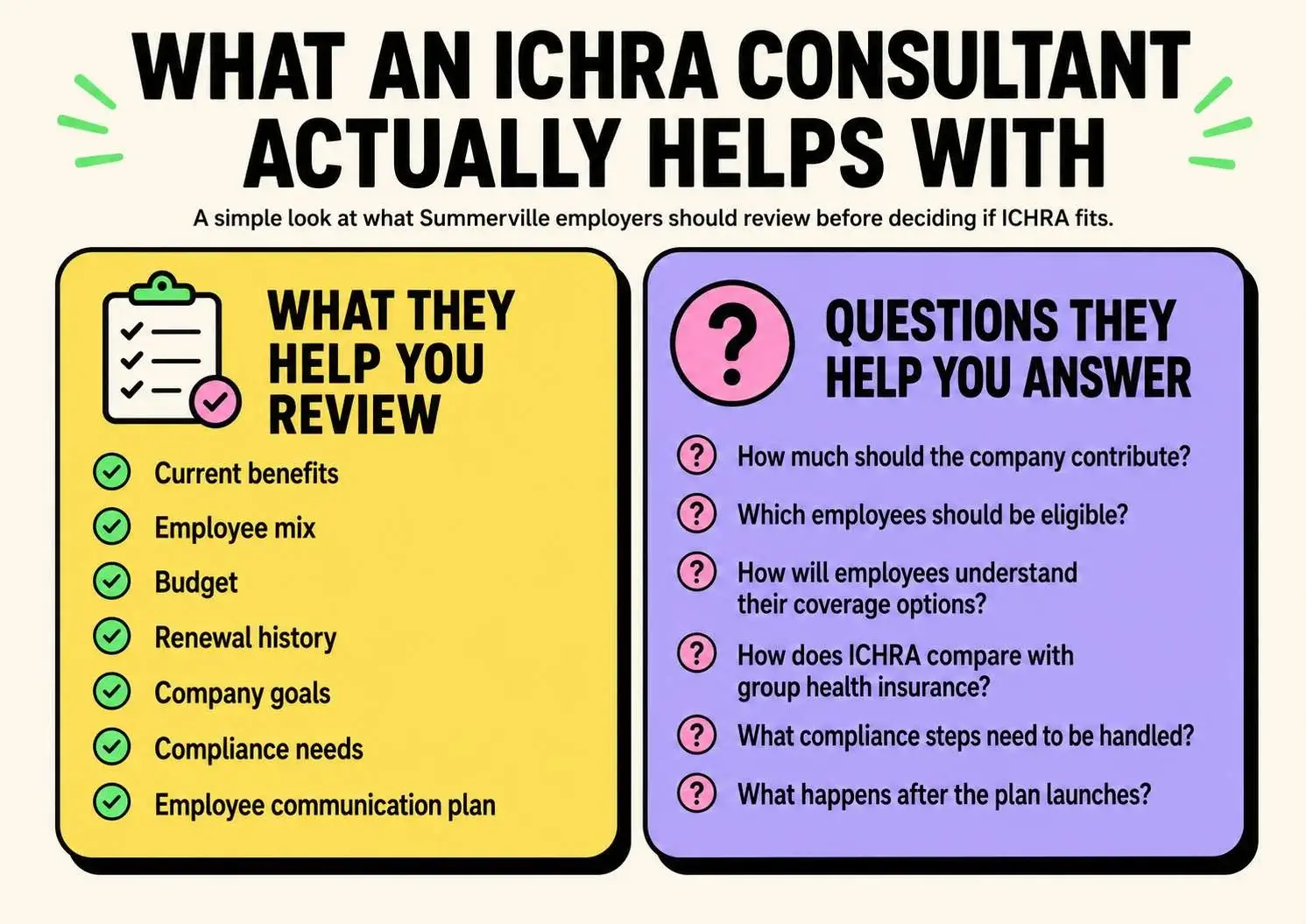
A consultant can help you review your:
- Current benefits
- Employee mix
- Budget
- Renewal history
- Company goals
- Compliance needs
- Employee communication plan
From there, they can help answer practical questions like:
- How much should the company contribute?
- Which employees should be eligible?
- How will employees understand their coverage options?
- How does ICHRA compare with group health insurance?
- What compliance steps need to be handled?
- What happens after the plan launches?
This is where many employers need support. ICHRA has flexibility, but flexibility can create confusion if the plan is not designed carefully.
Comparing ICHRA With Group Health Options
ICHRA is not automatically better than group health insurance. For some employers, it can make benefits spending more predictable and give employees more choice. For others, a traditional group health plan may still be easier to manage and explain. A consultant helps you compare both paths side by side.
That comparison should include:
- Premium costs
- Employee needs
- Plan availability
- Participation
- Tax considerations
- Compliance steps
- Employee support during enrollment
If your team is used to one group plan, switching to an ICHRA may require clear communication and extra education. The right question is not, “Is ICHRA popular?” The better question is, “Does ICHRA fit how our business actually works?”
Explaining Employee Classes, Notices, and Premium Tax Credits
ICHRA decisions can affect more than the monthly benefits budget.
Employers also need to think about:
- Employee classes
- Required notices
- Affordability
- Premium tax credits
- Employee communication
- Benefits administration technology
HealthCare.gov explains that employers can decide how much to contribute to an individual coverage HRA, with no annual minimum or maximum contribution requirement. It also notes that an ICHRA offer can affect whether employees may qualify for premium tax credits through the Marketplace. That is why setup matters.
If employees do not understand how the offer works, they may feel confused during enrollment. If the employer does not understand the rules, the plan can create problems later. A consultant helps make these details easier to explain before employees start asking questions.
When Hiring a Consultant Makes the Most Sense
Hiring a consultant makes the most sense when the decision is not obvious. For example, your company may be facing a renewal increase and wondering if there is a better way to offer health benefits.
You may also have employees with very different coverage needs. Some may want richer coverage. Others may prefer lower premiums.
Your workforce may include:
- Full-time employees
- Part-time employees
- Seasonal workers
- Remote employees
- Employees with different family coverage needs
A consultant can help sort through those moving parts. If your company is comparing ICHRA with traditional group health coverage, GetBenni’s Summerville benefits support can help you review the options with local employer needs in mind.
The value is not only in choosing a plan. It is in making sure the plan fits your people, budget, and long-term benefits goals.
When ICHRA May Not Be the Right Fit
A strong consultant should also tell you when ICHRA may not be the best choice. ICHRA can be a good option for many employers, but it is not the right fit for every company. Employers that want one traditional group health plan may find it easier to explain, manage, and communicate to their team.
Teams that prefer a guided benefits experience may not feel comfortable asking employees to shop for individual coverage on their own. Employees who are unfamiliar with individual plans may need extra support when comparing costs, provider networks, coverage details, and plan options.
In other cases, the numbers may not be as strong once you look at:
- Affordability
- Plan options
- Employee needs
- Communication work
- Compliance requirements
That kind of honest review matters. If an agency only tells you the upside, you are not getting the full picture. A good consultant should help you understand both the benefits and the tradeoffs before you make a change.
Questions to Ask Before Choosing a Summerville ICHRA Consultant
Before hiring an ICHRA consultant, ask practical questions. You do not need a complicated sales pitch. You need clear answers.
Good questions include:
- How do you compare ICHRA with group health insurance?
- How do you help decide contribution amounts?
- What employee education support is included?
- How do you handle notices and compliance steps?
- Will you help review the plan after launch?
- How do you explain ICHRA to employees in simple terms?
These questions help you see whether the consultant is focused on your actual business needs. You want someone who can explain the plan clearly, not someone who hides behind insurance language. If you walk away more confused than when you started, that is a sign to slow down.
A Smarter Way to Review Your Benefits Options
Choosing an ICHRA should not start with a product. It should start with your people, your budget, and the kind of support your team actually needs.
For some Summerville employers, ICHRA can create more control over monthly benefits spending while giving employees more choice. For others, a traditional group health plan, voluntary benefits, or a different funding strategy may still make more sense. The best next step is to compare the options side by side.
Look at your:
- Current renewal
- Employee mix
- Contribution goals
- Compliance needs
- Employee communication needs
- Enrollment support needs
Benni can help you review those pieces without making the decision feel rushed. The goal is simple: understand whether ICHRA fits your business before you commit to a new benefits structure. A short benefits review can help you see whether ICHRA is worth exploring or whether another option is a better fit.