Your renewal rates went up, employees still have questions, and HR is spending too much time fixing benefits problems. What should a Summerville employee benefits agency be doing to help?
A good agency should support more than the annual renewal. It should help your company compare plans, manage costs, educate employees, handle enrollment, reduce administrative work, and solve problems throughout the year. This guide is for Summerville business owners and HR leaders who want to understand what good agency support looks like and where their current benefits process may be falling short.
Key Takeaways
- An employee benefits agency should help with plan decisions, enrollment, employee communication, administration, and year-round issues.
- Employers should compare total cost, not only premiums. Contributions, deductibles, networks, prescriptions, and HR workload all matter.
- A capable agency should explain group health, level-funded plans, ICHRA, and voluntary benefits without pushing the same answer for every company.
- Benefits technology should reduce duplicate work and recurring errors. A portal alone does not fix a broken process.
- Summerville employers may recruit and support employees across the Charleston region, making workforce location and provider access important parts of plan selection.
What Should an Employee Benefits Agency Actually Handle?
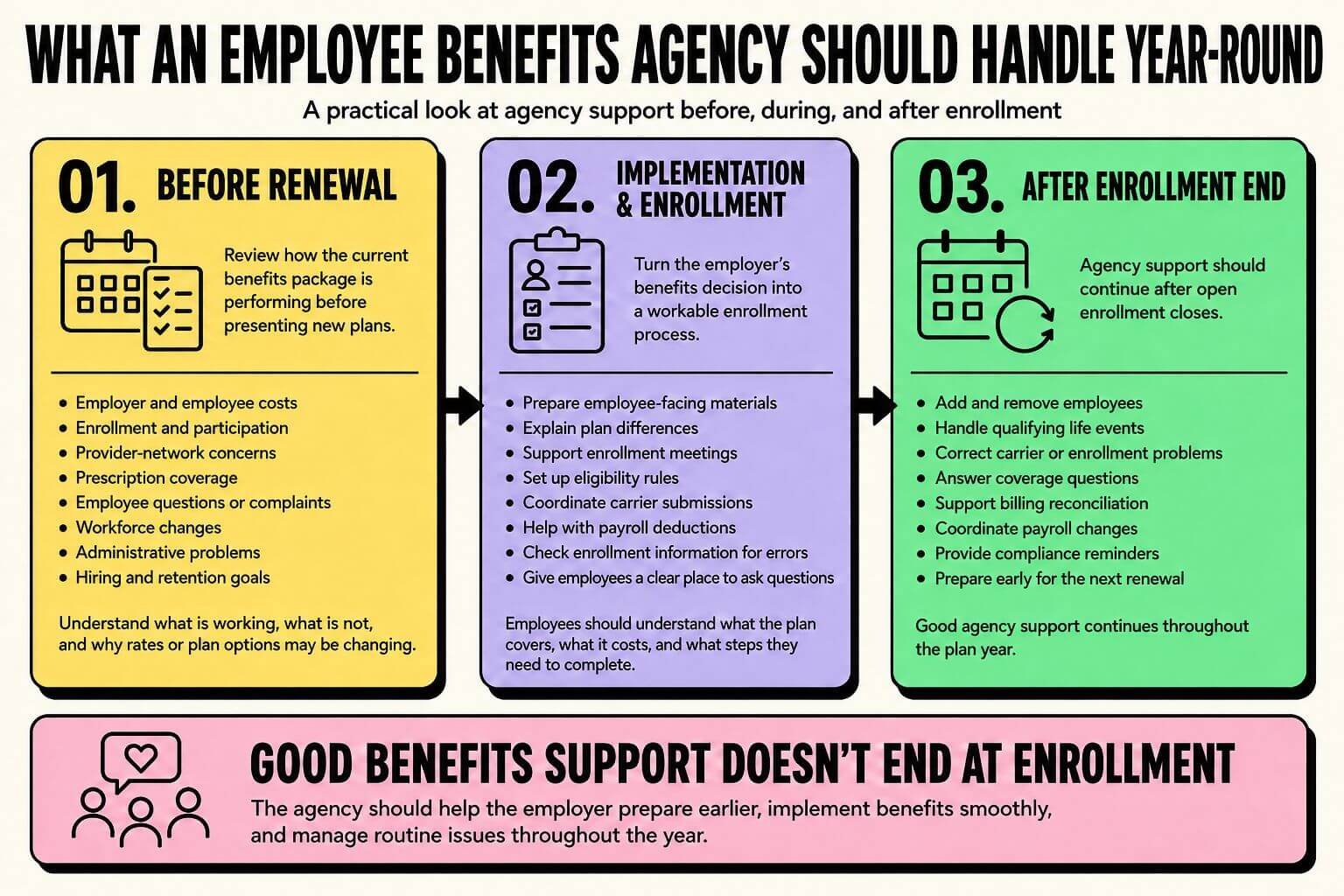
An employee benefits agency should bring structure to the full benefits process. That starts well before renewal and continues long after employees make their elections.
Some employers receive a spreadsheet of rates once a year, select a plan, and hear very little from their agency until the next renewal. That leaves the employer responsible for employee questions, carrier problems, payroll corrections, and administrative changes. A stronger agency relationship should make those tasks easier to manage.
Before Renewal and Enrollment
Before presenting new plans, the agency should learn how the current benefits package is performing. That includes reviewing:
- Current employer and employee costs
- Enrollment and participation
- Provider-network concerns
- Prescription coverage
- Employee questions or complaints
- Workforce changes
- Administrative problems
- The company’s hiring and retention goals
The agency should also explain why rates changed and what options are available. Simply replacing one plan with a similar plan at a different price does not give the employer much direction. Good planning may include changing contribution levels, comparing funding models, adjusting plan choices, or improving benefits employees are not using or understanding.
During Implementation and Enrollment
Once the employer makes a decision, the agency should help turn that decision into a workable enrollment process. That may include:
- Preparing employee-facing materials
- Explaining plan differences
- Supporting enrollment meetings
- Setting up eligibility rules
- Coordinating carrier submissions
- Helping with payroll deductions
- Checking enrollment information for errors
- Giving employees a clear place to ask questions
This part of the process matters because even a well-designed plan can create frustration when employees do not understand it. Employees need to know what the plan covers, what it costs, which providers they can use, and what steps they need to complete. HR should not have to answer every technical question alone.
After Enrollment Ends
The agency’s work should not stop when open enrollment closes.
Employees get hired, leave the company, add family members, lose other coverage, move, and experience qualifying life events throughout the year. Carrier records and payroll deductions also need to remain accurate.
Year-round support may include:
- Adding and removing employees
- Handling qualifying life events
- Correcting carrier or enrollment problems
- Answering coverage questions
- Supporting billing reconciliation
- Coordinating payroll changes
- Providing compliance reminders
- Preparing early for the next renewal
This is where employers see the difference between an agency that sells plans and one that supports the benefits program.
What Should Employers Compare Besides Premiums?
Premiums matter, but the lowest-priced plan is not always the least expensive choice for the company or its employees. A lower premium can come with a narrower provider network, higher deductibles, larger prescription costs, or more out-of-pocket exposure. Employees may save money from each paycheck but pay much more when they use the plan. Employers should look at the full picture:
- Employer contribution
- Employee payroll deduction
- Deductible
- Copays and coinsurance
- Out-of-pocket maximum
- Provider network
- Prescription coverage
- Participation requirements
- Administrative workload
- Employee understanding
A plan may look affordable on the renewal spreadsheet and still create problems once employees begin using it.
Employer Cost and Employee Cost Are Not the Same
Employers and employees experience plan costs differently. The employer may focus on the monthly premium and contribution amount. Employees are more likely to notice paycheck deductions, office visit costs, prescriptions, deductibles, and unexpected bills. For example, moving to a lower-premium plan may reduce the employer’s annual expense. But if the deductible rises sharply, employees who need regular care may view the change as a reduction in benefits. An agency should explain both sides of that decision. It should also help the employer decide how much cost the business can carry and how much employees can reasonably absorb.
Networks, Prescriptions, and Plan Use Matter
A health plan only works well when employees can use it. Provider-network fit may be especially important when employees live across Dorchester, Berkeley, and Charleston counties. A plan that works for employees near one office may offer weaker access for someone living or receiving care elsewhere. Prescription coverage also deserves attention. Two plans with similar premiums may place the same medication on different tiers or apply different approval rules. An agency should help employers look past the plan summary and ask practical questions:
- Are employees’ current doctors in the network?
- Are commonly used medications covered?
- Will employees need referrals?
- How much will regular care cost?
- Can employees understand the differences between their choices?
These details often shape how employees feel about the benefits package.
Which Benefits Models Should an Agency Be Able to Explain?
Employers should not be pushed toward one benefits model before the agency understands the workforce, budget, and business goals. A knowledgeable agency should be able to explain several approaches, including their costs, limits, and administrative requirements.
Traditional Group Health Coverage
Traditional group health coverage remains a good fit for many employers. The company selects one or more group plans, contributes toward employee premiums, and gives eligible employees a shared set of options. This model can feel familiar and may be easier for employees who prefer guided plan choices. The employer still needs to evaluate participation, contribution levels, provider networks, renewals, and employee affordability. South Carolina’s small-group health insurance market generally includes employers with 2 to 50 employees. Eligibility and plan availability should be confirmed using current carrier and regulatory information.
Level-Funded Plans
A level-funded plan combines parts of fully insured and self-funded coverage. The employer usually pays a fixed monthly amount covering estimated claims, administrative costs, and stop-loss protection. Depending on the arrangement and claims performance, there may be an opportunity for a refund or credit. These plans can provide more cost information than some traditional options, but they are not right for every group. Underwriting, employee health risk, contract terms, claims exposure, and renewal calculations need careful review. An agency should explain the possible savings and the risks rather than presenting level funding as an automatic upgrade.
ICHRA
An Individual Coverage Health Reimbursement Arrangement allows an employer to provide a defined reimbursement amount for qualifying individual health insurance. Instead of enrolling everyone in the same group plan, eligible employees select individual coverage that fits their own needs. This can be useful when employees live in different areas or when the employer wants greater control over its contribution. ICHRA also brings plan-design, notice, documentation, affordability, and administration requirements. Employees may need support comparing individual plans. Employers considering this option can learn more in Benni Agency’s guide to ICHRA for small businesses.
Voluntary and Supplemental Benefits
Voluntary benefits can help employees manage costs that major medical insurance does not fully cover. Options may include:
- Dental
- Vision
- Life insurance
- Disability insurance
- Accident coverage
- Critical illness coverage
- Hospital indemnity
- Other supplemental health benefits
These plans should be chosen based on real employee needs, not added simply to create a longer benefits list. A company with a high-deductible medical plan may find accident or hospital coverage helpful. Another workforce may place more value on disability, life, dental, or vision coverage. The right voluntary benefits mix should strengthen the main benefits strategy without making enrollment harder to understand.
How Benefits Technology Should Reduce HR Work
Benefits technology should remove work from HR, not create another system to manage. A useful setup can help with:
- Employee onboarding
- Digital enrollment
- Eligibility tracking
- Payroll deductions
- Employee self-service
- Carrier submissions
- Reporting
- Life-event changes
- Document collection
The practical test is simple: What work no longer has to be done manually? If HR still enters the same employee information into payroll, carrier, and benefits systems, the process is not fully connected. If deduction errors keep returning, the technology has not solved the underlying problem.
A company may manage benefits through spreadsheets when it has 15 employees. That process often becomes harder to control as the company grows, opens another location, or hires employees with different eligibility dates. A proper benefits administration system should reduce repeated data entry, make employee changes easier to track, and give the employer a more reliable record of elections and eligibility.
A Portal Alone Does Not Fix the Process
A modern-looking portal can still sit on top of a manual process. Employers should ask:
- Does employee information flow to payroll?
- Who sends eligibility changes to carriers?
- How are deduction differences identified?
- Can employees update information without emailing HR?
- Who helps when the system and carrier records do not match?
- What reporting can the employer access?
Technology works best when the agency, employer, payroll provider, carriers, and employees have clear responsibilities. Without that coordination, the portal may only move the same administrative work to a different screen.
Why Local Context Matters for Summerville Employers
Summerville continues to grow. The U.S. Census Bureau estimated the town’s population at 53,177 in July 2025, about 4.6% higher than its April 2020 population-estimate base. That growth can affect where companies recruit, where employees live, and how benefits need to support a changing workforce. An agency supporting Summerville businesses should understand that employees may live, commute, and receive care across Dorchester, Berkeley, and Charleston counties.
That matters when comparing provider networks. It may also affect employee communication, enrollment support, and the types of plans that make sense for a workforce spread across several communities. Local knowledge should not replace careful analysis. An agency still needs to understand costs, plan contracts, administration, carrier rules, and the employer’s goals. The real value comes from combining benefits experience with an understanding of how local companies hire and operate.
Signs Your Agency Relationship May Be Too Reactive
A difficult renewal does not automatically mean you need to change agencies. But repeated service problems may show that the current relationship needs a closer review. Watch for signs such as:
- Renewal discussions begin too close to the deadline.
- Rate increases are presented without a clear explanation.
- The same plans are shown each year without reviewing alternatives.
- Employees do not know whom to contact for help.
- HR handles most carrier and eligibility problems.
- Enrollment or payroll errors keep returning.
- The agency becomes difficult to reach after enrollment.
- Benefits have not changed even though the workforce has.
- Technology adds more steps instead of removing them.
- The employer cannot clearly explain what services are included.
One problem may be fixable. A pattern of the same problems is more concerning. The agency should be helping the employer prepare earlier, understand the available choices, and keep routine issues from becoming an ongoing HR burden.
Is Your Benefits Agency Solving the Right Problems?
A difficult renewal does not always mean your company needs to replace every benefit or change carriers. The real problem may be an outdated contribution strategy, poor employee communication, limited plan choices, recurring enrollment errors, or a service team that only becomes involved once a year. Start with a few practical questions:
- Are rate increases explained clearly?
- Do employees know where to get help?
- Is HR still correcting eligibility or payroll issues manually?
- Does the current plan reflect changes in your workforce?
- Are you reviewing more than one funding or coverage model?
- Does the agency stay involved after enrollment?
A benefits review can help separate plan problems from process problems. It can also show whether the agency is providing the support your company needs throughout the year. Benni Agency works with employers that want a clearer view of their benefits costs, choices, and administrative process. A second review can provide useful answers even when you decide to keep the current plan or agency.