Manufacturers need benefits that work for people on the plant floor, in the warehouse, on different shifts, and in the office. The strongest packages usually combine health insurance, income protection, retirement benefits, paid time off, and employee-paid options that give workers more choice.
The right mix depends on your workforce, budget, locations, and hiring needs. This guide is for manufacturing employers and HR teams deciding which benefits deserve priority and where their current package may have gaps.
Key Takeaways
- Health insurance should remain a core benefit, but employers should compare employee costs, provider access, and plan structure before renewing the same plan.
- Disability and life insurance provide financial protection when an employee cannot work or a family loses income.
- Retirement benefits, PTO, and employee support matter when manufacturers are competing for experienced workers.
- Voluntary benefits give employees more choice without requiring the employer to fund every option completely.
- Benefits need to work across shifts, which makes enrollment, communication, and easy access part of the benefits decision.
What Makes a Good Benefits Package for Manufacturing Employees?
A manufacturing workforce rarely has one set of needs. You may have machine operators working overnight, maintenance employees moving between facilities, supervisors on longer shifts, office employees working standard hours, and experienced technicians you cannot easily replace.
That makes benefit selection less about offering the longest list and more about choosing coverage employees can afford, understand, and use. Before adding a new benefit, look at who works for you. Consider employee ages, family needs, hourly versus salaried roles, shift schedules, turnover, recruiting problems, and what employees already use. Those details should guide the package.
1. Health Insurance
For many employees, health insurance is one of the first benefits they look at when comparing jobs. Manufacturers should review more than the monthly premium. A plan that appears affordable to the company may still be difficult for employees to use if deductibles, family contributions, or out-of-pocket costs are too high. Look at:
- Employee and family premiums
- Deductibles and copays
- Provider networks
- Prescription coverage
- Out-of-pocket maximums
- Access near employee locations
- Employer contribution levels
Employers comparing health coverage options Core Health & Wellness should consider how the plan works for the whole workforce, not just whether the renewal price fits the budget.
Choosing the Right Health Plan Structure
Traditional group health insurance is not the only way an employer can provide medical benefits. Depending on company size, workforce location, budget, and employee needs, an employer may also consider arrangements such as an Individual Coverage Health Reimbursement Arrangement, or ICHRA.
Under an ICHRA, eligible employees purchase individual health coverage and the employer reimburses qualified expenses according to the plan rules. Manufacturers comparing ICHRA and group health should look at employee choice, employer contributions, locations, administration, and how each option fits the workforce before choosing a direction.
2. Dental and Vision Coverage
Dental and vision plans are familiar benefits that can strengthen a medical package without adding much complexity for employees. Dental insurance may help with preventive care, fillings, crowns, and other covered services. Vision coverage can help with eye exams, glasses, contacts, and related care based on the plan.
The details still matter. Check waiting periods, provider networks, annual maximums, employee contributions, and what the plan actually covers. A low-cost benefit is not especially useful if employees have difficulty finding an in-network provider near home or work.
3. Short-Term and Long-Term Disability Insurance
If an employee cannot work because of a covered illness or injury, losing a paycheck can quickly become a bigger concern than the medical bill itself.
Short-term disability insurance generally replaces part of an employee’s income for a limited period after a qualifying condition.
Long-term disability insurance is designed for longer periods of disability, subject to the policy’s waiting period, benefit amount, exclusions, and other terms.
South Carolina provides a useful example of why employers should take income protection seriously. The U.S. Bureau of Labor Statistics reported a total recordable workplace injury and illness rate of 2.0 cases per 100 full-time workers in manufacturing in 2024. That statistic does not mean disability insurance is only for injuries that happen at work. Disability policies can cover qualifying conditions outside the workplace too. Workers’ compensation and disability insurance also serve different purposes. When reviewing disability coverage, employers should check the waiting period, benefit duration, percentage of income replaced, eligibility requirements, and how premiums are paid.
4. Life Insurance and AD&D
Life insurance provides a benefit to an employee’s beneficiary when the insured employee dies and the policy requirements are met. Manufacturers may offer a basic employer-paid amount, voluntary supplemental coverage, or both. Some plans also allow employees to purchase coverage for spouses or dependents.
Accidental death and dismemberment insurance, commonly called AD&D, can provide additional benefits for certain covered accidental deaths or serious injuries. The key is keeping the options easy to understand. Employees should know:
- How much coverage they receive
- Whether the company pays the premium
- What optional coverage they can purchase
- Whether medical questions apply at higher amounts
- How to name or update beneficiaries
A basic life benefit can be straightforward, but employees still need clear enrollment information.
5. Accident, Critical Illness, and Hospital Indemnity Benefits
Medical insurance can still leave employees responsible for deductibles, copays, travel expenses, household bills, and other costs. Supplemental health benefits can help with some of those expenses when a covered event occurs. Common options include:
- Accident insurance
- Critical illness insurance
- Hospital indemnity insurance
These plans usually pay benefits based on their policy terms rather than replacing major medical insurance. That distinction should be clear during enrollment. A manufacturing employee may see value in accident coverage, while another worker may care more about critical illness protection. Employers do not have to assume everyone wants the same option. Employee education matters here because supplemental coverage can be difficult to judge from the plan name alone.
6. Retirement Benefits
Health insurance solves an immediate need. Retirement benefits address a much longer one. A 401(k) or similar retirement plan can give employees a structured way to save through payroll deductions. Employers may also choose to provide matching or other contributions based on the plan design. For manufacturers trying to keep skilled technicians, supervisors, engineers, and experienced operators, retirement benefits can become part of the employee’s reason to stay. Employers should review:
- Employee eligibility
- Employer contributions or matches
- Vesting rules
- Investment education
- Participation levels
- Plan fees
Do not assume employees understand the value automatically. A retirement plan may be available for years while some workers still do not know how the match works or how much they need to contribute to receive it.
7. Paid Time Off and Scheduling Support
Manufacturing employers cannot always offer the same flexibility as companies where employees can work from home. That does not make flexibility irrelevant. Paid time off, sick leave, predictable scheduling, and reasonable shift-change policies can make a noticeable difference to employees balancing work with family responsibilities, appointments, and unexpected problems. Options will vary by operation, but employers can review:
- Vacation or PTO policies
- Sick leave
- Advance scheduling
- Shift-swap procedures
- Personal days
- Leave policies
The goal is not to promise scheduling freedom the operation cannot support. A better question is: Where can you give employees useful flexibility without creating staffing problems on the floor? That answer will look different for a 24-hour facility than for a single-shift manufacturer.
8. Telehealth, Mental Health, and Employee Support
A worker on second or third shift may find it difficult to schedule routine care during normal office hours. Telehealth can give employees another way to access certain medical services without leaving work early or spending additional time traveling to an appointment. Mental health support can also be part of the package through health-plan benefits, virtual counseling, or an employee assistance program. These services may help employees access:
- Routine virtual medical visits
- Mental health counseling
- Behavioral health support
- Employee assistance resources
- Help with personal or family concerns, depending on the program
Check how the service actually works before promoting it. Availability, provider networks, covered services, costs, and operating hours can differ. Employees need to know where to go and what they will pay before the benefit becomes useful.
9. Voluntary Benefits Employees Can Choose
Not every benefit has to be fully employer-paid. Voluntary benefits can let employees purchase additional coverage through the workplace, often through payroll deductions. The options offered will depend on the carrier and employer. Beyond supplemental health coverage, choices may include:
- Supplemental life insurance
- Legal benefits
- Pet insurance
- Additional disability options
- Other specialty benefits
The advantage is choice. A 25-year-old employee, a parent with young children, and an employee approaching retirement may have very different priorities. Giving every employee the exact same extras may not make sense. Employers considering voluntary benefit options should focus on gaps employees actually have rather than filling the enrollment menu with plans that receive little attention.
How to Make Benefits Work Across Shifts and Locations
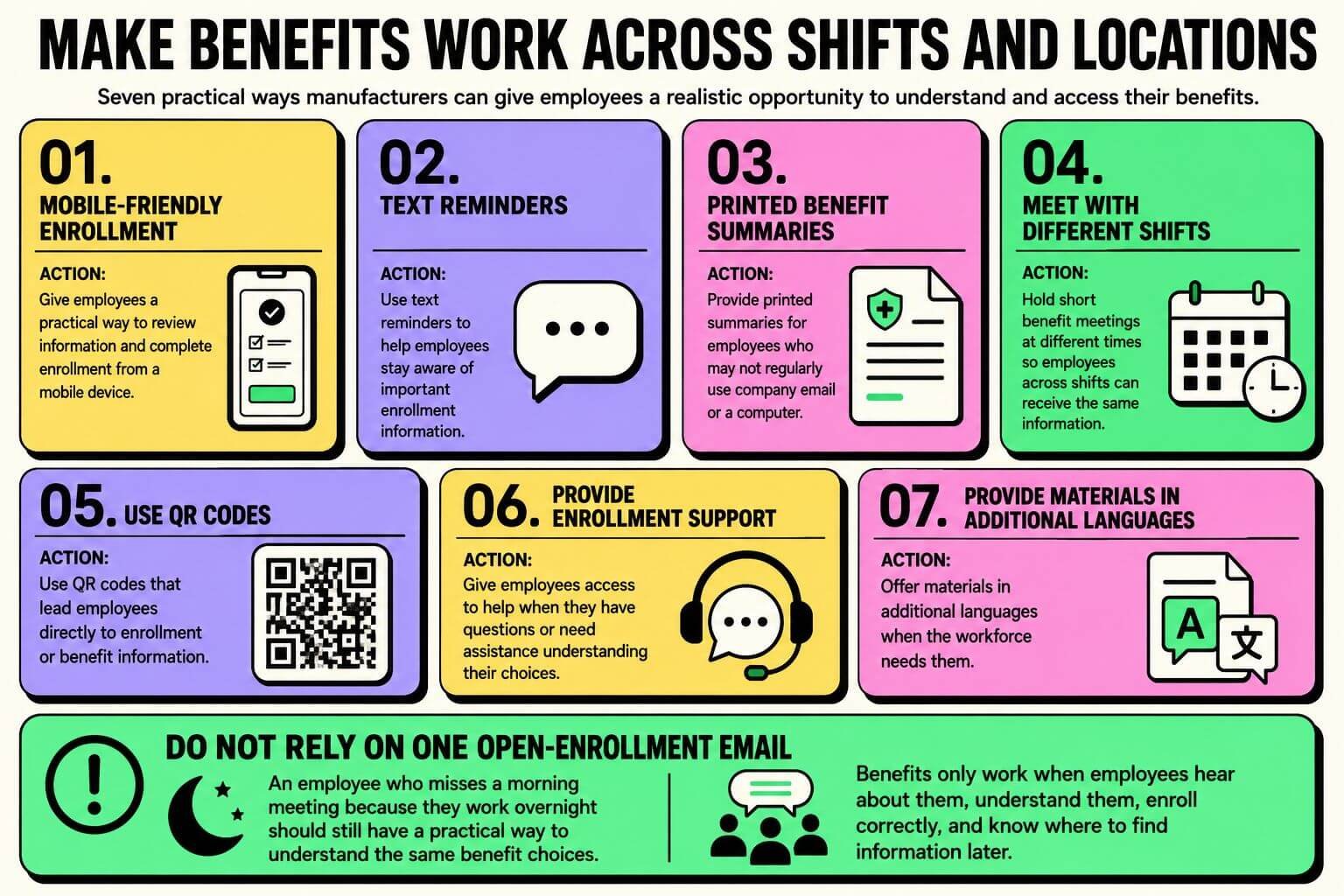
Choosing good benefits is only half the job. Employees also have to hear about them, understand them, enroll correctly, and know where to find information later. That can be harder in manufacturing because many workers do not sit in front of a computer all day. Some may rarely check company email. A stronger communication plan can include:
- Mobile-friendly enrollment
- Text reminders
- Printed benefit summaries
- Short meetings for different shifts
- QR codes that lead to enrollment or plan information
- Employee support during enrollment
- Materials in additional languages when the workforce needs them
Do not expect one open-enrollment email to do all the work. An employee who misses a morning meeting because they work overnight should still have a practical way to understand the same choices.
Use Benefits Technology Where It Solves a Real Problem
Benefits technology is useful when it removes work for HR or makes benefits easier for employees to access. For example, employers may use benefits administration tools for online enrollment, employee self-service, reporting, payroll connections, and benefits information. Benni Agency’s current administration service includes these types of functions.
Technology should solve a clear problem. If HR is entering the same employee information into several systems, employees cannot find plan documents, or eligibility changes are being tracked manually, the administration process deserves attention. A new platform alone will not fix poor communication. The system and the enrollment process still need to make sense to employees.
How Manufacturers Should Evaluate Their Benefits Package
Do not judge the package only by how many benefits appear on the enrollment screen. Look at what is happening inside your workforce. Start with questions such as:
- Which benefits have strong participation?
- Which benefits receive very little interest?
- What are employees paying?
- What benefit questions does HR hear repeatedly?
- Are employees missing enrollment deadlines?
- Has turnover increased in certain roles or shifts?
- Are recruiting candidates asking about benefits you do not offer?
- Have your workforce size or locations changed?
- Is benefits administration taking too much HR time?
Employee feedback can also help. A short benefits survey may reveal that employees want better medical affordability, more income protection, retirement help, easier enrollment, or something different from what management expected. The answer is not always adding another policy. Sometimes a better plan design, clearer communication, or a simpler enrollment process can improve what you already offer.
Is Your Manufacturing Benefits Package Still Competitive?
A benefits package does not need more plans simply because another manufacturer offers them. It needs to fit the people you are trying to hire and keep. Review participation, employee contributions, turnover, enrollment questions, and which benefits employees actually use. Check whether shift workers can access and understand their options. Look at whether your medical plan, income protection, retirement benefits, PTO, and voluntary choices still make sense for your workforce and budget.
Repeated employee confusion, low participation, rising costs, or gaps raised during recruiting are good reasons to review the package. Benni Agency can help employers compare plan choices, administration, costs, and employee communication when another perspective would help.