A health plan may cover part of an employee’s treatment after an injury, but deductibles and other expenses can still add up. Accident insurance may provide a separate benefit after a covered accidental injury, based on the terms of the policy.
For Charleston employers, the main questions are how claims work, what the policy may pay, and whether the coverage fits beside existing employee benefits. This article is for business owners and HR teams who want to understand the process, compare plan details, and explain the coverage clearly to employees.
Key Takeaways
- Accident insurance works beside health insurance. It does not replace major medical coverage.
- Employees submit a claim after receiving treatment. The carrier reviews the injury and services under the policy terms.
- Payments may not match the medical bill. Many plans use fixed benefits for covered injuries or treatments.
- The insured employee may receive the payment directly. The exact payment process depends on the policy.
- Employers should compare more than premiums. Exclusions, claims support, dependent coverage, and employee communication matter too.
What Accident Insurance Is and What It Does
Accident insurance is a type of supplemental coverage that may pay a defined benefit after an insured person experiences a covered accidental injury. It works separately from the employee’s health insurance. The health plan handles eligible medical expenses according to its deductible, copays, coinsurance, and network rules. Accident insurance reviews the injury and treatment under its own policy. For example, a policy may list separate benefits for:
- An ambulance ride
- Emergency room treatment
- An X-ray
- A fracture
- Physical therapy
- Follow-up medical visits
The payment is based on the policy’s benefit schedule, not simply on the amount left unpaid by the medical plan. That difference matters. Employees should not assume accident insurance will reimburse every bill or eliminate every out-of-pocket expense.
How Accident Insurance Works Step by Step
The exact process depends on the carrier, but most employer-sponsored accident plans follow a similar path.
Enrollment and Premium Payments
Employees first need to enroll in the coverage. Enrollment may happen when the plan is first introduced, during an annual enrollment period, or after an eligible life event. Employers can structure the premium in several ways:
- The employer pays the full premium.
- The employee pays through payroll deductions.
- The employer and employee share the cost.
- The employer provides a base benefit and employees pay for added coverage.
Some plans may allow employees to add a spouse or eligible children. The carrier’s eligibility rules determine who can enroll and when coverage begins. Before enrollment, employees should receive a clear explanation of the cost, covered events, exclusions, and claim process.
What Happens After a Covered Accident
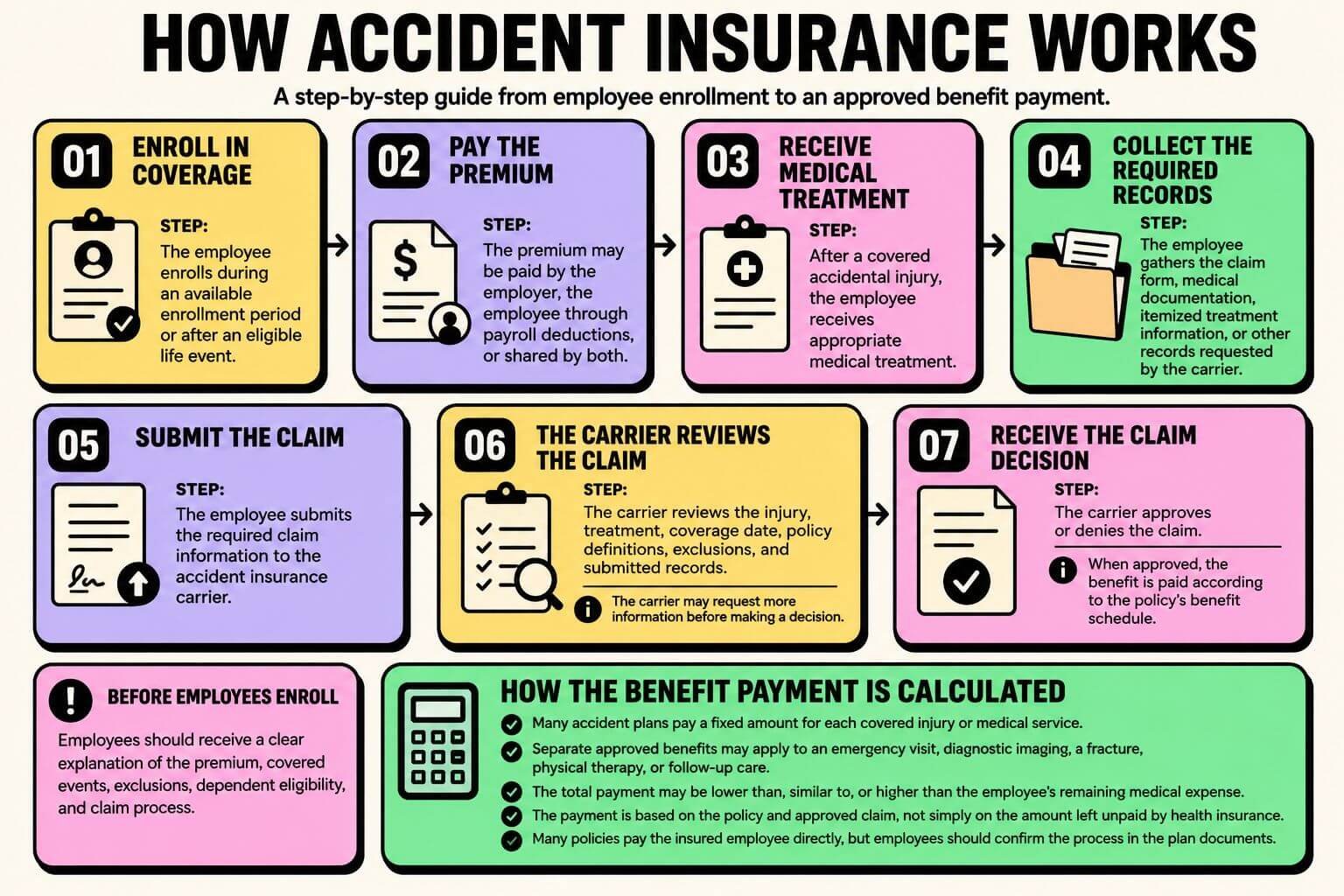
Consider an employee who falls at home and hurts their wrist. They visit an urgent care center, receive an X-ray, and learn that the wrist is fractured. The accident insurance process may include these steps:
- The employee receives medical treatment.
- The employee collects the required records or treatment information.
- A claim is submitted to the accident insurance carrier.
- The carrier reviews the injury, services, coverage date, and policy terms.
- The carrier requests more information if needed.
- The carrier approves or denies the claim.
- An approved benefit is paid according to the policy.
The employee may need to submit a claim form, medical documentation, itemized treatment information, or other records requested by the carrier. Receiving treatment does not automatically guarantee payment. The injury and treatment must meet the policy’s definitions and claim requirements.
How Benefit Payments Are Calculated
Many accident plans pay a fixed amount for each covered injury or service. A policy might have one benefit for an emergency room visit, another for diagnostic imaging, and another for a covered fracture. The approved amounts may be added together when more than one benefit applies. This means the payment can be:
- Lower than the employee’s actual medical bill
- Similar to the employee’s out-of-pocket cost
- Higher than the remaining medical expense
The result depends on the policy, the approved claim, and the treatment received. Many policies send approved payments to the insured employee rather than the medical provider. Employees should confirm the payment process in the plan documents instead of assuming every policy works the same way.
What Accident Insurance May Cover
Accident insurance focuses on accidental injuries, not illnesses or routine medical care. Depending on the policy, covered injuries and services may include:
- Fractures
- Dislocations
- Burns
- Concussions
- Cuts requiring medical treatment
- Eye injuries
- Ambulance transportation
- Emergency room visits
- Urgent care visits
- Diagnostic tests
- Surgery
- Hospital admission after an accident
- Physical therapy
- Follow-up care
A benefit appearing on one carrier’s plan does not mean it will appear on another. Benefit amounts, definitions, exclusions, and treatment requirements can differ considerably. Employers should review the actual policy schedule instead of relying only on a short benefits summary.
What Accident Insurance Does Not Replace
Accident insurance can add another layer of financial support, but it serves a limited purpose. It should not be presented as a substitute for broader coverage.
Major Medical Insurance
Major medical insurance covers a wide range of eligible healthcare needs, including illnesses, preventive care, prescriptions, specialist visits, and treatment after injuries. Accident insurance applies only to events and benefits listed in its policy.
This distinction matters in Charleston County, where U.S. Census Bureau data estimates that 10% of residents under age 65 were without health insurance during the 2020 to 2024 measurement period. Accident insurance cannot solve a lack of comprehensive medical coverage. It only provides defined benefits after qualifying events. An employee with accident coverage but no major medical plan could still face substantial medical bills that the accident benefit does not cover.
Workers’ Compensation and Disability Insurance
Accident insurance is not the same as workers’ compensation. Workers’ compensation applies to eligible job-related injuries and is governed by state requirements. Accident insurance is a separate policy that may cover eligible injuries based on its own terms, including some accidents that happen away from work.
It is not disability insurance either. Disability insurance may replace part of an employee’s income when an illness or injury keeps them from working. Accident insurance commonly pays listed benefits for covered injuries and treatments. It does not automatically replace lost wages for the full recovery period. Accident insurance should not be confused with accidental death and dismemberment coverage. AD&D focuses on death or severe losses caused by eligible accidents, while accident insurance can include benefits for less severe injuries and treatment.
How Accident Insurance Compares With Other Supplemental Benefits
Employers may review accident insurance alongside hospital indemnity and critical illness coverage. These products can work beside health insurance, but each one responds to a different type of event.
Hospital Indemnity Insurance
Hospital indemnity insurance commonly pays a fixed benefit after a covered hospital admission, stay, or service. The trigger is usually the hospital event rather than the accidental cause. An employee could potentially use hospital indemnity coverage after an eligible hospitalization caused by an illness or injury, depending on the policy. Accident insurance is more closely tied to covered accidental injuries and related treatment.
Critical Illness Coverage
Critical illness insurance may pay a lump-sum benefit after an insured person is diagnosed with a condition listed in the policy. Covered conditions may include certain cancers, heart attacks, strokes, or other serious diagnoses. Definitions and eligibility rules vary by plan. The main difference is the event that starts the claim:
- Accident insurance: A covered accidental injury or related treatment
- Hospital indemnity: A covered hospital admission, stay, or service
- Critical illness insurance: A covered medical diagnosis
An employer does not need to assume that one option is automatically better. The right comparison depends on the medical plan, workforce concerns, employee budget, and purpose of the benefit.
When Accident Insurance May Fit a Charleston Workforce
Accident coverage may be worth reviewing when employees are concerned about the costs that can follow an injury. It may be relevant for a company when:
- Employees are enrolled in a high-deductible health plan.
- Workers have limited emergency savings.
- The workforce includes active employees or families with children.
- Employees want access to voluntary benefits through payroll deductions.
- The company wants to add supplemental options without replacing its medical plan.
- Employees regularly ask for help with unexpected out-of-pocket expenses.
Charleston employers span hospitality, construction, healthcare, transportation, retail, professional services, and other industries. Those workforces may have very different priorities. A business reviewing accident coverage can consider its broader Charleston benefits support needs rather than evaluating one policy in isolation. The decision should come back to a practical question: Does this policy address a concern employees actually have, at a cost they understand?
What Employers Should Compare Before Choosing a Plan
Two accident plans can look similar on a one-page summary but differ in ways employees will notice when they file a claim. Employers should compare the following details.
Covered Injuries and Treatments
Review which injuries, medical services, and follow-up treatments appear in the benefit schedule. Check whether the plan includes benefits for:
- Emergency care
- Urgent care
- Ambulance transportation
- Diagnostic imaging
- Fractures and dislocations
- Surgery
- Hospital care
- Rehabilitation
- Follow-up visits
Exclusions and Limitations
Look for situations the policy excludes or limits. Possible areas to review include:
- Injuries that happened before coverage began
- Certain sports or activities
- Self-inflicted injuries
- Injuries connected to illegal activity
- Treatment received outside the required time frame
- Services that lack the required documentation
- State-specific coverage limitations
The policy documents, not the marketing summary, control how claims are handled.
Premium and Payroll Structure
Employers should confirm:
- Who pays the premium
- Whether deductions are pre-tax or after-tax
- How often deductions occur
- Whether employees can change coverage
- What happens when an employee takes unpaid leave
- Whether coverage can continue after employment ends
Tax treatment can depend on how the premium is paid and how the plan is structured. Employers should obtain guidance based on their specific arrangement rather than relying on a general rule.
Dependent Coverage
Some plans allow employees to cover a spouse or eligible children. Review:
- Dependent age limits
- Enrollment deadlines
- Premium differences
- Benefit amounts
- Coverage termination rules
- Documentation requirements
Claims and Employee Support
A low premium is less useful when employees cannot understand or complete the claims process. Ask the carrier or broker:
- How are claims submitted?
- Can employees file claims online?
- What records are usually required?
- How are claim decisions communicated?
- Who helps employees with missing information?
- How long do employees have to file?
- Are claim forms available in clear language?
Enrollment Communication
Employees should know that accident insurance is limited coverage. Enrollment materials should explain:
- What the plan may pay
- What it does not cover
- How it differs from health insurance
- How premiums are collected
- How to file a claim
- Where to find the benefit schedule
- Who to contact with questions
A simple example often explains the policy better than a long list of features.
A Simple Accident Insurance Example
Suppose an employee at a Charleston company fractures an ankle while playing a recreational sport on the weekend. The employee visits an emergency room, receives an X-ray, and later attends physical therapy. After treatment, the employee submits the required claim information. The carrier checks whether:
- The coverage was active on the accident date
- The injury meets the policy definition
- The emergency visit and X-ray are listed benefits
- The fracture qualifies under the benefit schedule
- The physical therapy meets the plan requirements
- Any exclusions apply
Once approved, the policy may pay separate scheduled amounts for the eligible services and injury. The payment does not automatically equal the hospital bill, deductible, or total out-of-pocket cost. It is based on the benefits listed in the policy. This is why employees need more than a statement that accident insurance “pays cash.” They need to understand what creates an eligible claim and how the payment is determined.
Reviewing Accident Coverage as Part of Your Benefits Plan
Accident insurance can look simple on a benefits summary, but the details determine how useful the coverage may be for employees. Before adding a plan, employers should compare the covered injuries, treatment benefits, exclusions, dependent options, premium structure, and claims process. It helps to review how the benefit fits beside the company’s medical plan, disability coverage, workers’ compensation program, and other voluntary benefits.
Employee communication matters too. Workers should understand what the policy pays, what it does not cover, and how to submit a claim before they enroll. Benni can help employers review these details and compare accident coverage with the rest of their benefits package. The point is not to add another benefit simply because it is available. The point is to see whether it addresses a real employee need and can be explained clearly. A benefits review can clarify whether accident insurance fits the company’s current plan and workforce priorities.