A difficult renewal, rising employee costs, and a busy HR team can make benefits feel harder to manage each year. A Summerville employee benefits broker can help your business compare plans, control costs, reduce administrative work, and give employees clearer support throughout the year.
The broker’s role should go well beyond collecting quotes before renewal. This article is for Summerville business owners and HR leaders who want to understand what useful broker support looks like and whether their current benefits setup still fits the company.
Key Takeaways
- A broker should help design and manage your benefits plan, not simply collect insurance quotes.
- Good plan comparisons consider premiums, contributions, deductibles, networks, and employee costs.
- Broker support can reduce HR work tied to enrollment, eligibility changes, carrier issues, and employee questions.
- Renewal planning should begin early enough to compare options and explain changes clearly.
- Summerville employers should look for benefits support that can scale as the workforce grows.
What a Benefits Broker Should Do for Your Business
A benefits broker should help you make informed decisions before, during, and after renewal. That starts with understanding your business. A broker needs to know your headcount, hiring plans, employee groups, current costs, payroll process, and the problems your HR team handles each month. Without that information, plan recommendations may not reflect what your company or employees need. Useful broker support may include:
- Comparing medical and supplemental coverage
- Reviewing employer contribution levels
- Preparing renewal cost scenarios
- Helping employees understand their choices
- Coordinating with insurance carriers
- Supporting enrollment and eligibility changes
- Reviewing benefits technology and payroll processes
- Helping the company prepare for future growth
A broker should also explain trade-offs clearly. You may not be able to lower every cost, expand every benefit, and keep employee contributions unchanged at the same time. Good advice helps you decide which priorities matter most.
Build a Plan Around Your Workforce and Budget
The cheapest plan on a rate sheet isn’t always the most affordable choice for your employees. A lower premium may come with a higher deductible, a limited provider network, or larger out-of-pocket costs. Employees may avoid using the plan or decide not to enroll if their share of the cost feels too high. A richer plan may provide stronger coverage but place too much pressure on the company’s budget. A broker should help you review the full picture, including:
- Employer and employee contributions
- Deductibles and copays
- Out-of-pocket limits
- Prescription coverage
- Provider networks
- Family coverage costs
- Expected participation
- Employee income levels and needs
The right balance will be different for every business. A growing construction company may have different needs from a professional office, healthcare practice, or retail employer. A broker can also help determine whether dental and vision coverage, life insurance, disability coverage, or voluntary benefits could fill gaps without placing the full cost on the employer.
Prepare for Renewals Before Decisions Become Urgent
Renewal planning shouldn’t begin when the final rates arrive. Starting earlier gives the broker time to review plan use, contribution levels, employee feedback, carrier options, and possible changes to the plan structure. It also gives the employer time to consider the effect of those changes before presenting them to employees. An early review may include:
- Comparing current and projected costs
- Checking whether employees are using the plan
- Reviewing employee contribution levels
- Identifying coverage or network concerns
- Comparing available carrier options
- Considering changes to deductibles or copays
- Preparing employee communication
There may not always be a simple way to avoid a rate increase. Still, early preparation gives the employer more room to make a measured decision instead of accepting the first available option because enrollment is approaching.
Provide Support Throughout the Year
Benefits work continues long after enrollment closes. Employees get married, have children, lose other coverage, leave the company, or move into new roles. New hires need to understand their options and complete enrollment before the deadline. Carrier bills and payroll deductions may also need corrections. A broker should help your team handle issues such as:
- New-hire enrollment
- Employee terminations
- Qualifying life events
- Eligibility questions
- Missing identification cards
- Incorrect carrier records
- Billing discrepancies
- Coverage changes
- Employee plan questions
This support matters most when one HR employee is already responsible for recruiting, payroll, employee relations, and benefits. Every carrier problem that the broker resolves is one less issue the internal team has to chase.
How a Broker Helps Control Benefits Costs
A broker cannot promise that premiums will fall every year. Healthcare prices, employee claims, carrier pricing, plan design, and market conditions can all affect costs. What a broker can do is help you understand where the money is going and compare realistic ways to manage it. That may involve reviewing:
- The company’s contribution strategy
- Employee contributions
- Deductible and copay options
- Provider networks
- Prescription benefits
- Participation requirements
- Alternative funding arrangements
- Voluntary coverage
- Different medical plan structures
The goal isn’t always to find the lowest rate. It is to create a plan the business can continue funding and employees can reasonably use.
Compare More Than the Monthly Premium
Two plans with similar premiums can produce very different results for employees. One may have a broad provider network but a higher deductible. Another may have lower out-of-pocket costs but fewer local doctors and hospitals. A third may look affordable for employee-only coverage but become expensive when a worker adds a spouse or children. A broker should compare these details in a way that makes the trade-offs easy to see. Ask questions such as:
- Can employees access the providers they already use?
- What will common prescriptions cost?
- How much will employees pay before the plan begins sharing costs?
- Is family coverage affordable?
- Will the employer contribution support reasonable participation?
- Are employees likely to understand the plan?
These questions provide a clearer picture than the monthly premium alone.
Review Different Funding and Coverage Options
Traditional group health insurance may remain the right fit for many employers. Other businesses may benefit from comparing a different structure. An ICHRA approach allows an employer to provide a defined allowance that eligible employees use toward individual health insurance. It may provide more budget control and employee choice, but it also requires careful setup and clear education.
Employers may also consider voluntary benefits such as accident, critical illness, or hospital indemnity coverage. These plans may help employees prepare for expenses that major medical insurance doesn’t fully cover. No single model works for every company. A broker should compare the available approaches based on your workforce, budget, employee preferences, and capacity to manage the program.
How a Broker Reduces HR and Administrative Work
A benefits plan can look good on paper and still create problems every week. Manual enrollment forms, email chains, missed deductions, late terminations, and incorrect carrier records take time away from other HR work. They can also frustrate employees who need coverage or answers. A broker should help create a clear process for:
- Employee onboarding
- Open enrollment
- Eligibility tracking
- Payroll deductions
- Carrier submissions
- Employee communication
- Reporting
- Year-round changes
The broker may not control every carrier or payroll system, but the broker should help coordinate the people and information involved.
Enrollment and Employee Changes
Enrollment errors often happen when responsibilities aren’t clear. An employer may collect the forms, the broker may send information to the carrier, and the payroll team may update deductions. If one step is missed, an employee can end up with the wrong coverage or deduction. A clear enrollment process should identify:
- What the employee must complete
- When the information is due
- Who sends the election to the carrier
- When payroll deductions begin
- How coverage is confirmed
- Where employees should take questions
The same process is needed for new hires, terminations, marriages, births, and loss of other coverage. Good broker support doesn’t remove the employer from the process. It gives the employer a reliable process to follow and someone to help when a problem occurs.
Benefits Technology That Actually Saves Time
Technology should reduce manual work, not add another system for HR to manage. A useful benefits platform may support digital enrollment, eligibility records, employee documents, reporting, and connections with payroll. Employees should be able to review plan information without searching through old emails or asking HR for another copy.
Still, software alone doesn’t solve every problem. Employees may need help comparing plans. Payroll information may not transfer correctly. A carrier may have a different eligibility record from the employer. The best arrangement combines useful technology with responsive human support. Before adding a platform, ask what work it will replace, who will maintain it, and what help is available when the information doesn’t match.
Why Employee Communication Matters
Employees can’t value a benefit they don’t understand. Plan documents often include unfamiliar terms, coverage limits, networks, deductibles, and exclusions. Giving employees a large packet during open enrollment doesn’t guarantee they’ll know how the plan works. A broker can support communication through:
- Enrollment meetings
- Plan comparison guides
- Plain-language summaries
- Individual employee meetings
- Recorded presentations
- Decision-support tools
- Year-round question support
Clear communication helps employees compare their choices based on their own healthcare needs and budgets. It can also reduce repeated questions for HR. This is especially important when the employer introduces a new carrier, changes contributions, adds voluntary coverage, or moves to a different health-benefit structure. Employees need to know what is changing, what action they must take, and where to get help.
Why Local Knowledge Can Help Summerville Employers
Benefits rules and carrier arrangements aren’t limited to one city, but local business conditions still matter. According to the U.S. Census Bureau, Dorchester County’s estimated population reached 178,397 in July 2025, an increase of about 10.6% from the April 2020 estimates base. For employers, continued local growth may bring more hiring, onboarding, and pressure to build benefits processes that can support a larger workforce. A broker familiar with the Summerville area may also understand the hiring concerns faced by local employers and the questions employees commonly raise about medical networks, family coverage, and plan affordability.
Local knowledge shouldn’t replace careful plan analysis or reliable technology. It should add useful context when the employer is deciding how much to contribute, how to communicate the plan, and which coverage options deserve a closer look. Employers can review available Summerville benefits options to see how medical coverage, voluntary benefits, benefits technology, and employee support may fit together.
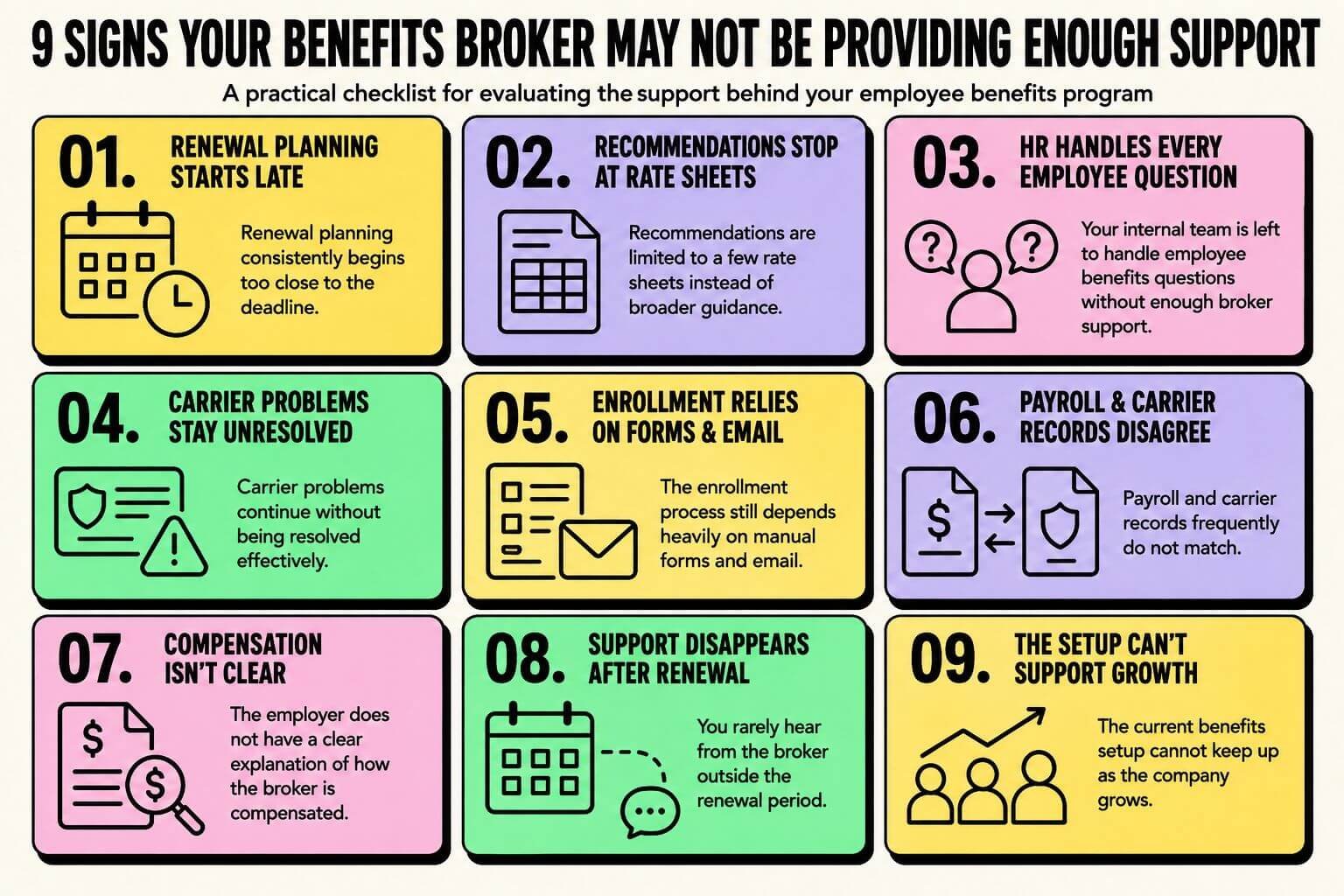
How to Tell Whether Your Broker Is Providing Enough Support
Not every broker relationship needs to change. But recurring problems may show that the current support model is no longer working. Take a closer look when:
- Renewal planning consistently starts late
- Recommendations are limited to a few rate sheets
- Your team handles every employee question alone
- Carrier problems remain unresolved
- Enrollment depends heavily on forms and email
- Payroll and carrier records frequently disagree
- Broker compensation isn’t clearly explained
- You rarely hear from the broker outside renewal
- The current setup can’t support company growth
One isolated issue doesn’t necessarily mean you need a new broker. Look for patterns. Does the broker take ownership when something goes wrong? Are recommendations based on your business, or do they look the same each year? Can the broker explain what is working, what isn’t, and what options you realistically have? Those answers provide a better measure of the relationship than the number of quotes delivered at renewal.
Does Your Current Benefits Setup Still Fit Your Business?
A plan that worked when your company had 12 employees may become difficult to manage at 40 or 80. Your payroll process may have changed. Employees may need different coverage. The person handling benefits may now have several other responsibilities. Review the complete process before assuming the insurance plan is the only problem. Are renewal discussions beginning early enough? Does your team get help with enrollment and employee changes? Can employees receive answers without taking every question to HR? Do you understand how your broker is paid and which services are included?
These questions can show whether the problem is the plan, the administration process, or the level of broker support. Benni Agency can help review the current benefits setup and identify areas that deserve closer attention. The goal isn’t to change plans simply to make a change. It is to make sure the benefits program still fits the way your company operates. A practical benefits review can show what is working, what is creating extra work, and what may need attention before the next renewal.