You’ve opened your benefits renewal and the numbers are higher than expected. So, how much do employee benefits cost in Rock Hill, SC? There is no single price because costs vary based on your workforce, enrollment, coverage levels, plan design, and employer contribution.
This article is for Rock Hill business owners, employers, and HR leaders who want a realistic cost estimate, a clearer budgeting process, and better ways to manage benefits expenses without making rushed coverage decisions
Key Takeaways
- There is no standard Rock Hill benefits price. Each employer receives rates based on its group, coverage choices, and funding arrangement.
- Health insurance is usually the largest benefits expense, but it isn’t the only cost employers should include.
- Total premiums and employer costs are different numbers because employees may pay part of the premium.
- Family enrollment can affect the budget far more than employee-only coverage.
- The cheapest plan may create higher deductibles, narrower networks, or larger employee payroll deductions.
- A useful estimate requires current employee data, enrollment assumptions, and a clear contribution strategy.
How Much Should Rock Hill Employers Expect to Spend?
National data can provide a useful starting point, but it shouldn’t be treated as a Rock Hill quote. The U.S. Bureau of Labor Statistics reported that private-industry employers spent an average of $46.60 per hour on total employee compensation in March 2026. Benefits accounted for $14.01 per hour, or 30.1% of that total. This figure includes paid leave, insurance, retirement contributions, and legally required benefits. It doesn’t refer only to health insurance. For health coverage, KFF reported the following national averages for 2025:
- $9,325 per year for employee-only coverage
- $26,993 per year for family coverage
- Average worker contributions of $1,440 for employee-only coverage
- Average worker contributions of $6,850 for family coverage
These are total annual premiums before separating the portion paid by the employer from the amount deducted from employees’ paychecks. A Rock Hill employer’s actual cost may be higher or lower. The final amount depends on the group’s details and the plans available at the time of quoting.
What Counts as an Employee Benefits Cost?
Employers often use “benefits cost” to mean health insurance premiums. A complete budget includes much more. Your total may include:
- Medical insurance
- Dental and vision coverage
- Life insurance
- Short-term and long-term disability
- Employer HSA or HRA contributions
- Retirement contributions
- Paid leave
- Benefits administration software
- Broker or consulting arrangements, where applicable
- Payroll and enrollment administration
- Legally required benefits and payroll taxes
Some benefits create a direct monthly premium. Others depend on employee pay, usage, contribution elections, or enrollment. Voluntary benefits may require little or no employer premium contribution, but they can still require enrollment support, payroll setup, communication, and ongoing administration.
Total Premium vs. the Employer’s Actual Cost
One of the most common budgeting mistakes is treating the full premium as the amount the employer must pay.
Total premium
The total premium is the complete amount charged by the insurer for coverage. It includes both the employer-paid and employee-paid portions.
Employer contribution
The employer contribution is the amount the company agrees to pay. An employer might pay:
- A fixed dollar amount
- A percentage of employee-only coverage
- A percentage of every coverage tier
- The full employee-only premium but little or none of the dependent premium
Employee contribution
The remaining amount is generally deducted from the employee’s paycheck. Consider a simple example. A plan costs $750 per month for employee-only coverage. If the employer pays 70%, the employer’s monthly cost is $525, and the employee pays $225. The calculation changes if the employee selects family coverage. That is why enrollment by tier matters when forecasting the annual budget.
What Changes the Cost of Employee Benefits?
Two Rock Hill businesses with the same number of employees can receive different prices and end up with very different budgets.
Company size and participation
The number of eligible employees and the number who enroll can affect which plans and funding arrangements are available. Small employers may also need to meet carrier participation rules. These rules can vary, especially when employees have other valid coverage through a spouse, Medicare, or another source.
Workforce information
Depending on the product and market, pricing may be affected by details such as:
- Employee ages
- Home ZIP codes
- Family enrollment
- Full-time eligibility
- Tobacco status where permitted
- Current coverage and claims experience for certain funding arrangements
A quote prepared without accurate employee data is only a rough estimate.
Coverage level
A plan with a low deductible, broad provider network, and lower office visit costs generally costs more than a high-deductible plan with a more limited network. That doesn’t automatically make the lower-premium plan the better option. Employees may pay more when they receive care, fill prescriptions, or use an out-of-network provider.
Employer contribution strategy
The contribution strategy can change the company’s cost even when the insurance rates remain the same. Employers need to decide:
- How much to pay toward employee-only coverage
- Whether to contribute toward dependent coverage
- Whether contributions will be a percentage or fixed amount
- Whether executives and other eligible workers follow the same rules
- How future premium increases will be shared
A small change to dependent contributions can make a large difference when several employees enroll their families.
Funding arrangement
Employers may consider different approaches, including:
- Fully insured group coverage
- Level-funded plans
- Health reimbursement arrangements
- High-deductible plans paired with HSAs
- Voluntary or employee-paid benefits
Each option has different rules, risks, administration requirements, and cost patterns. The right choice depends on more than the monthly rate.
Why Rock Hill’s Regional Labor Market Matters
Benefits are a cost, but they are also part of how local employers compete for workers. Rock Hill sits within the larger Charlotte regional economy. Employers may be recruiting from the same labor pool as companies across York County and the Charlotte-Concord-Gastonia area. The U.S. Bureau of Labor Statistics reported that the Charlotte-Concord-Gastonia metropolitan area had a labor force of about 1.48 million in May 2026. Education and health services employment was up 4% from the previous year, while professional and business services employment grew by 2.6%.
Rock Hill’s estimated population reached 75,911 in 2025, according to the U.S. Census Bureau. These figures don’t determine insurance rates. They do show why employers should think about employee expectations and regional hiring competition when setting contributions and choosing plans. A company that lowers its benefits budget by shifting a large share of the premium to employees may save money on paper but create a harder recruiting or retention problem.
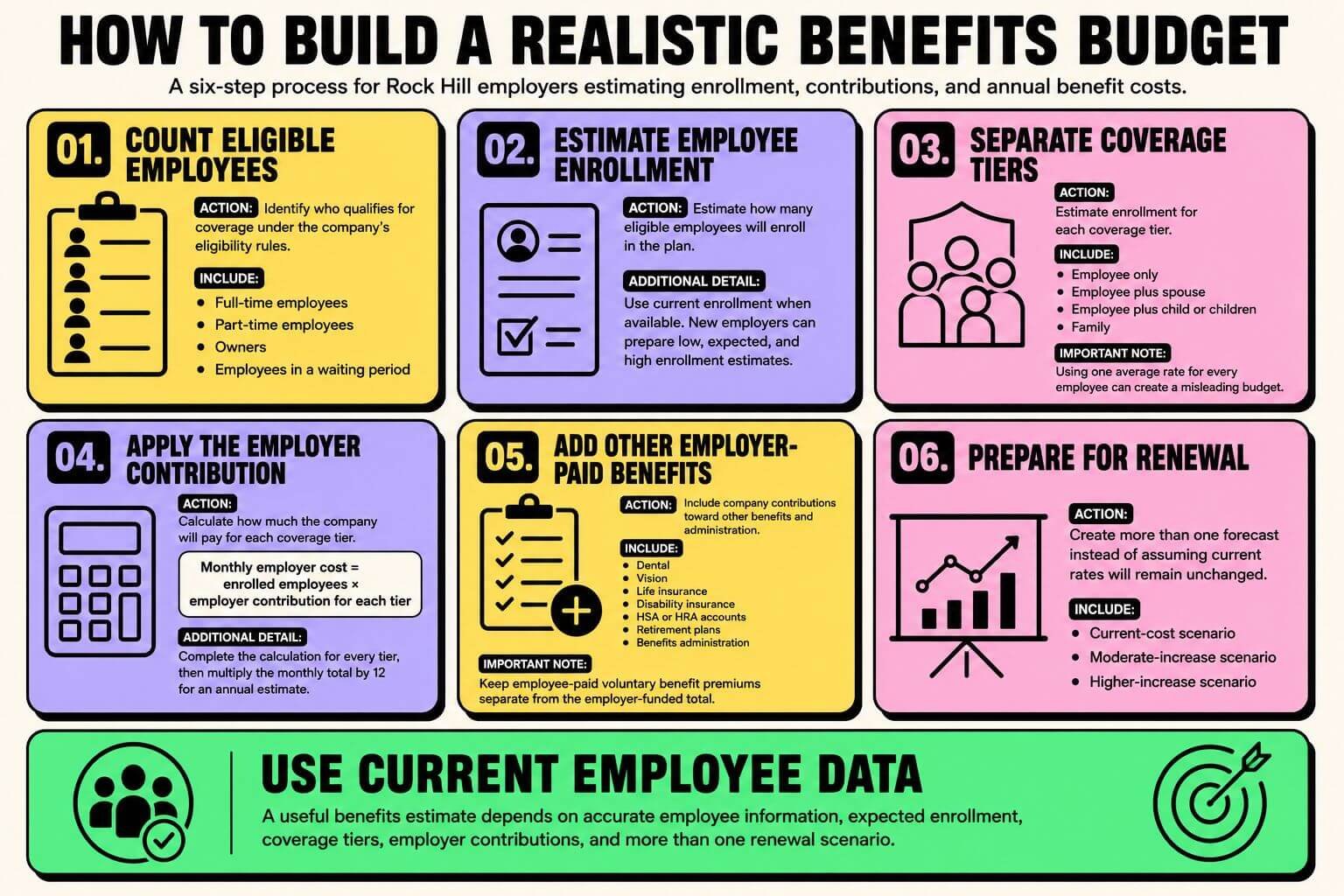
How to Build a Realistic Benefits Budget
A useful budget starts with employee information rather than a generic cost-per-person estimate.
1. Count eligible employees
Identify who will qualify for coverage under the company’s eligibility rules. Separate full-time employees, part-time employees, owners, and anyone currently in a waiting period.
2. Estimate how many employees will enroll
Not every eligible employee will join the plan. Some may have coverage through a spouse, Medicare, Medicaid, the individual market, or another source.
Use current enrollment when available. New employers can create low, expected, and high enrollment estimates.
3. Separate coverage tiers
Estimate enrollment across:
- Employee only
- Employee plus spouse
- Employee plus child or children
- Family
Using one average rate for everyone can produce a misleading budget.
4. Apply the employer contribution
Calculate the amount the business will pay for each coverage tier.
For example: Monthly employer cost = enrolled employees × employer contribution for each tier
Complete the calculation for every tier, then multiply the total by 12 for an annual estimate.
5. Add other employer-paid benefits
Include any company contributions toward:
- Dental
- Vision
- Life insurance
- Disability insurance
- HSA or HRA accounts
- Retirement plans
- Benefits administration
Keep voluntary employee-paid benefits separate so they don’t inflate the employer-funded total.
6. Prepare for the renewal
Don’t assume the current rate will remain unchanged. Create more than one forecast, such as:
- Current-cost scenario
- Moderate-increase scenario
- Higher-increase scenario
This gives your business room to compare options before the renewal deadline instead of reacting to one final number.
Ways to Control Costs Without Weakening the Package
Cost control should focus on value, not simply finding the smallest premium.
Offer more than one medical plan
A business may offer a lower-premium high-deductible plan alongside a plan with richer benefits. Employees can choose based on their expected healthcare use and monthly budget. Employers must still review participation, contribution, and carrier requirements before adding choices.
Review provider and prescription access
A cheaper plan may leave employees without access to preferred doctors, hospitals, or medications. Before switching, compare:
- Provider networks
- Hospital access
- Prescription formularies
- Deductibles
- Copays
- Out-of-pocket limits
- Referral requirements
A rate reduction loses value if employees can’t use the coverage where they receive care.
Revisit the contribution structure
Employers can adjust how contributions are divided among coverage tiers without removing the benefit entirely. A fixed-dollar contribution may make the company’s budget easier to forecast. A percentage-based contribution may rise automatically when premiums increase. Neither method is right for every company. Review how each option affects lower-paid employees and workers covering dependents.
Use voluntary benefits carefully
Accident, critical illness, hospital indemnity, voluntary life, and similar benefits may help employees fill specific coverage gaps. These products shouldn’t be presented as substitutes for major medical insurance. Employees need clear information about what the policies pay, what they exclude, and how claims work.
Compare funding and reimbursement options
A fully insured plan isn’t the only option for every employer. Depending on company size and workforce needs, an employer may review level-funded coverage or a health reimbursement arrangement. These choices have different financial risks, compliance rules, and administrative requirements. Compare the full arrangement, not just the first monthly figure.
Common Budgeting Mistakes to Avoid
Using one cost for every employee
Employees don’t all choose the same coverage tier. Family enrollment can cost much more than employee-only coverage.
Focusing only on the carrier increase
The renewal percentage is only one part of the budget. Enrollment changes, new hires, contribution decisions, and dependent elections may affect the total just as much.
Comparing plans with different benefits
A lower rate may come with a higher deductible, narrower network, different drug coverage, or larger employee cost. Put the plans side by side before deciding that one is cheaper.
Treating voluntary benefits as employer-paid premiums
Some voluntary plans are paid mainly or entirely by employees. Include any setup and administration needs, but don’t count employee-paid premiums as a company expense.
Waiting until the last minute
Late decisions leave little time to compare plans, explain changes, update payroll deductions, or answer employee questions. Begin reviewing the renewal early enough to check both cost and coverage details.
Review the Numbers Before Making Plan Changes
A reliable benefits estimate requires more than your employee count. Before comparing options, gather:
- An updated employee census
- Current plan summaries and rates
- Enrollment by coverage tier
- Employer and employee contributions
- Renewal date and renewal offer
- Provider and prescription priorities
- Expected hiring changes
- Employee feedback
- Current dental, vision, life, and disability benefits
Benni Agency can help employers organize these details and compare possible plan structures without assuming that the lowest premium is automatically the best result. Rock Hill employers can also review available employee benefits services when planning a new program or preparing for renewal.