Consultants are hired for their judgment, analysis, expertise, and recommendations. If a client believes that advice, a deliverable, or a missed obligation caused financial harm, a dispute can become costly even before fault is established. Professional liability insurance, also called errors and omissions or E&O coverage, is designed to address certain professional-services exposures, subject to the policy’s terms, exclusions, limits, and conditions. This guide explains the coverage questions consultants should review, including contracts, claims-made provisions, policy limits, exclusions, and related insurance.
Key Takeaways
- Professional liability insurance is intended to address covered claims alleging financial loss caused by a consultant’s professional services, advice, errors, omissions, or work product.
- General liability and professional liability cover different types of risks, so one should not be assumed to replace the other.
- Many E&O policies are claims-made, making reporting requirements, retroactive dates, prior-acts coverage, and continuous coverage especially important.
- Client contracts may require specific professional liability limits, certificates, policy terms, or other insurance provisions even when no general business requirement applies.
- Compare professional-services definitions, exclusions, defense-cost treatment, limits, deductibles, and prior-acts provisions instead of choosing coverage based on premium alone.
What Is Professional Liability Insurance for Consultants?
Professional liability insurance is a form of liability coverage designed for businesses that provide professional services, expertise, or advice. For consultants, it may respond to covered allegations that a:
- Mistake
- Omission
- Negligent act
- Professional error
- Failure to perform defined services
caused a client financial loss.
The policy’s definition of professional services is especially important because it helps determine which activities the insurer agrees to consider within the coverage. A policy should therefore be reviewed against the actual:
- Engagement letter
- Statement of work
- Service agreement
- Marketing language
- Project scope
- Deliverables
- Client expectations
A management consultant, IT consultant, project manager, financial consultant, and marketing consultant can face different professional exposures. Some specialized work may also require a professional-liability form designed specifically for that profession.
Professional Liability vs. General Liability
Professional liability is not simply a broader version of general liability. General liability commonly focuses on covered third-party allegations involving bodily injury, property damage, and certain personal or advertising injuries. Professional liability generally focuses on allegations that a consultant’s professional advice, services, or work product caused a client financial loss.
| Question | General Liability | Professional Liability (E&O) |
| Typical allegation | A visitor is injured at your office or you damage a client’s property. | A client alleges your advice, service, or deliverable caused financial loss. |
| Main exposure | Bodily injury or property damage. | Professional error, omission, negligence, or service failure. |
| Key review point | Covered locations, operations, exclusions, and limits. | Defined professional services, exclusions, limits, and claims-made dates. |
Both policies can be important, but each needs to be reviewed on its own terms. For more detail about the liability side of the comparison, Benni Agency’s guide to what general liability covers explains common third-party bodily injury and property-damage exposures.
What a Consultant’s E&O Policy May Cover or Exclude
A consultant’s E&O policy may help address covered defense costs, settlements, or judgments tied to claims alleging a professional error or omission. However, professional liability insurance does not mean every unhappy client, project disagreement, late deliverable, or disappointing business result is covered. Coverage depends on factors such as:
- The allegation
- Defined professional services
- Policy exclusions
- Policy limits
- Deductible
- Reporting requirements
- Retroactive date
- Prior knowledge provisions
- Contract language
- Other applicable policy conditions
Common exclusions or separate risk areas may include:
- Bodily injury
- Property damage
- Intentional or dishonest acts
- Certain contractual obligations
- Cyber incidents
- Employment-related disputes
- Known claims or circumstances
- Services outside the policy definition
For additional background, review information about professional liability insurance for consultants. Do not rely on a coverage label alone. Ask for the actual policy form and endorsements that apply to your consulting work.
Claims-Made Coverage, Prior Acts, and Tail Options
Many professional liability policies use a claims-made coverage structure. With claims-made insurance, timing can matter in two ways:
- When the alleged professional act occurred
- When the claim is first made and reported
A retroactive date, sometimes called a prior-acts date, may determine how far back the policy reaches for professional work completed before the current policy period. For example, a current policy may not respond to work performed before its retroactive date even when the client makes the claim during the current policy term.A gap in continuous coverage can also create complications for older engagements. Before:
- Switching insurers
- Replacing a professional liability policy
- Closing a consulting practice
- Selling a consulting business
- Retiring
- Changing professional-liability forms
Ask how prior acts and any extended reporting period, sometimes called tail coverage, will work. Get the answer in writing and compare the policy dates with client contracts and previous project dates. These provisions can be just as important as the stated policy limit.
How Much Does Professional Liability Insurance Cost?
There is no dependable flat professional liability rate for Mount Pleasant consultants. Current consulting business insurance costs published by Insureon show an average professional-liability premium of approximately $62 per month for consulting businesses purchasing through its platform. Its reported annual policy costs range from roughly $400 to more than $3,750. These figures are national marketplace data. They should not be treated as a Mount Pleasant quote, local average, or prediction for a particular consulting business. Actual premiums can vary based on:
- Consulting specialty
- Services offered
- Annual revenue
- Client industries
- Contract sizes
- Claims history
- Policy limits
- Deductible
- Professional-services definition
- Coverage exclusions
- Business location
- Prior-acts coverage
Compare quotes using the same description of services and similar limits. A lower premium may reflect a higher deductible, narrower definition of professional services, lower limits, or an exclusion that materially changes the coverage.
Mount Pleasant Considerations: Keep the Analysis Specific
A Mount Pleasant address alone does not determine a consultant’s professional liability limit or premium. A useful local review should instead focus on the facts of the business. Questions to consider include:
- Does a specific client require E&O coverage?
- Does a government opportunity establish insurance requirements?
- Does a professional license create separate obligations?
- What services and deliverables are provided?
- What is the potential financial impact of an alleged error?
- Does the consultant handle sensitive customer information?
- Do contracts contain indemnification provisions?
- Are subcontractors involved?
- Does the business provide technology or financial advice?
- Are particular limits required before a contract can begin?
Regulated professional services may also have requirements beyond the scope of this guide. For information about Benni Agency’s local commercial and employee-benefit services, review the Mount Pleasant business insurance resources. The goal is to connect coverage to actual professional services and contractual obligations rather than making assumptions based only on location.
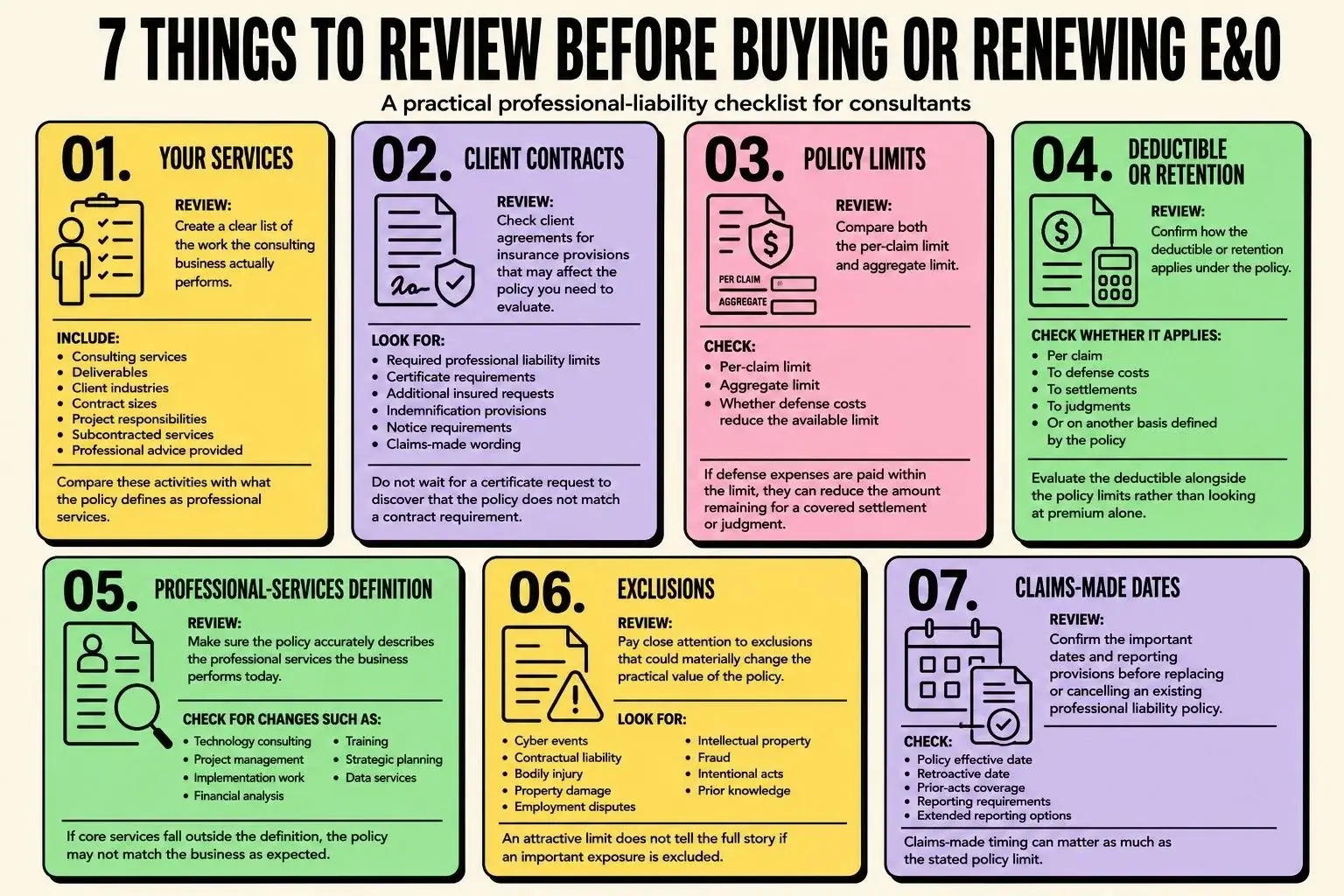
How to Review a Policy Before You Buy or Renew
Start With the Work You Perform
Create a clear list of:
- Consulting services
- Deliverables
- Client industries
- Contract sizes
- Project responsibilities
- Subcontracted services
- Professional advice provided
Then compare those activities with the policy’s definition of professional services. If core services fall outside that definition, the policy may not match the business as expected.
Review Client Contracts
Look for insurance provisions involving:
- Required professional liability limits
- Certificate requirements
- Additional insured requests
- Indemnification provisions
- Notice requirements
- Claims-made wording
- Prior-acts requirements
- Coverage duration
Do not wait until a certificate request arrives to determine whether the policy meets a contract requirement.
Compare the Limit Structure
Review both:
- Per-claim limits
- Aggregate limits
Also determine whether defense costs reduce the available policy limit. If legal defense expenses are paid within the limit, a significant defense bill can reduce the amount remaining for a covered settlement or judgment.
Confirm the Deductible or Retention
Ask whether the deductible applies:
- Per claim
- To defense costs
- To settlements
- To judgments
- On another basis specified by the policy
The amount should be evaluated alongside the policy limits rather than considering premium alone.
Review the Professional-Services Definition
Make sure the policy accurately describes the services the business performs today. If the consulting firm has added:
- Technology consulting
- Project management
- Implementation work
- Financial analysis
- Training
- Strategic planning
- Data services
since the previous policy was issued, confirm whether those services remain within the covered definition.
Check Exclusions
Pay particular attention to exclusions involving:
- Cyber events
- Contractual liability
- Bodily injury
- Property damage
- Employment disputes
- Intellectual property
- Fraud
- Intentional acts
- Prior knowledge
An exclusion can significantly change the practical value of otherwise attractive limits.
Review Claims-Made Dates
Confirm:
- Policy effective date
- Retroactive date
- Prior-acts coverage
- Reporting requirements
- Extended reporting options
Do this before replacing or cancelling an existing professional liability policy.
How Benni Agency Can Help
Benni Agency provides business and commercial insurance for South Carolina businesses. For consultants, a useful coverage discussion starts with a clear description of:
- Services performed
- Client contracts
- Project responsibilities
- Professional exposures
- Data handled
- Existing policies
- Required insurance limits
Those details can then be compared with professional liability, general liability, cyber insurance, and other coverage that may be relevant. A professional liability review should focus on whether the policy matches the actual consulting work, contract obligations, and potential claims rather than relying only on an E&O label. Coverage remains subject to policy terms, conditions, exclusions, limits, and insurer approval.