If you’re paying for employee benefits but still handling most of the planning, enrollment, employee questions, and renewal work yourself, it’s fair to ask what your broker is actually adding. A Beaufort benefits broker should help employers make better plan decisions, control costs, reduce HR work, and support employees throughout the year.
For Beaufort business owners and HR teams, this article explains where broker value should show up, what support to expect, and how to tell whether your current benefits setup is doing enough for your company.
Key Takeaways
- A Beaufort benefits broker should do more than collect renewal quotes. Employers should get help with plan strategy, costs, administration, and employee support.
- A broker should compare funding options based on your workforce, budget, and goals instead of assuming the current plan is still the right fit.
- Beaufort’s seasonal employment patterns can make eligibility, onboarding, enrollment, and offboarding especially important for some local employers.
- Benefits technology should reduce real HR work, including enrollment changes, employee records, payroll coordination, and reporting.
- Broker value should continue throughout the year through employee support, plan reviews, administration help, and preparation for the next renewal.
What Should a Beaufort Benefits Broker Actually Do?
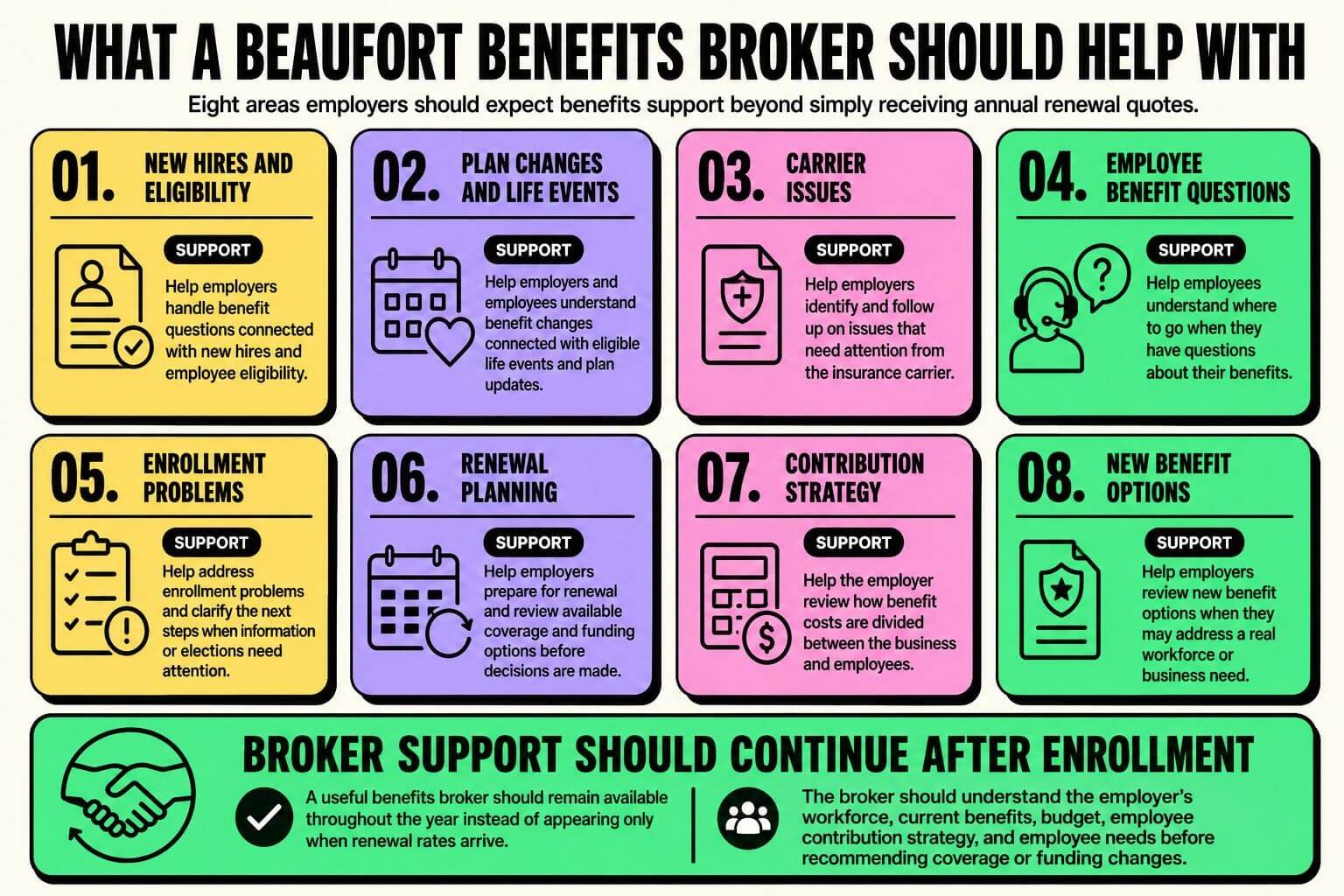
A benefits broker should help you make decisions before problems reach your HR team or employees. That starts with understanding your workforce, current benefits, budget, employee contribution strategy, and what employees actually need. From there, the broker should help compare coverage and funding options, explain the trade-offs, and support implementation. The job also continues after open enrollment. A useful broker should be available when you have questions about:
- New hires and employee eligibility
- Plan changes and life events
- Carrier issues
- Employee benefit questions
- Enrollment problems
- Renewal planning
- Contribution strategy
- New benefit options
If your broker mainly appears when renewal rates arrive, you may be missing part of the value a broker can provide.
Why Beaufort Employers May Need More Than Annual Quotes
Some Beaufort businesses deal with noticeable changes in staffing throughout the year, especially employers connected with hospitality, tourism, and other seasonal industries. South Carolina Department of Employment and Workforce data showed that Beaufort County employment fell by about 2,300 jobs from the second to third quarter of 2024, with most of the decline coming from accommodation and food services.
The agency linked much of that change to the area’s seasonal labor market. That matters for benefits administration. When employee numbers change frequently, HR may be dealing with:
- New-hire enrollments
- Terminations
- Eligibility updates
- Payroll changes
- Benefit questions
- Coverage effective dates
- Employee communications
A broker who understands how your workforce changes during the year can help keep those tasks organized rather than treating benefits as a once-a-year renewal exercise. Not every Beaufort employer has a seasonal workforce, of course. The bigger point is that benefits strategy should fit the way your business actually operates.
Where a Benefits Broker Can Add Value
Broker value becomes easier to judge when you look at the specific decisions and tasks the broker helps you handle.
Plan Design and Funding Decisions
Renewing the same plan every year may be simple, but it doesn’t mean the plan still fits your company. A broker should help you compare available options and explain why one approach may work better than another. Depending on your business, that conversation could include:
- Fully insured coverage
- Level-funded coverage
- Individual Coverage Health Reimbursement Arrangements
For example, reviewing ICHRA options alongside traditional group coverage may help an employer decide whether a defined-contribution approach fits its workforce and budget. The broker should look at more than the monthly premium. Useful questions include:
- How predictable are employer costs?
- How much are employees expected to contribute?
- What administrative work does each option require?
- How much plan choice will employees have?
- How comfortable is the employer with claims risk?
- Will the structure still make sense if headcount changes?
There isn’t one funding model that works for every company. The broker’s value comes from explaining the trade-offs clearly enough for you to make an informed choice.
Benefits Employees Can Actually Use
Adding more benefit options doesn’t automatically create a better benefits package. The right mix depends on what employees need, what the employer can support, and whether people understand the coverage they’re being offered. Along with medical coverage, employers may consider benefits such as:
- Dental
- Vision
- Life insurance
- Disability insurance
- Accident coverage
- Critical illness coverage
The question shouldn’t simply be, “How many benefits can we offer?” A better question is, “Which benefits will employees understand, value, and realistically use?” Education matters here too. Good employee benefits education can help employees understand their choices, costs, enrollment deadlines, and how their coverage works after enrollment. That can save HR from answering the same basic questions over and over.
Benefits Administration and HR Support
A benefits program can look good on paper and still create a lot of extra work for HR. Enrollment changes, new hires, terminations, employee records, payroll updates, and reporting all have to stay accurate. This is where broker support and the right systems can make a noticeable difference. Useful benefits administration technology can help reduce repetitive work by giving HR and employees a clearer way to manage enrollment and ongoing changes.
The technology itself isn’t the goal. What matters is whether it helps your team spend less time fixing errors, entering the same information in several places, or chasing down missing benefit changes. For Beaufort employers with staffing levels that change during the year, that operational support can be just as useful as getting better renewal options.
Year-Round Guidance, Not Just Renewal Support
Your benefits broker’s work shouldn’t end once employees finish enrolling. Questions and changes continue throughout the plan year. An employee may get married or have a child. A new hire needs coverage. Someone leaves the company. HR needs help understanding an eligibility issue. An employee doesn’t know who to contact about a carrier problem. Those situations are part of benefits management too. Good year-round broker support may include:
- Employee benefit questions
- New-hire and life-event guidance
- Carrier issue escalation
- Eligibility support
- Benefit education
- Midyear plan reviews
- Early renewal preparation
This ongoing involvement also makes the next renewal easier because your broker already knows what worked, what caused problems, and what employees asked about during the year.
How to Tell If Your Current Broker Is Adding Enough Value
You don’t need to wait for a bad renewal to evaluate your broker. Look at how the relationship works during the whole year. Ask yourself:
- Does renewal planning begin early enough?
- Are different coverage or funding approaches actually compared?
- Does the broker explain why one option may fit better than another?
- Does HR get help with enrollment and eligibility problems?
- Do employees know where to go with benefit questions?
- Does the broker remain involved after open enrollment?
- Are employer and employee contribution strategies reviewed?
- Does the broker adjust recommendations when your workforce changes?
Also look at whether your broker brings useful ideas before you ask. For example, if payroll taxes and employee contributions are becoming an issue, a discussion about a Section 125 plan may be worth having. The goal isn’t to add something new for the sake of it. The goal is to identify options that solve a real problem for the employer or employees.
A broker doesn’t need to recommend major changes every year. Sometimes the best advice is to keep a plan that is working well. What matters is knowing that the current setup was reviewed rather than simply renewed by default.
Not Sure Your Current Benefits Setup Is Working?
A benefits program doesn’t need to be failing before it deserves another look. You may simply be wondering whether renewal planning starts early enough, employees receive enough help, or your HR team is still doing work that the broker or benefits system should be handling.
Start by looking at what happens during the full plan year. Does your broker explain options clearly? Are funding and contribution strategies reviewed? Can employees get help when questions come up? Does someone assist with enrollment, eligibility changes, and carrier issues? If several of those areas still fall mostly on your team, it may be worth reviewing how your benefits program is being managed. Benni Agency can provide year-round benefits support and review the current setup before you decide whether any major change is necessary.