Flood damage is usually not covered by a standard commercial property policy or business owner’s policy (BOP). For North Charleston businesses, that makes flood coverage a separate decision from wind, fire, theft, and other property risks. A useful review starts with the property: its flood zone, building value, contents, financing requirements, and the effect of a shutdown. This guide explains how National Flood Insurance Program (NFIP) coverage works, common gaps, and what to compare before buying or renewing coverage.
Key Takeaways
- Standard commercial property and BOP coverage generally excludes flood, so separate flood insurance may be needed.
- NFIP commercial coverage can provide up to $500,000 for a nonresidential building and $500,000 for contents.
- NFIP commercial claims are generally settled on an actual cash value basis, which accounts for depreciation.
- NFIP coverage does not pay for business interruption or lost income, so downtime should be reviewed separately.
- Flood maps matter, but businesses should also review building values, contents, access, and operations.
Why Flood Risk Is More Than a Map Zone
A FEMA flood map is an important starting point, especially when a lender is involved. But being outside a high-risk Special Flood Hazard Area does not mean a property has no flood exposure. FEMA reports that from 2014 through 2024, 29% of NFIP claims came from outside current high-risk flood areas.
North Charleston businesses also have a useful local resource. The City of North Charleston Flood Plain Management office can provide information about special flood hazard areas, required elevations, and available elevation certificates. Because the city directs property owners to Charleston, Berkeley, and Dorchester County resources, confirming the correct map for an address matters.
For a business, the practical question is not only, “Is this building in a high-risk zone?” It is also, “What would water damage here, and what happens if this location cannot operate?”
What NFIP Commercial Flood Insurance Covers
The NFIP General Property Form is used for many nonresidential buildings and their business personal property. It responds to direct physical loss caused by “flood” as the policy defines it.
Current NFIP limits allow up to $500,000 of building coverage and $500,000 of contents coverage. Building and contents coverage are purchased separately and have separate deductibles.
Building coverage can include the insured structure and foundation, electrical and plumbing systems, central air and furnace equipment, water heaters, fire sprinkler systems, pumps, and certain permanently installed equipment.
Contents coverage can include furniture, fixtures, machinery, business equipment, and stock such as merchandise, raw materials, and finished goods. Actual claim outcomes depend on the policy wording, cause of loss, property involved, and facts of the claim.
FEMA’s Flood Insurance 101 guidance explains how NFIP coverage, eligibility, flood zones, and waiting periods work. Commercial building and personal property losses under the General Property Form are generally settled using actual cash value. Depreciation can therefore reduce the payment compared with buying new replacement property.
Coverage Gaps Businesses Should Review
The NFIP is useful, but its limits and exclusions can leave important gaps.
Business income is not covered. NFIP commercial flood coverage does not pay for financial losses caused by business interruption or loss of use. If a flood closes a location, payroll, rent, debt service, temporary operations, and lost revenue may remain with the business unless another policy responds.
The $500,000 limits may be too low. A commercial building, equipment schedule, or inventory peak can exceed NFIP limits. Private or excess flood coverage may offer additional capacity, but terms, deductibles, waiting periods, and eligibility vary.
Outdoor property has limited protection. Property outside the insured building, including many fences, walkways, decks, patios, and landscaping features, is generally excluded under the NFIP form.
Sewer and drain backup is not automatically a flood claim. NFIP coverage may respond when the backup is directly caused by a covered flood. A backup from another cause may need to be addressed elsewhere in the insurance program.
Vehicles and valuable papers need separate attention. Most licensed self-propelled vehicles are not covered by the NFIP property form. Currency, precious metals, and certain valuable papers or recorded data are also excluded.
Timing Matters: The NFIP Waiting Period
A new NFIP policy generally has a 30-day waiting period before coverage becomes effective. FEMA lists limited exceptions, including certain policies purchased in connection with making, increasing, extending, or renewing a mortgage loan and some purchases following a flood-map revision.
That timing makes flood insurance difficult to use as a last-minute storm response. Businesses should review coverage before hurricane season, a property closing, a lease renewal, or a major increase in inventory or equipment.
The NFIP also depends on periodic congressional authorization. Because authorization dates change, businesses with an upcoming renewal or loan closing should confirm current program status rather than rely on an older article.
When a Lender Requires Flood Insurance
Federal rules can require flood coverage when a building in a Special Flood Hazard Area secures certain loans from federally regulated or supervised lenders in participating NFIP communities.
For nonresidential property, the required amount is generally tied to the lesser of the outstanding principal balance, the property’s insurable value, or the maximum flood insurance available under the NFIP. A lease or financing agreement can impose additional requirements.
The lender’s minimum is not a complete risk analysis. A business may have building, contents, income, or contractual exposure beyond the amount a lender requires.
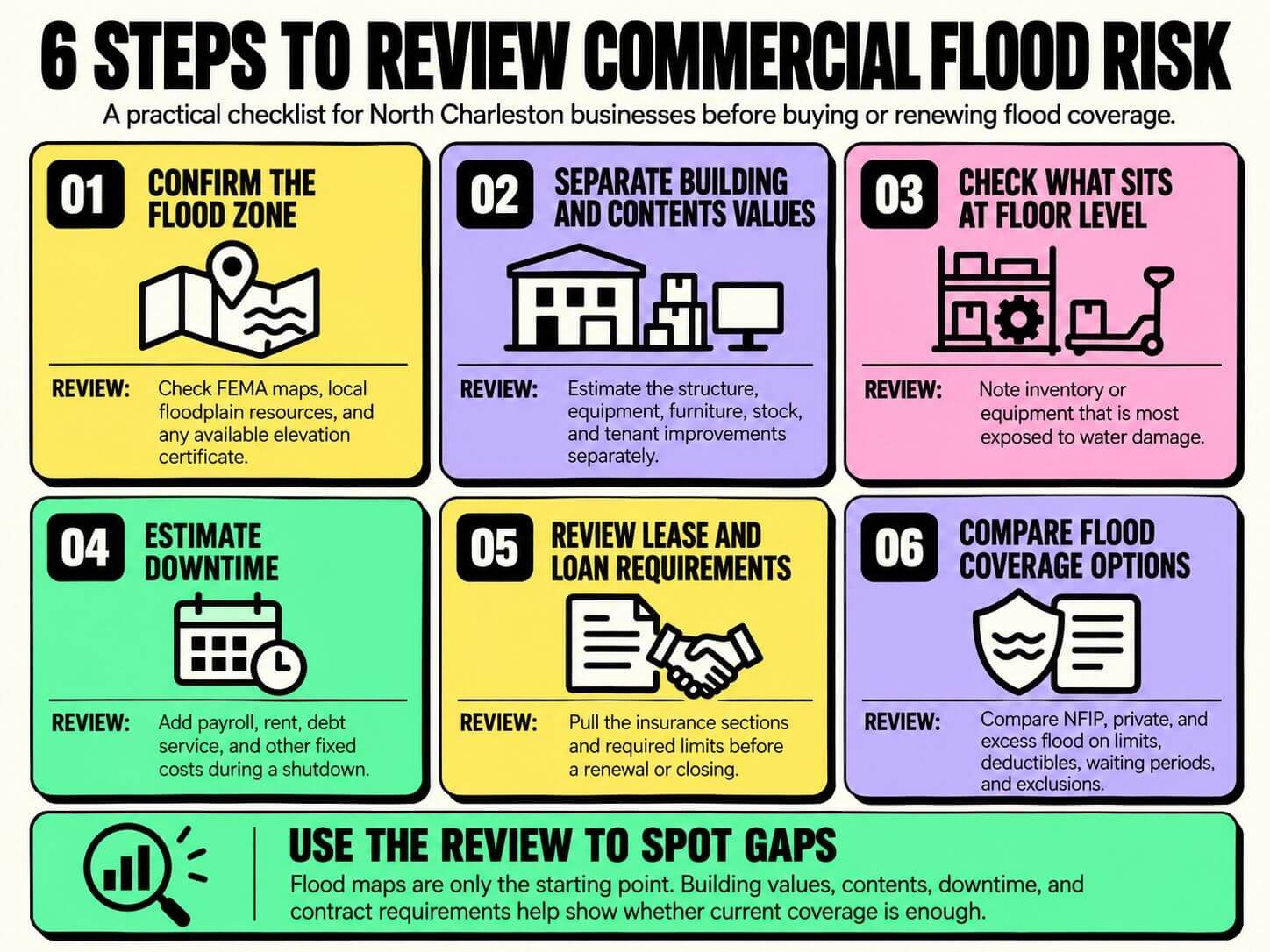
A Practical Flood-Risk Review for a North Charleston Business
Work through the exposure in a consistent order:
- Confirm the flood zone and property data. Use FEMA and local floodplain resources, and request an elevation certificate if available.
- Separate building and contents values. Estimate the structure, machinery, equipment, furniture, stock, and tenant improvements.
- Check where valuable property sits. Inventory or equipment at floor level may face different damage potential than property that can be elevated or moved.
- Estimate downtime. Identify fixed costs and operational dependencies that continue if the location closes.
- Review loan and lease requirements. Pull the insurance sections before comparing limits.
- Compare NFIP, private, and excess options. Review limits, valuation, deductibles, waiting periods, exclusions, and whether business-income protection is available.
A coordinated review can also show how flood coverage fits with commercial property, commercial auto, business income, and liability policies. Benni Agency’s insurance and commercial insurance services include coverage reviews for South Carolina businesses. Employers that also want local benefits information can use Benni Agency’s North Charleston page.
This article is general educational information, not legal, financial, or individualized insurance advice. Policy forms, endorsements, declarations, insurer rules, lender requirements, and the facts of a loss control actual coverage.