A retail property policy should reflect what a store owns, what the lease requires, and what it would take to resume operations after a covered loss. For a Mount Pleasant retailer, the review should also separate wind and flood questions instead of assuming every storm-related loss falls under one policy. Use this checklist to prepare for a quote or renewal, then confirm all coverage against the issued forms and endorsements.
Key Takeaways
- List buildings, inventory, equipment, tenant improvements, signs, and other property separately so important assets are not overlooked.
- Compare replacement cost and actual cash value because the valuation method can materially change a claim payment.
- Verify wind, hail, named-storm, and flood terms individually; they may involve different policies, deductibles, or exclusions.
- Match business income coverage to a realistic restoration period, not simply the time needed to repair physical damage.
- Recheck values, lease obligations, and policy terms at every renewal and after a major operational change.
What Retail Property Insurance May Cover
Commercial property insurance can cover insured physical property after a covered cause of loss, subject to the policy’s limits, exclusions, deductibles, and conditions. A retail store’s property schedule may include:
- Building: The structure and permanently installed fixtures if the retailer owns the premises.
- Business personal property: Inventory, shelving, furniture, computers, point-of-sale equipment, security equipment, and supplies.
- Tenant improvements and betterments: Flooring, lighting, counters, fitting rooms, and other improvements paid for by a tenant.
- Signs and outdoor property: Storefront signs, awnings, fencing, or outdoor displays, which may have separate limits or restrictions.
- Business income and extra expense: Lost income and certain continuing or additional expenses when a covered property loss interrupts operations.
Do not assume the landlord’s policy covers a tenant’s inventory, equipment, or improvements. The lease and both parties’ insurance documents should be reviewed together.
The Mount Pleasant Retail Property Insurance Checklist
1. Build an Accurate Property Inventory
Create an itemized list of stock, furniture, equipment, improvements, signs, and other assets. Use current values and keep invoices, photographs, serial numbers, and valuation records where practical. If inventory rises at predictable times, ask how the policy addresses changing values and whether a reporting form, peak-season endorsement, or higher limit is appropriate. Availability and terminology vary by insurer.
2. Separate Building and Contents Values
Owners generally need a building value as well as limits for business personal property. Tenants should identify what they own and what they are contractually responsible for. A certificate of insurance is evidence that coverage exists; it does not replace the policy or prove that every lease obligation is satisfied.
3. Compare Replacement Cost and Actual Cash Value
Replacement cost generally measures the cost to replace covered property with property of comparable kind and quality, subject to policy terms. Actual cash value generally accounts for depreciation. Ask which method applies to the building, inventory, equipment, signs, and tenant improvements. Also review any conditions that must be met before replacement-cost benefits are paid.
4. Understand Coinsurance and Limits
Some property forms include a coinsurance condition requiring the insured to carry a stated percentage of value. Falling below that requirement can reduce payment on a partial loss. Confirm the percentage, the valuation basis, and whether an agreed-value option or another provision changes how coinsurance applies. Do not lower reported values solely to reduce premium without understanding the claim consequence.
5. Review Causes of Loss and Exclusions
A named-perils form covers only listed causes of loss. A special or open-perils form is broader, but it still contains exclusions. Compare fire, theft, vandalism, water damage, wind, hail, equipment breakdown, utility interruption, ordinance or law, and spoilage terms. A broader label does not mean every cause of damage is covered.
6. Check Wind, Hail, and Named-Storm Terms
For a Mount Pleasant address, confirm whether wind and hail are included, excluded, or handled through separate coverage. Review any hurricane or named-storm deductible, its trigger, and whether it is a flat amount or percentage of insured value. The South Carolina Wind and Hail Underwriting Association provides wind and hail coverage for qualified property within defined coastal territory. Use its official eligibility tool rather than assuming every Mount Pleasant location qualifies.
7. Obtain a Separate Flood Review
Flood damage is typically excluded from standard commercial property insurance. This distinction matters for surface water and storm surge. The National Flood Insurance Program offers separate commercial building and contents coverage, with limits of up to $500,000 for each. Its commercial coverage generally does not cover business-interruption losses. Review the NFIP commercial coverage guidance, then compare it with available private-market options when the limits or terms do not fit the property.
8. Test Business Income Assumptions
Business income coverage usually depends on direct physical loss from a covered cause at a covered location. Review the waiting period, period of restoration, income limit, payroll treatment, extra expense terms, and any extended period after reopening. Consider how long permitting, debris removal, equipment replacement, inventory replenishment, and building-code work could delay a return to normal operations.
9. Review Specialized Retail Exposures
Standard property coverage may not fully address every retail loss. Depending on the operation, ask about equipment breakdown, spoilage, utility-services interruption, crime, employee theft, cyber events, property in transit, customers’ property, and product recall costs. These risks may require endorsements or separate policies. Coverage names alone are not enough; compare the trigger, limit, deductible, and exclusions.
10. Match the Policy to the Lease
Read the insurance, repair, indemnity, and waiver-of-subrogation provisions in the lease. Check required limits, loss-payee provisions, additional-insured requirements, and responsibility for glass, HVAC systems, signs, and improvements. Additional insured status usually relates to liability protection and should not be treated as a substitute for property coverage or loss-payee status.
How to Compare Retail Property Quotes
Place proposals side by side and compare the same fields:
| Review area | What to confirm |
| Property values | Building, inventory, equipment, improvements, and signs |
| Valuation | Replacement cost, actual cash value, and settlement conditions |
| Causes of loss | Covered causes, exclusions, and endorsements |
| Deductibles | Standard, wind/hail, and named-storm amounts or percentages |
| Flood | Separate building and contents coverage, limits, and exclusions |
| Business income | Limit, waiting period, restoration period, and extra expense |
| Coinsurance | Required percentage and any agreed-value provision |
| Lease terms | Required limits, interests, endorsements, and responsibilities |
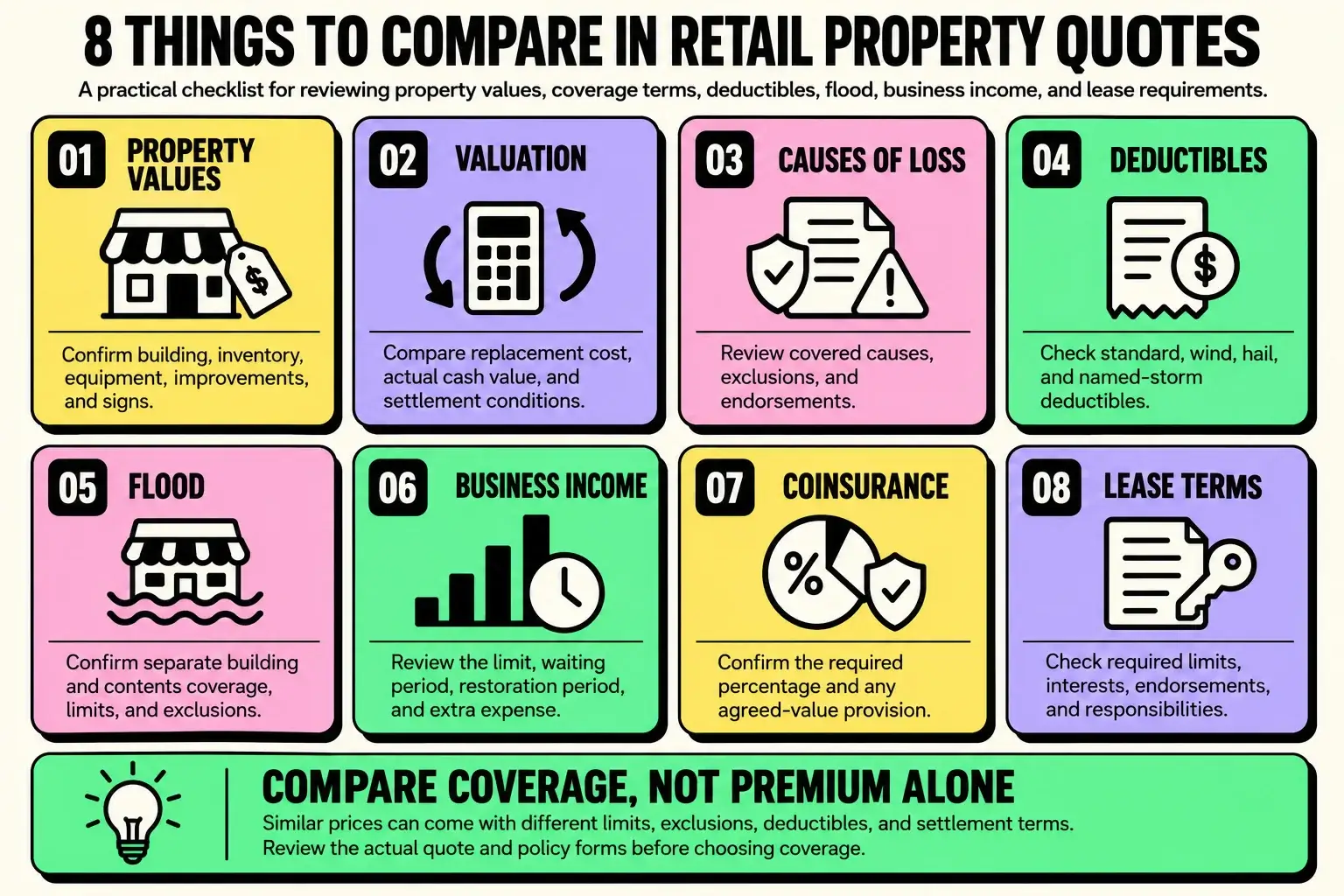
A retailer choosing between package structures can also compare Benni Agency’s BOP and CPP explanation. The policy label is less important than the coverage parts and terms actually included.
Prepare for the Renewal Conversation
Bring the current declarations, forms, endorsements, lease, loss runs, property inventory, building details, planned renovations, and revenue records. Note new equipment, online sales operations, off-site storage, delivery activity, or additional locations. These changes can affect more than property insurance.
Benni Agency’s business and commercial insurance services explain how property coverage can fit with liability and other business policies. The Mount Pleasant service-area page provides local contact and service information. A licensed insurance professional should review the actual quote and policy language before coverage is selected.