Restaurant insurance is not one universal policy. It is a combination of coverages selected around the operation, including the premises, equipment, employees, alcohol sales, delivery activity, and contractual requirements. For Charleston restaurant owners, the most important questions are what each policy covers, where exclusions or separate deductibles apply, and whether the program reflects how the restaurant operates today. This guide explains the core coverages, South Carolina requirements, and details to review before requesting quotes or renewing a policy.
Key Takeaways
- General liability and commercial property are common foundations, but they do not cover every restaurant exposure.
- South Carolina workers’ compensation and liquor liability requirements depend on specific facts about the business.
- Flood, liquor-related claims, employee injuries, and business-use vehicles may require separate policies or endorsements.
- Delivery, catering, outdoor dining, alcohol service, and valuable equipment can materially change coverage needs.
- Compare proposals using the same limits, deductibles, valuations, and operating details, not premium alone.
How Restaurant Insurance Is Usually Structured
A restaurant may qualify for a Business Owners Policy (BOP) that combines general liability and commercial property, often with business income coverage. A more complex operation may use a Commercial Package Policy (CPP) or several coordinated policies. Neither label guarantees a particular price or scope. Eligibility, forms, endorsements, limits, deductibles, and exclusions determine the protection provided.
Owners researching business and commercial insurance in Charleston should start with a complete description of the operation. A café with no cooking or alcohol has different exposures from a full-service restaurant with fryers, a bar, delivery vehicles, and catering.
Core Coverages to Review
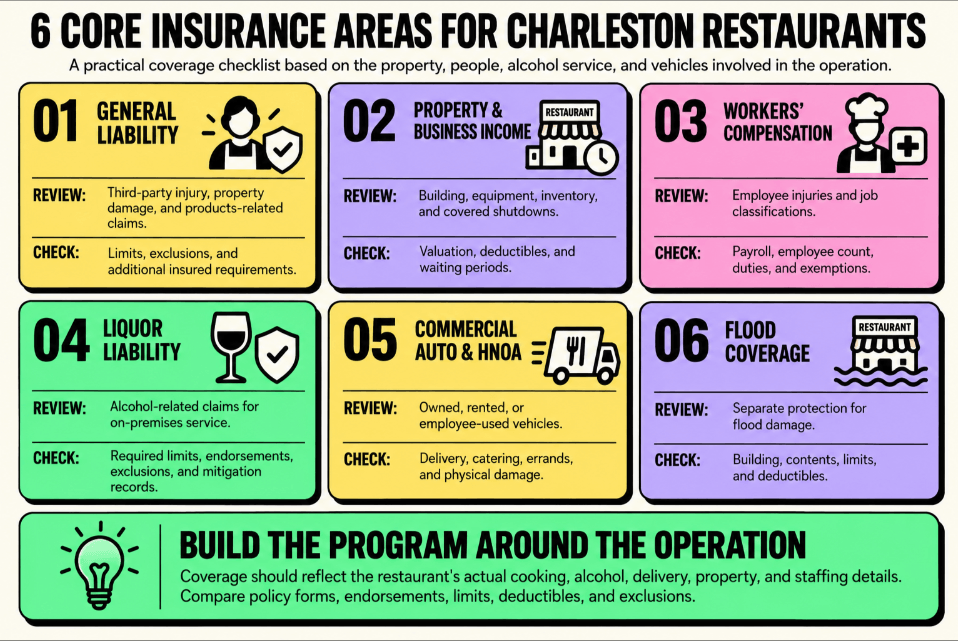
General Liability
Commercial general liability may respond to covered third-party bodily injury, property damage, and certain personal or advertising injury claims. Restaurant examples can include a customer slipping on a wet floor or alleging bodily injury from food sold by the business. Whether a foodborne-illness claim is covered depends on the policy’s products-completed-operations provisions, exclusions, and facts of the claim.
General liability normally does not replace workers’ compensation, commercial auto, or liquor liability. A lease or vendor contract may also require specified limits, certificates of insurance, or additional-insured status. Those requirements should be compared with the actual policy rather than assumed from a certificate alone.
Commercial Property and Business Income
Commercial property can cover insured physical assets such as an owned building, tenant improvements, cooking equipment, refrigeration, furniture, inventory, and signs against covered causes of loss. Owners should check whether valuation is replacement cost or actual cash value and whether special deductibles apply to wind or named storms.
Business income coverage may help with lost income and continuing expenses when a covered property loss causes a shutdown. The waiting period, restoration period, limits, and covered causes of loss matter. Equipment breakdown and spoilage coverage may address certain mechanical, electrical, refrigeration, or inventory losses, but one does not automatically include the other.
Standard commercial property policies typically exclude flood. A Charleston restaurant should review separate flood options and confirm whether a proposed policy covers the building, contents, or both. Flood coverage should not be confused with protection for wind-driven damage or water damage from a covered plumbing loss.
Workers’ Compensation
The South Carolina Workers’ Compensation Commission says businesses that regularly employ four or more employees generally must maintain coverage. Part-time workers and family members count, and listed exemptions may apply, including for businesses with annual payroll below $3,000. Classification can be fact-specific, so restaurants near a threshold should confirm how the rule applies.
Payroll and job classifications affect underwriting. Kitchen, service, management, and delivery duties should be reported accurately so the application reflects the work employees perform.
Liquor Liability
Under South Carolina Code Section 61-2-145, specified licensees or permittees selling alcohol for on-premises consumption after 5 p.m. generally must maintain liquor liability coverage or general liability with a liquor liability endorsement. The current statute sets a $1 million minimum annual aggregate unless a licensee qualifies for documented mitigation reductions. Per-occurrence coverage must be at least 50% of the aggregate, and the aggregate cannot fall below $300,000 under the mitigation provisions.
Restaurants should verify the required limit for their license, hours, and mitigation documentation. They should also review exclusions involving assault and battery, entertainment, security, and late-night operations instead of assuming the statutory minimum addresses every exposure.
Commercial Auto and Hired and Non-Owned Auto
A restaurant that owns vehicles may need commercial auto coverage. When employees use personal vehicles or the business rents vehicles for deliveries, catering, or supply runs, hired and non-owned auto liability may address certain business liability. It generally does not cover physical damage to an employee’s car. Third-party delivery platforms also do not eliminate the need to disclose the restaurant’s own delivery practices.
Match Coverage Questions to the Operation
| Operational detail | Coverage question to ask |
| Deep fryers, grills, or hood systems | Are fire-protection requirements, equipment values, and loss-control records accurate? |
| Refrigerated or perishable inventory | Are equipment breakdown and spoilage limits separate and adequate? |
| Alcohol service | Are liquor liability limits, endorsements, exclusions, and mitigation records correct? |
| Delivery, catering, or employee errands | Which commercial auto or hired and non-owned auto exposures apply? |
| Online ordering, card payments, or stored data | What cyber events, response costs, and business interruption are covered? |
| Outdoor seating, events, or valet service | Are all premises, activities, property, and contractual requirements disclosed? |
Other options may include employment practices liability, crime, cyber, inland marine, and commercial umbrella or excess liability. These policies address different exposures. The umbrella-versus-excess distinction is especially important because an upper layer may follow only scheduled underlying policies and does not automatically broaden every coverage.
How to Compare Restaurant Insurance Proposals
Before renewal, prepare current sales separated into food and alcohol, payroll by job duty, cooking methods, equipment and inventory values, delivery or catering details, vehicle information, lease requirements, fire-suppression records, and claims history. Disclose changes such as a new bar, expanded hours, outdoor seating, renovations, or a second location.
Then compare the same limits, deductibles, valuations, waiting periods, and endorsements across proposals. A lower premium may reflect narrower coverage or higher deductibles. For a deeper pricing review, use Benni Agency’s restaurant insurance cost factors guide.
How Benni Agency Can Help
Benni Agency can help Charleston restaurant owners review commercial insurance options, organize application information, and compare how proposed policies address the operation. Coverage decisions should ultimately be based on the issued forms, endorsements, exclusions, and the restaurant’s current facts.
This article provides general educational information, not individualized insurance, legal, or tax advice.