Renewal season can expose weak benefits support fast. Rates go up, employees get confused, and HR ends up answering the same plan questions again. To choose a Charleston insurance broker for better benefits, look for more than plan quotes. The right broker should help with strategy, employee communication, plan fit, administration, compliance support, and year-round guidance.
For Charleston business owners and HR teams, selecting the right benefits broker is about more than finding lower premiums. This guide explains how to choose a partner who enhances your benefits strategy while making administration and employee support easier.
Key Takeaways
- A Charleston insurance broker should help with strategy, not just plan quotes.
- Better benefits should be affordable, useful, understandable, and easier for HR to manage.
- Employers should ask brokers about service, technology, compliance support, employee education, and compensation.
- The cheapest plan is not always the best choice if it creates confusion, weak access, or higher employee costs.
- Charleston’s active labor market makes clear, well-managed benefits more important for hiring and retention.
What Better Benefits Should Mean for Employers
Better benefits do not always mean more expensive benefits. For most employers, better means the plan works for the people who use it and the team that manages it. Employees should understand their options, know what the plan covers, and feel like the benefits are useful. HR should not have to spend the whole year chasing forms, fixing payroll issues, or answering questions that could have been explained earlier. For Charleston employers, better benefits usually means:
- Clearer plan choices
- More predictable costs
- Better employee communication
- Cleaner enrollment
- Less HR admin work
- Benefits that support hiring and retention
For employers reviewing options in this market, Benni supports Charleston businesses that need clearer plan choices, better employee guidance, and cleaner benefits administration.
What You Should Expect from a Charleston Insurance Broker
A strong broker should do more than send a spreadsheet of carrier options. The broker should help you understand how your current benefits are working, where employees are struggling, and what changes may make sense before renewal pressure builds.
A good broker should help with:
- Plan design
- Contribution strategy
- Employee education
- Open enrollment support
- Compliance questions
- Benefits communication
- Year-round service
- Renewal planning
The broker should also ask about your business before recommending anything. That includes your team size, hiring plans, turnover, budget, payroll setup, HR capacity, and employee needs. A broker who skips those questions may not understand what your benefits program actually needs to solve. A broker that provides ongoing benefits consulting can help employers think through plan changes, compliance questions, and employee communication before renewal becomes rushed.
Why Plan Quotes Are Not the Whole Decision
Plan quotes matter, but they are only one part of the decision. A cheaper plan may look good during renewal. But if it has a weaker network, higher deductibles, confusing coverage, or higher employee costs, it may create more problems later.
KFF reported that average annual employer-sponsored health insurance premiums in 2025 were $9,325 for single coverage and $26,993 for family coverage, with family coverage rising 6% from 2024. That cost pressure is one reason employers need a broker who can explain the full trade-off, not just show the lowest premium.
A broker should help you compare:
- Premiums
- Deductibles
- Copays
- Network access
- Prescription coverage
- Employee contributions
- Payroll impact
- Employee understanding
- HR workload
The lowest price is not always the best value. The better choice is the one your business can afford, your employees can use, and your HR team can manage.
How to Evaluate a Charleston Insurance Broker
Choosing a broker should feel like a business decision, not a guess. A good broker should be able to explain their service model clearly. They should also show how they support employers before, during, and after renewal.
Before choosing a broker, look at these areas:
- Strategy: Do they review your current benefits setup before recommending changes?
- Service: Who supports your account during the year?
- Technology: Can they help reduce manual enrollment work?
- Communication: Do they help employees understand their options?
- Compliance: Can they guide you on benefits rules and documentation?
- Transparency: Can they explain how they are paid?
- Fit: Do they understand your workforce and business goals?
If a broker only talks about rates, they may not be the right fit for better benefits.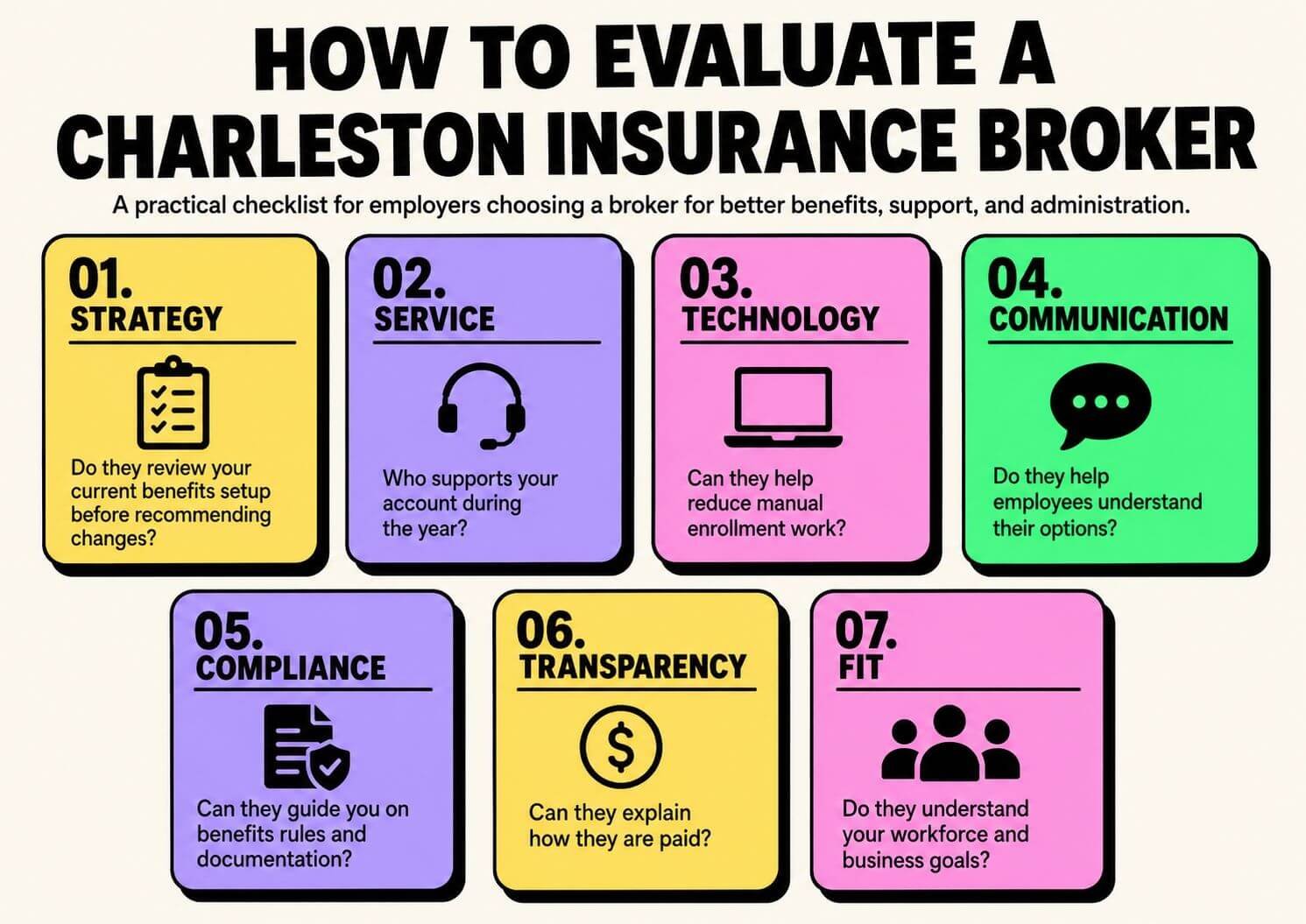
Questions Worth Asking Before You Choose
Use these questions when comparing brokers:
- What do you review besides premium?
- How do you help us prepare before renewal?
- Who handles employee questions after enrollment?
- How do you support billing, eligibility, and carrier issues?
- What technology do you use for enrollment and reporting?
- How do you help with compliance and employee communication?
- How are you paid?
- What would you improve in our current benefits process?
The answers should be clear. If the broker gives vague responses, that may be a sign they do not have a strong service process.
Group Health, ICHRA, and Ancillary Benefits
A better broker should help you compare the right mix of benefits. For some Charleston employers, a traditional group health plan may still be the right fit. For others, different plan designs may deserve a closer look.
Common options include:
- Group health insurance: Often works well for stable teams that want a familiar benefits structure.
- ICHRA: May fit employers with mixed teams, budget pressure, or employees in different areas.
- Ancillary benefits: Includes dental, vision, life, disability, accident, critical illness, and hospital indemnity coverage.
For employers with mixed teams or budget concerns, ICHRA options may be worth reviewing. But they should be compared carefully against group coverage. The right broker should not push one answer for every employer. They should explain how each option affects cost, employee choice, administration, and communication.
Administration Is Where Benefits Either Work or Break Down
A benefits plan can look good on paper and still create problems if the process behind it is messy. This is where many employers feel the hidden cost of poor broker support. HR may be stuck handling forms, eligibility updates, billing problems, payroll deduction questions, and employee confusion. Strong benefits administration support can reduce manual work and help keep the process cleaner throughout the year.
A broker should help with:
- Online enrollment
- New hire benefit setup
- Eligibility changes
- Payroll coordination
- Carrier questions
- Employee plan questions
- Reporting
- Renewal preparation
If benefits admin is difficult every month, the issue may not only be the plan. It may also be the support model.
Why Charleston Workforce Pressure Makes Benefits Matter
Charleston employers compete for people across many industries, including healthcare, hospitality, trades, logistics, manufacturing, professional services, and growing small businesses. That makes benefits communication and plan quality more important. Employees may compare not only pay, but also health coverage, family costs, plan access, and how easy the benefits are to understand.
The Charleston Regional Development Alliance reports that the region has 460,000+ skilled workers and added nearly 100,000 workers from 2015 to 2025, growing the labor force by about 26.7%.
That kind of growth gives local employers more reason to think carefully about benefits. A broker should help you build a program that supports hiring and retention while still protecting the company’s budget.
When It Makes Sense to Review Your Broker Relationship
You do not need to switch brokers every time rates increase. But if renewal always feels rushed, employees are still confused after enrollment, or HR is spending too much time on forms, billing, eligibility, and carrier questions, it may be time to review the relationship.
A useful broker review should start with what is happening inside the business.
Ask yourself:
- Are employees using the plan?
- Are costs rising faster than expected?
- Is benefits admin taking too much HR time?
- Are employees confused every year?
- Does the current broker help after enrollment?
- Are benefits helping with hiring and retention?
For Charleston employers, this kind of review can be helpful when the team is growing, the workforce is mixed, or benefits need to do more without becoming harder to manage. Benni can help employers look at the full benefits setup and identify where strategy, administration, or employee support may need to improve. If benefits feel harder to manage every year, a broker review can show where the process needs to change before the next renewal.