Employers can spend a lot on benefits and still end up with a package employees don’t fully understand, can’t comfortably afford, or rarely use. Employee group benefits that work usually combine health coverage, retirement, paid leave, income protection, and carefully selected supplemental options with reasonable costs and clear communication.
The right mix depends on your workforce and budget. This guide is for business owners and HR teams who want to decide which benefits deserve their investment and spot where an existing package may need attention.
Key Takeaways
- Health coverage usually remains the foundation, but affordability matters as much as simply offering a plan.
- Retirement, paid leave, life, and disability benefits add protection beyond medical care by supporting employees’ income, time, and future finances.
- Dental, vision, and voluntary benefits work best when they address a real employee need, not when they’re added just to make the package look bigger.
- A benefit only works when employees understand, can afford, and use it. Enrollment by itself doesn’t prove the plan is valuable.
- Employers should review participation, employee costs, usage, feedback, administration, and total spending before deciding what to keep, change, or add.
Which Employee Group Benefits Actually Work?
There isn’t one benefits package that works for every company. A 15-person professional office may have different priorities from a 100-person manufacturer with employees at several income levels. Still, certain benefit categories consistently matter. SHRM’s 2026 Employee Benefits Survey found that 88% of employers rated health-related benefits as very or extremely important, while 82% gave the same rating to retirement benefits and 82% to leave benefits. useful question isn’t simply, “What can we offer?” Ask which benefits solve a meaningful employee need while remaining affordable and manageable for the business.
Health Coverage
Medical coverage is often the starting point because healthcare expenses can create a large financial burden for employees and their families. But offering a plan isn’t enough. Look at the employee premium contribution, deductible, provider network, prescription coverage, dependent cost, and how easily employees can get care. A plan with a low employer premium may become much less useful if employees face payroll deductions or out-of-pocket costs they struggle to manage. Cost and access should be reviewed together.
Retirement, Leave, and Income Protection
Employees also need protection when they’re not dealing with a routine medical bill. Retirement benefits help employees prepare for long-term financial needs. Paid leave gives people room to handle illness, family responsibilities, and other time away from work. Life insurance and short-term or long-term disability coverage can provide financial support when death, illness, or an injury affects household income. These benefits don’t need to be complicated. The goal is to cover meaningful financial risks without filling the package with options employees don’t need.
Dental, Vision, and Voluntary Benefits
Dental and vision coverage can round out the core package, especially when employees regularly use those services. Employers can also offer voluntary supplemental benefits to help with expenses tied to accidents, serious illnesses, hospital stays, and other covered events. More options aren’t always better. If employees receive a long list of plans with little explanation, choice can turn into confusion. Pick options that fit the workforce, then explain what each one does and what employees will pay.
What Makes an Employee Benefit Actually Work?
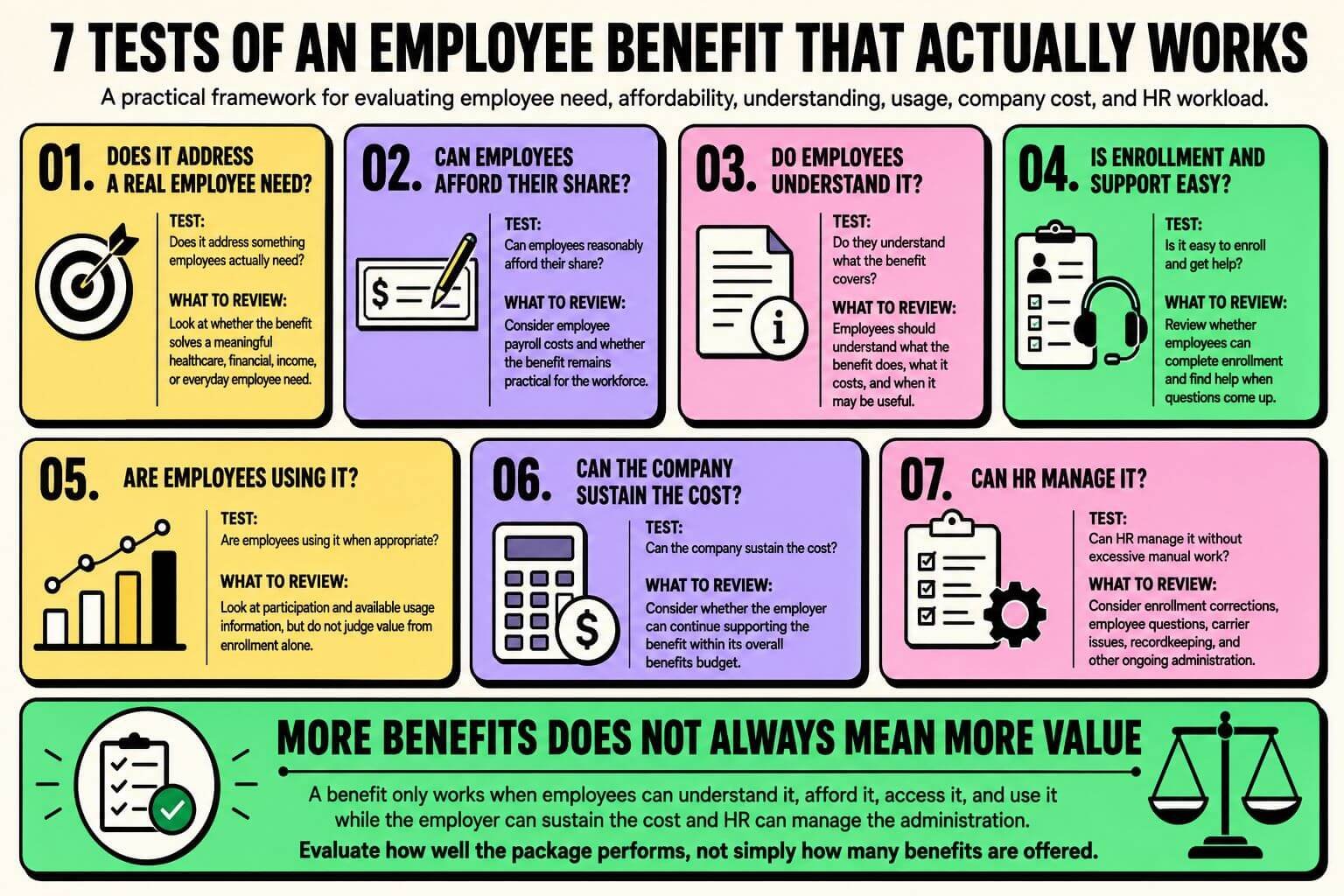
A benefit can look impressive during enrollment and still provide little value afterward. For most employers, a useful benefit should pass a few basic tests:
- Does it address something employees actually need?
- Can employees reasonably afford their share?
- Do they understand what the benefit covers?
- Is it easy to enroll and get help?
- Are employees using it when appropriate?
- Can the company sustain the cost?
- Can HR manage it without excessive manual work?
Looking at benefits this way changes the conversation from how many benefits you offer to how well the package performs.
Employees Have to Value and Afford It
Employee preference matters, but affordability often decides whether people can actually use a benefit. That concern is easy to see in South Carolina. KFF reports that the average annual employer-based family health premium in the state was $22,035, with employers contributing about $15,650 and employees contributing about $6,384. an employer reviewing health coverage, that makes employee contributions worth close attention. Also look at deductibles, dependent premiums, copays, and the income levels across your workforce. A benefit may be valuable in principle while still being difficult for some employees to use because of its cost.
Employees Have to Understand and Use It
Have you ever offered a benefit that sounded useful but drew very little participation? The problem may not be the benefit itself. Employees may not understand what it covers, how much it costs, when they should use it, or where to go for help. That makes benefit communication part of plan performance, not just an enrollment task. Good benefits administration technology also reduces enrollment confusion and helps HR keep employee, payroll, and carrier information organized. Clear explanations, simple enrollment steps, and easy access to plan information can make an existing package more useful without adding another benefit.
Why Employee Benefits Stop Working
Benefits usually become less effective for practical reasons, not because every traditional plan is outdated. Common problems include:
- The workforce changes. A package designed several years ago may no longer match employee ages, family needs, locations, or income levels.
- Employee costs rise too far. Employees may decline coverage or avoid using it.
- The same plans renew without enough review. Keeping last year’s package may feel easier, but it can hide growing problems.
- Too many choices create confusion. More plans can mean more questions rather than more value.
- Optional benefits receive little explanation. Employees can’t make good choices if they don’t understand the coverage.
- Administration becomes fragmented. Separate systems and manual processes can create extra work for HR.
- Premium becomes the only measure. A lower premium doesn’t automatically mean better value.
Fixing these issues can sometimes matter more than adding another product.
How Funding and Plan Design Affect Results
Two employers can both provide health benefits and have very different experiences with cost, employee choice, and administration. A company may use fully insured group coverage, consider level-funded or self-funded approaches where appropriate, or compare group coverage with an individual coverage reimbursement arrangement.
Some employers consider ICHRA options because they want another way to set employer contributions while allowing eligible employees to purchase individual health coverage. No funding structure is automatically right for every employer. Company size, employee needs, budget, risk tolerance, contribution strategy, and administrative capacity all matter. The same applies to voluntary coverage. Adding employee-paid options can broaden the package, but those options still need to solve a clear need and be explained well.
How Employers Can Tell if Their Benefits Are Working
You don’t need one perfect metric. Instead, review several signs together. Before renewal, look at:
- Enrollment: Are eligible employees choosing the benefit?
- Employee cost: Are payroll contributions still reasonable for the workforce?
- Usage: Are employees using the benefit where utilization information is available?
- Employee questions: Which plans create repeated confusion?
- Feedback: What do employees value, dislike, or wish they had?
- HR workload: How much time goes into enrollment corrections, carrier issues, and routine questions?
- Employer spending: What is the company paying in premiums, contributions, administration, and related costs?
- Recruiting feedback: Are candidates asking for benefits you don’t currently offer?
- Retention patterns: Are benefits coming up in exit conversations or employee feedback?
- Renewal changes: Has the cost or design shifted enough to justify comparing other approaches?
Don’t assume low participation always means a benefit should disappear. Employees might not need it, but they might also find it confusing or too expensive. Look for the reason before making the decision.
Review Your Benefits Before Adding More
Adding another benefit isn’t always the answer. Before expanding the package, look closely at what employees already have and how well those benefits are performing. Start with participation, employee contributions, common questions, available utilization information, and the amount of time HR spends handling enrollment or benefit issues. A plan with low participation may need better communication. A heavily used benefit may still need changes if employee costs have become difficult to manage.
The review may also uncover real gaps. Employees might have good medical coverage, but limited income protection, or the company may offer several optional plans that few people understand. Benni Agency helps employers review their current benefit mix, compare plan and contribution choices, and identify areas worth keeping, changing, or simplifying. The point isn’t to add more benefits. It’s to make sure the benefits you’re paying for still make sense for your employees and your budget.