Choosing employee health insurance can feel difficult when several plans have similar premiums but very different networks, deductibles, prescription benefits, and employee costs. Charleston SMBs should compare coverage based on their workforce, budget, local provider access, plan structure, and administrative needs instead of choosing the lowest-priced quote.
This guide is written for Charleston business owners, employers, and HR leaders who want to compare their options clearly, avoid costly plan-selection mistakes, and choose coverage that employees can understand and use.
Key Takeaways
- Start with your workforce. Review eligibility, employee locations, family needs, doctors, prescriptions, and payroll affordability before requesting quotes.
- Compare total costs. Deductibles, copays, dependent coverage, and out-of-pocket limits matter just as much as monthly premiums.
- Verify Charleston provider access. Check whether each plan includes the hospitals, doctors, specialists, and pharmacies employees use.
- Compare plan structures fairly. Traditional group coverage, ICHRA, QSEHRA, and level-funded plans work differently.
- Review enrollment and administration. A plan can look good on paper but still create problems if employees cannot understand it or the company cannot manage it.
Start With Your Workforce, Not the Insurance Quote
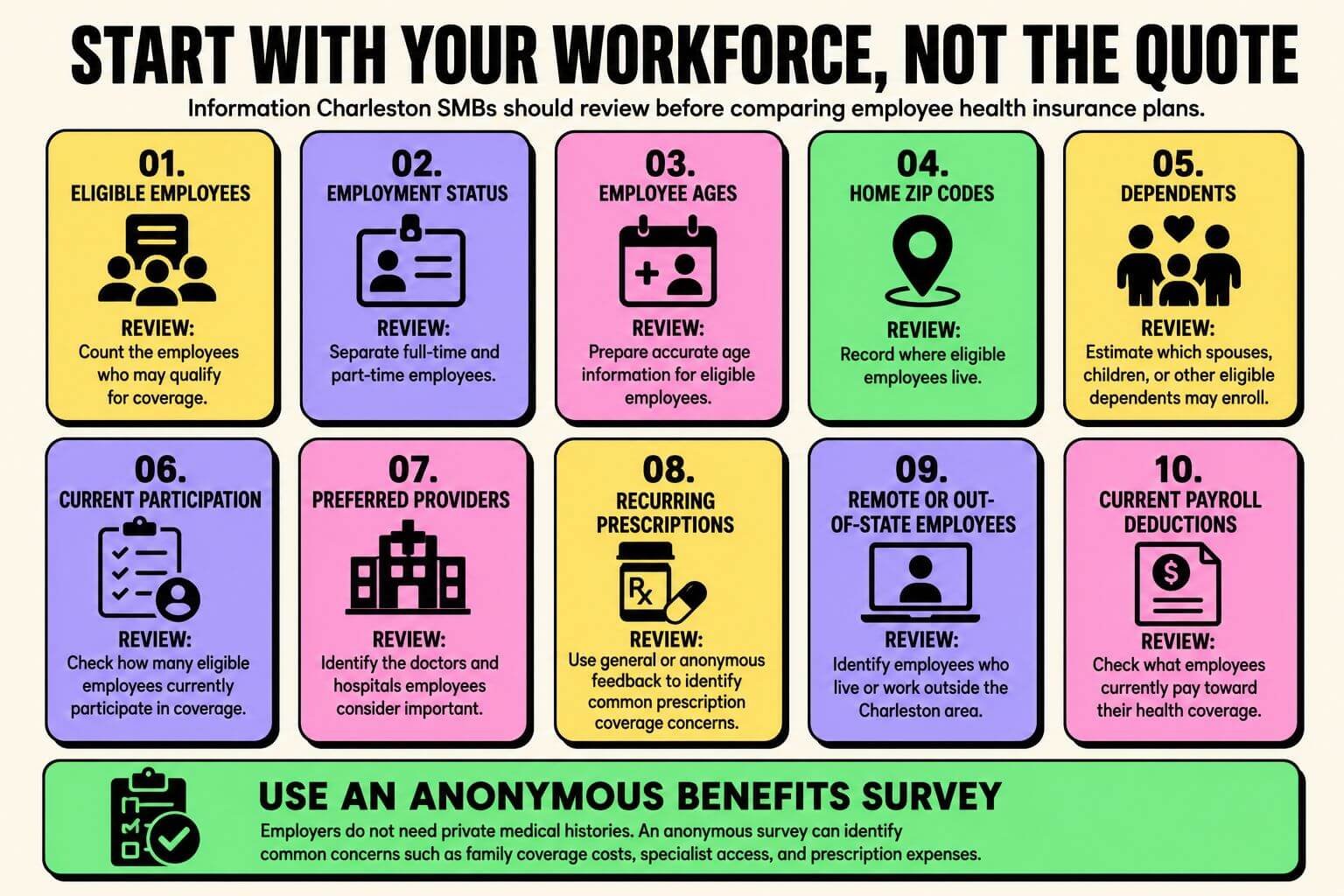
Before comparing plans, get a clear picture of the employees who may need coverage. A quote based on incomplete information may not show the company’s likely cost or whether the plan will work for the people being covered. Start by reviewing:
- Number of eligible employees
- Full-time and part-time status
- Employee ages
- Home ZIP codes
- Dependents who may enroll
- Current participation
- Preferred doctors and hospitals
- Recurring prescriptions
- Remote or out-of-state employees
- Current employee payroll deductions
You do not need employees to share private medical histories. However, an anonymous benefits survey can help identify common concerns, such as expensive family coverage, limited specialist access, or high prescription costs.
Review Employee Needs and Eligibility
Workforce needs can vary widely inside the same company. One employee may care most about keeping a current doctor. Another may need affordable family coverage. Someone who rarely visits a doctor may prefer a lower premium, while an employee who receives regular treatment may focus more on deductibles and specialist costs.
Employee location also matters. A network that works well in Charleston may offer weaker access for someone living in another part of South Carolina or working remotely in another state. Review who is eligible, where employees live, and what types of coverage they are likely to use before comparing plan designs.
Set a Realistic Employer Budget
Decide how much the company can contribute before reviewing quotes. Look at both the total employer budget and the amount employees would pay through payroll deductions. Ask practical questions:
- How much can the company contribute each month?
- Will the contribution cover employees only or also dependents?
- Can lower-paid employees afford their share?
- Could high family premiums reduce enrollment?
- How would a future rate increase affect the budget?
Charleston businesses employ people across a wide range of occupations and income levels. The U.S. Bureau of Labor Statistics reported a mean hourly wage of $30.89 in the Charleston-North Charleston area in May 2025, compared with $33.54 nationally. Office support and food-service roles were among the area’s largest occupational groups. These differences make employee payroll deductions and out-of-pocket costs an important part of the decision. A contribution strategy that works for a professional firm may not work as well for a hospitality company with many hourly employees.
Compare the Main Health Plan Options
There is no single plan structure that works best for every Charleston employer. The right option depends on company size, budget, employee locations, risk tolerance, and administrative capacity. South Carolina’s small-group health insurance market generally includes employers with 2 to 50 employees. Employers may also have access to reimbursement arrangements or other funding structures, depending on their eligibility and circumstances.
Traditional Small-Group Health Insurance
With traditional group health insurance, the employer chooses one or more plans and usually pays part of the premium. Eligible employees can then enroll and pay their share through payroll deductions. This structure may work well when:
- Most employees live in the same region
- The company wants a shared plan
- Employees value group coverage
- The available networks fit local needs
- The employer wants a familiar enrollment process
Traditional group coverage can provide a straightforward experience, but the employer has less control over annual carrier rate changes. Employees may also have fewer individual plan choices.
ICHRA and QSEHRA Options
An Individual Coverage Health Reimbursement Arrangement, or ICHRA, allows an employer to provide a set reimbursement amount that eligible employees can use toward qualifying individual health insurance and other approved medical expenses. An ICHRA can give employees more choice, particularly when they live in different areas. However, the employer must review affordability rules, employee classes, notice requirements, individual market availability, and administrative responsibilities before adopting one. CMS confirms that ICHRAs can reimburse premiums for individual coverage when applicable conditions are met.
A Qualified Small Employer Health Reimbursement Arrangement, or QSEHRA, may be available to qualifying smaller employers that do not offer a group health plan. Contribution limits and eligibility rules apply, so employers should verify current requirements before making a decision. Neither option should be chosen only because it appears flexible. Employers still need to compare employee costs, available individual plans, provider networks, and the work required to manage reimbursements.
Level-Funded Coverage
A level-funded plan usually combines fixed monthly payments with features of self-funded coverage. Part of the payment covers expected claims, while other portions cover administration and stop-loss insurance. This structure may appeal to employers looking for more insight into claims or different cost arrangements. However, the employer should review:
- Contract terms
- Stop-loss protection
- Claims risk
- Renewal calculations
- Refund provisions
- State and federal oversight
- Administrative fees
A lower initial rate does not automatically make level funding the best choice. Employers should understand what happens when claims are higher than expected and how future renewals will be calculated.
Look Beyond the Monthly Premium
The monthly premium is easy to compare, but it does not show the full value of a plan. Review the costs paid by both the company and its employees:
- Employer premium contribution
- Employee payroll deduction
- Deductible
- Copays
- Coinsurance
- Out-of-pocket maximum
- Family or dependent premiums
- Prescription costs
- Specialist visit costs
- Administrative expenses
KFF reported that average annual employer-sponsored premiums in 2025 reached $9,325 for single coverage and $26,993 for family coverage. These are national averages, not Charleston quotes, but they show why family coverage and contribution decisions deserve close attention.
Employee Out-of-Pocket Costs
A plan with a low premium may have a high deductible or require employees to pay more for specialist visits and hospital care. Consider a hypothetical employee who pays $40 less each month under one plan but faces a deductible that is $2,000 higher. The lower premium may help during a healthy year, but it could create a larger financial burden when that employee needs care. Compare how each plan handles:
- Primary care visits
- Specialist appointments
- Urgent care
- Emergency care
- Imaging and laboratory work
- Outpatient procedures
- Hospital admissions
- Mental health services
Ask whether employees could realistically afford to use the coverage after enrolling.
Dependent and Prescription Coverage
Dependent coverage can change the employee’s cost considerably. A plan that looks affordable for employee-only coverage may become difficult to afford when a spouse or children are added. Review employee-only, employee-plus-spouse, employee-plus-child, and family rates separately. Prescription formularies also require careful attention. Check:
- Whether recurring medications are covered
- Which pricing tier applies
- Whether prior authorization is required
- Whether step therapy applies
- Whether specialty drugs use a separate process
- Which pharmacies are preferred
- Whether mail-order prescriptions are available
Employees may become dissatisfied with a plan quickly if a medication they regularly use is excluded or moved to a more expensive tier.
Check Charleston Provider Networks Carefully
An affordable plan has limited value if employees cannot easily reach the doctors, hospitals, or specialists they use. Charleston-area employees may receive care through systems such as:
- MUSC Health
- Roper St. Francis Healthcare
- Trident Health
- Independent physician groups
- Local urgent-care centers
- Behavioral health providers
- Retail and independent pharmacies
Do not assume that a carrier name guarantees access to every facility. Networks may differ between plans offered by the same insurer, and provider participation can change. Before choosing coverage, verify:
- Primary care doctors
- Pediatricians
- OB-GYN providers
- Specialists
- Hospitals
- Urgent-care locations
- Behavioral health providers
- Physical therapy
- Pharmacies
- Telehealth services
- Out-of-area care
Ask employees which providers matter most, then search each plan’s current directory. When possible, confirm network participation directly with both the carrier and provider. Also review what happens when employees travel, live outside Charleston, or have children attending college in another area.
Use a Clear Process to Compare Your Options
Health insurance comparisons become easier when every option is reviewed using the same criteria.
Review Quotes Side by Side
Create a comparison worksheet with one column for each plan. Include:
- Employer monthly cost
- Employee payroll deductions
- Deductible
- Copays and coinsurance
- Out-of-pocket maximum
- Dependent rates
- Provider network
- Prescription coverage
- HRA or savings account compatibility
- Administrative requirements
- Enrollment tools
- Renewal terms
Make sure the quotes use the same employee census and contribution assumptions. Otherwise, you may be comparing different scenarios rather than different plans. Do not eliminate a plan based on one figure. A higher-premium option may provide lower deductibles, better local networks, or more affordable family coverage.
Test the Plan Against Real Employee Scenarios
A plan summary can look reasonable until you apply it to the situations employees may actually face. Test each option against examples such as:
- An employee who needs family coverage
- A worker who regularly visits a specialist
- An employee taking a recurring prescription
- Someone expecting surgery or ongoing treatment
- A remote employee living outside South Carolina
- A lower-paid employee concerned about payroll deductions
- An employee who wants to keep a specific doctor
These examples make trade-offs easier to see. You may find that one plan works well for employees who rarely need care but creates high costs for employees with regular medical needs. Another may offer stronger coverage but require payroll deductions that reduce participation.
Plan Enrollment and Communication
Choosing the plan is only part of the work. Employees also need enough information to make their own enrollment decisions. Prepare clear explanations of:
- What is changing
- What the employer will contribute
- What employees will pay
- How the deductible works
- How to search for providers
- How prescriptions are covered
- How to enroll
- Where to ask questions
- Important deadlines
Benefits administration technology can make enrollment easier, but it does not replace employee education. Give employees enough time to review their options and avoid relying only on carrier documents filled with unfamiliar terms.
Avoid These Common Plan-Selection Mistakes
Small employers often run into trouble because they focus on one part of the plan and overlook the rest.
Choosing the Lowest Premium
A low premium may come with a high deductible, narrow network, costly prescriptions, or expensive dependent coverage. Compare the total employee and employer cost.
Ignoring Family Coverage
Employee-only coverage may look affordable while family coverage requires a much larger payroll deduction. Review every coverage tier before making a decision.
Assuming Providers Are In-Network
Carrier networks differ by plan. Verify the exact doctors, hospitals, and specialists employees use.
Overlooking Prescription Formularies
A medication covered by the current plan may be excluded or placed on a higher tier under a new one. Review common prescriptions before enrollment.
Choosing a Structure Too Early
Do not decide that the company needs an ICHRA, group plan, or level-funded arrangement before reviewing employee needs and local coverage options.
Waiting Until the Renewal Deadline
Starting late leaves less time to gather accurate census information, request quotes, check networks, and communicate changes.
Giving Employees Too Little Information
Confusing enrollment materials can lead to missed deadlines, poor plan choices, and frustration. Explain the costs and coverage in plain language.
Treating Estimated Savings as Guaranteed
Premiums, claims, employee enrollment, carrier rates, and individual market prices can change. Use projections as planning tools, not promises.
When Comparing Plans Becomes More Complicated
Comparing a few premiums may be manageable, but the decision becomes harder when networks, contribution levels, prescriptions, and employee locations begin to differ. You may need a more detailed review when your renewal increases, employees live in several areas, dependent coverage is becoming difficult to afford, or you are comparing group insurance with an HRA. The same applies when employees use different hospital systems or take medications that are handled differently by each plan.
Benni Agency can help employers organize employee census information, review plan structures, compare provider access, and understand how costs may be divided between the company and its employees. The goal is not to push one type of coverage. It is to make the trade-offs easier to see before a decision is made. Employers can learn more about Benni Agency’s Charleston benefits support and the options available for local businesses. Reviewing the details before renewal can help you avoid choosing a plan that looks affordable but does not work well for your employees.