Prescription prices can be frustrating, especially when the cost changes between pharmacies or a regular refill suddenly becomes more expensive. Florence seniors can save on prescription medications by comparing payment options, asking about lower-cost drugs, reviewing Medicare coverage, and checking assistance programs.
The lowest price may come from insurance for one medication and a pharmacy’s cash price for another. This article is for Florence seniors, caregivers, and families who want to lower medication costs without making unsafe changes or overlooking valuable coverage.
Key Takeaways
- Compare the final price. Check the insurance price, pharmacy cash price, discount price, and preferred-network price.
- Ask about lower-cost drugs. A generic or another covered medication may cost less, but any change must be approved by the prescriber.
- Review Medicare coverage annually. Formularies, pharmacy networks, premiums, deductibles, and copays can change.
- Understand discount-card limits. Purchases made outside Part D may not count toward its deductible or annual out-of-pocket limit.
- Use free local guidance. Florence-area I-CARE counselors can help with Medicare questions, financial-assistance screening, and medication support.
Compare the Price You Would Actually Pay
Prescription prices can vary even when the medication, dosage, and quantity are exactly the same. A pharmacy may be preferred by one insurance plan but out of network for another. Cash prices and discount-card prices can also differ. Before filling an expensive or recurring prescription, ask the pharmacy to compare:
- Your price through insurance
- The pharmacy’s regular cash price
- The price at a preferred-network pharmacy
- A legitimate prescription discount price
- The cost of a 30-day versus 90-day refill
- In-store and mail-order prices
Focus on the amount you will actually pay, not the advertised percentage discount. A card offering a large discount may still produce a higher final price than insurance or the pharmacy’s regular cash rate.
For several medications, write down each final price before deciding. The best payment method may be different for every prescription.
Check Insurance, Cash, and Discount Prices
A prescription discount card can sometimes reduce the cash price, including for people who have Medicare. The pharmacy generally processes the purchase as a cash transaction rather than a Part D claim. That distinction matters. Medicare explains that prescription discount cards are not insurance or creditable drug coverage. When someone buys a medication outside Part D, that payment generally does not count toward the plan’s deductible or annual out-of-pocket limit. Before choosing a discount price, ask:
- Is this price lower than my insurance copay?
- Will this payment count toward my Part D spending?
- Is this pharmacy in my plan’s preferred network?
- Will using cash affect a prior authorization or coverage requirement?
A lower price today may still be the right choice, but it helps to understand what you may give up by not processing the prescription through insurance.
Compare 30-Day, 90-Day, and Mail-Order Options
A 90-day supply may lower the cost per refill and reduce trips to the pharmacy. Mail-order pharmacies may also offer savings for maintenance medications taken regularly. Neither option is automatically cheaper.
Compare the total price and cost per dose before switching. Also consider whether the medication or dosage is stable enough for a longer supply. A 90-day refill may not make sense when a doctor expects to adjust the dose soon. Ask the prescriber and pharmacist whether:
- The medication is suitable for a 90-day supply
- Your plan offers a lower copay for longer refills
- Mail order is required or simply optional
- Shipping could delay an urgently needed medication
- Automatic refills could create unused medication
Ask About Lower-Cost Medication Options
Sometimes the biggest savings come from changing the medication rather than changing the pharmacy. That does not mean choosing a drug on your own. It means asking the prescriber and pharmacist whether an approved, lower-cost option could provide the same intended treatment.
Bring up cost before leaving the doctor’s office. A simple question such as, “Is there a less expensive drug on my plan that would work for me?” can help the prescriber consider both your health needs and your budget.
Ask Whether a Generic or Covered Alternative Is Appropriate
FDA-approved generic medications provide the same clinical benefit as their brand-name counterparts and must meet the same standards for strength, quality, safety, and effectiveness. A generic may cost less, but price is not the only issue to discuss. Another medication in the same treatment category may also be placed on a lower insurance tier. Questions to ask include:
- Is there an FDA-approved generic for this medication?
- Does my plan cover another suitable drug at a lower tier?
- Would changing the dosage form affect the price?
- Does the alternative require prior authorization?
- Is there a medical reason I should stay with the current drug?
Never stop a medication, take fewer doses, split tablets, or switch drugs without guidance from the appropriate healthcare professional.
Check Manufacturer and Patient Assistance Programs
Manufacturers sometimes provide patient assistance for expensive brand-name medications. Eligibility may depend on income, insurance status, diagnosis, and the specific drug. Some programs provide free medication, while others offer temporary copay help or reduced prices. Availability and rules can change, so avoid relying on an old program description. To check for assistance:
- Visit the manufacturer’s official website.
- Ask the prescribing office whether it helps with applications.
- Speak with the pharmacist about available programs.
- Ask a Medicare or I-CARE counselor to screen for additional support.
- Confirm whether assistance affects Medicare spending calculations.
Be cautious with websites that request payment simply to apply for a free assistance program. Verify the organization before providing financial, Medicare, or medical information.
Use Medicare Drug Coverage Carefully
Medicare Part D can lower prescription costs, but plans do not cover every medication in the same way. A drug’s formulary tier, pharmacy network, deductible, and coverage requirements can all affect the final price. That is why a plan that worked well last year may not remain the best option this year.
Review Part D Costs and Pharmacy Networks
Before comparing Part D plans, prepare a complete list of:
- Medication names
- Dosages
- Refill quantities
- Preferred pharmacies
- Current prescribers
- Expected medication changes
Then check whether each medication is covered, which tier it appears on, and whether the plan requires prior authorization, step therapy, or quantity limits. In 2026, a Part D plan may charge a deductible of up to $615. Once covered out-of-pocket Part D spending reaches $2,100, the beneficiary enters catastrophic coverage and pays nothing for covered Part D drugs for the rest of the calendar year.
These figures can change each year, so use current Medicare information when comparing plans. Medicare also offers a Prescription Payment Plan that can spread covered drug costs across monthly payments. It may make large early-year bills easier to manage, but it does not lower the total prescription cost.
Check Whether Extra Help Could Lower Costs
Extra Help is a Medicare program for people with limited income and resources. It may reduce Part D premiums, deductibles, and prescription copays. For 2026, Medicare lists general income limits of $23,940 for an individual and $32,460 for a married couple, along with separate resource limits. Some people qualify automatically because they receive Medicaid, Supplemental Security Income, or help from a Medicare Savings Program. Under Extra Help in 2026, qualifying beneficiaries may have:
- A $0 plan premium
- A $0 deductible
- Generic copays of up to $5.10
- Brand-name copays of up to $12.65
- No copay after reaching the annual covered-drug limit
Income and resource rules can change. Seniors who are close to the limit should still apply or speak with a qualified counselor rather than assuming they will not qualify.
Know What to Consider Without Part D
Florence seniors without Part D can still compare pharmacy cash prices, ask about generics, and check patient assistance programs. They should also find out whether they have another form of creditable prescription coverage. Medicare may add a lasting late-enrollment penalty when someone goes 63 consecutive days or longer without Part D or other creditable drug coverage after becoming eligible. The penalty generally increases the longer the person remains uncovered. Before delaying or dropping coverage, ask:
- Is my current prescription coverage considered creditable?
- Could I owe a late-enrollment penalty later?
- Are my medications included on an affordable Part D plan?
- Do I qualify for Extra Help or another Medicare Savings Program?
- Would a free SHIP or I-CARE review clarify my choices?
A discount card can lower a cash price, but it does not replace prescription insurance or protect against a future Medicare penalty.
Where Florence Seniors Can Get Free Local Help
Prescription and Medicare choices can become difficult when someone takes several medications or has limited income. Florence seniors do not have to sort through every option alone. CareSouth Carolina’s Vantage Point program serves Florence County and other communities throughout the Pee Dee region. Its I-CARE specialists provide free help with Medicare, Medicaid, supplemental insurance, billing questions, financial-assistance screening, medication management, and indigent medication support. A counselor may help a senior:
- Compare Medicare prescription options
- Understand plan notices and bills
- Apply for available financial help
- Review medication-related assistance
- Report suspected Medicare fraud
- Find other local aging services
South Carolina’s State Health Insurance Assistance Program also provides free, unbiased Medicare counseling. SHIP counselors can help with Part D comparisons, enrollment questions, Medicare Savings Programs, and low-income subsidies. Bring the following information to a counseling appointment:
- Medicare and insurance cards
- A current medication list
- Dosages and refill quantities
- Preferred pharmacy information
- Recent plan notices or pharmacy bills
- Income and resource records when applying for assistance
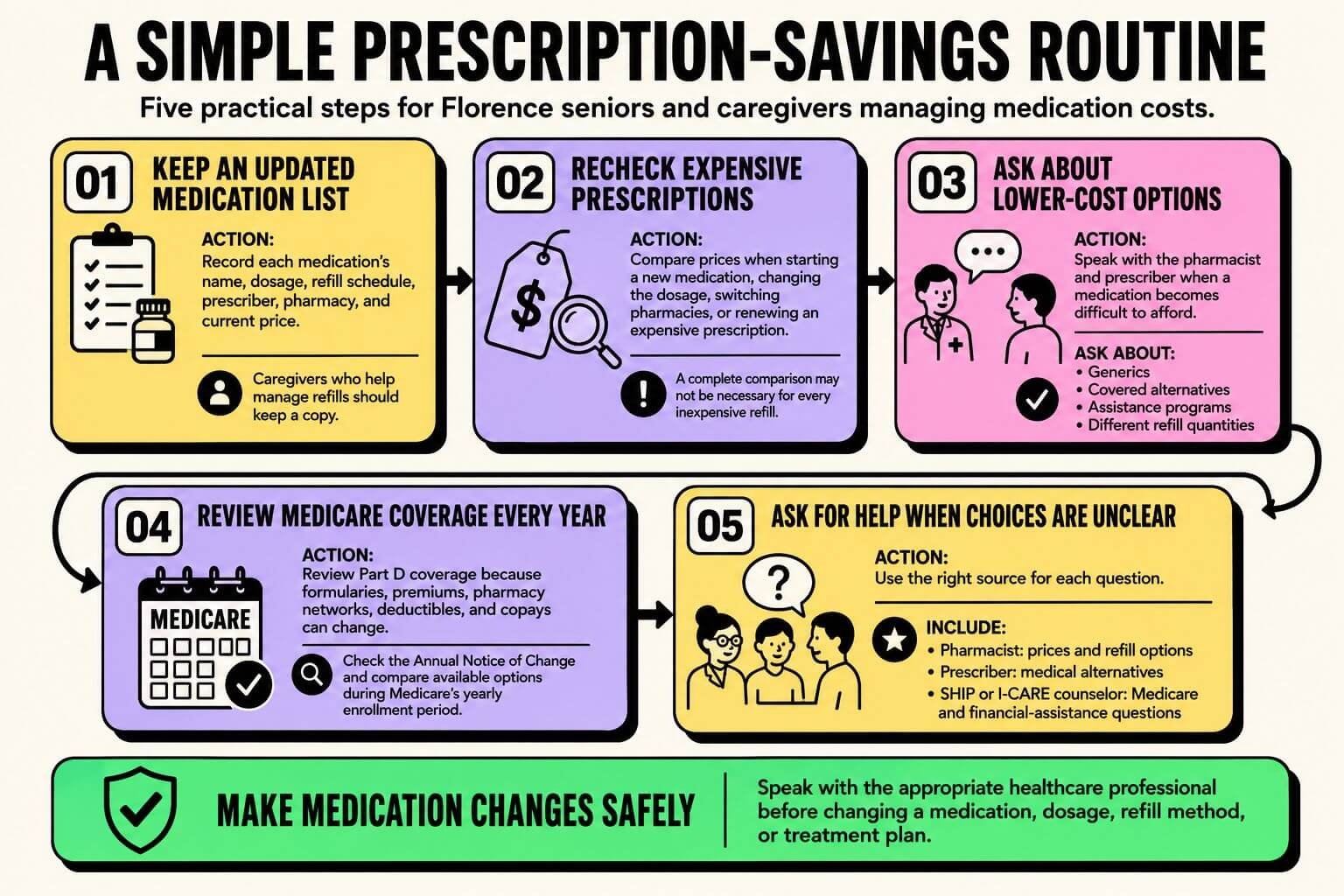
Build a Simple Prescription-Savings Routine
Prescription costs can change as medications, insurance plans, and pharmacy networks change. A simple routine makes it easier to catch new savings opportunities without starting the entire process again each month.
1. Keep an updated medication list
Include the medication name, dosage, refill schedule, prescriber, pharmacy, and what you currently pay. Caregivers should keep a copy when they help manage refills.
2. Recheck expensive prescriptions
Compare prices when starting a new drug, changing the dosage, moving to another pharmacy, or renewing a costly medication. You do not need to repeat a full comparison for every inexpensive refill.
3. Ask about lower-cost options
When a medication becomes difficult to afford, speak with the pharmacist and prescriber before changing how you take it. Ask about generics, covered alternatives, assistance programs, and different refill quantities.
4. Review Medicare coverage every year
Part D formularies, premiums, pharmacy networks, deductibles, and copays can change. Review the Annual Notice of Change and compare options during Medicare’s yearly enrollment period.
5. Ask for help when the choices are unclear
A pharmacist can explain prices and refill options. A prescriber can discuss medical alternatives. SHIP and I-CARE counselors can help with Medicare and financial-assistance questions. Using the right person for each question can save time and reduce costly mistakes.
Make Prescription Benefits Easier for Florence Employees
Prescription costs do not affect only retirees. Florence employers may have older workers approaching Medicare eligibility, employees managing ongoing conditions, or team members helping parents understand prescription coverage. Clear benefit communication can help employees find preferred pharmacies, check covered-drug lists, compare mail-order options, and understand how eligible HSA, FSA, or HRA funds may be used. Employees also need to know where employer-plan guidance ends and individual Medicare counseling begins.
Benni Agency helps local businesses review Florence employee benefits, including medical coverage, tax-advantaged accounts, enrollment support, and employee communication. The goal is to give employees useful information before they face an unexpected cost at the pharmacy. Florence employers can review their prescription benefits and educational materials before the next enrollment or plan-renewal period.