Contractors regularly move tools among their shops, vehicles, temporary storage areas, and job sites. That movement can create a property-insurance gap because coverage under a commercial property policy or Business Owners Policy may be tied primarily to listed premises or may provide only limited off-premises protection. Inland marine insurance can address eligible tools and equipment while they are transported or used away from the main business location. The exact protection depends on the policy form, limits, valuation terms, and exclusions.
Key Takeaways
- Inland marine insurance can cover eligible tools and mobile equipment in transit, at temporary locations, or at job sites.
- Commercial property or BOP coverage may include some off-premises protection, so existing limits and terms should be checked before adding coverage.
- Tools can be scheduled individually, covered under a blanket limit, or insured through a combination of both approaches.
- Theft conditions, per-item limits, valuation provisions, deductibles, and equipment-location requirements can materially affect a claim.
- Commercial auto generally covers the insured vehicle, not every tool or piece of equipment carried inside it.
What Inland Marine Insurance Can Cover
Despite its name, inland marine insurance is not limited to boats or property moving over water. It developed as an extension of marine insurance for property transported over land and property that does not remain at one fixed location. The Insurance Information Institute explains that inland marine insurance can cover products, materials, and equipment transported over land or temporarily stored by another party. Construction and contracting equipment are common examples.
A contractors’ tools and equipment form may cover eligible property against risks such as:
- Theft from a job site, trailer, or vehicle
- Fire, wind, vandalism, or falling objects
- Damage during loading, unloading, or transportation
- Collision or overturn involving the transporting vehicle
- Accidental direct physical damage at a covered location
Coverage is not uniform. Some forms cover risks unless specifically excluded, while others contain narrower terms, sublimits, or additional conditions. The declarations, endorsements, and exclusions determine whether a particular tool, location, and cause of loss are covered.
When Existing Property Coverage May Not Be Enough
Commercial property insurance usually focuses on buildings and business personal property at locations shown on the policy. A Business Owners Policy may provide some coverage for property temporarily away from the premises, but the available amount can be lower than the value of a contractor’s mobile inventory. That difference matters when a crew carries several power tools, testing devices, generators, or specialty equipment in one vehicle. Even if limited off-premises coverage applies, a loss could exceed the applicable sublimit.
Businesses should compare the value of equipment that can be away from the main premises at one time with the actual off-premises limit. They should also verify whether the policy covers property in transit, property left at a job site, and property kept overnight in a vehicle or trailer. Charleston business owners reviewing this exposure within a broader insurance program can use Benni Agency’s Charleston insurance and employee benefits page to identify related commercial coverage categories without treating the location page as a substitute for the issued policy.
Scheduled, Blanket, and Installation Coverage
The right structure depends on the types of property being moved and how accurately the business can maintain an inventory.
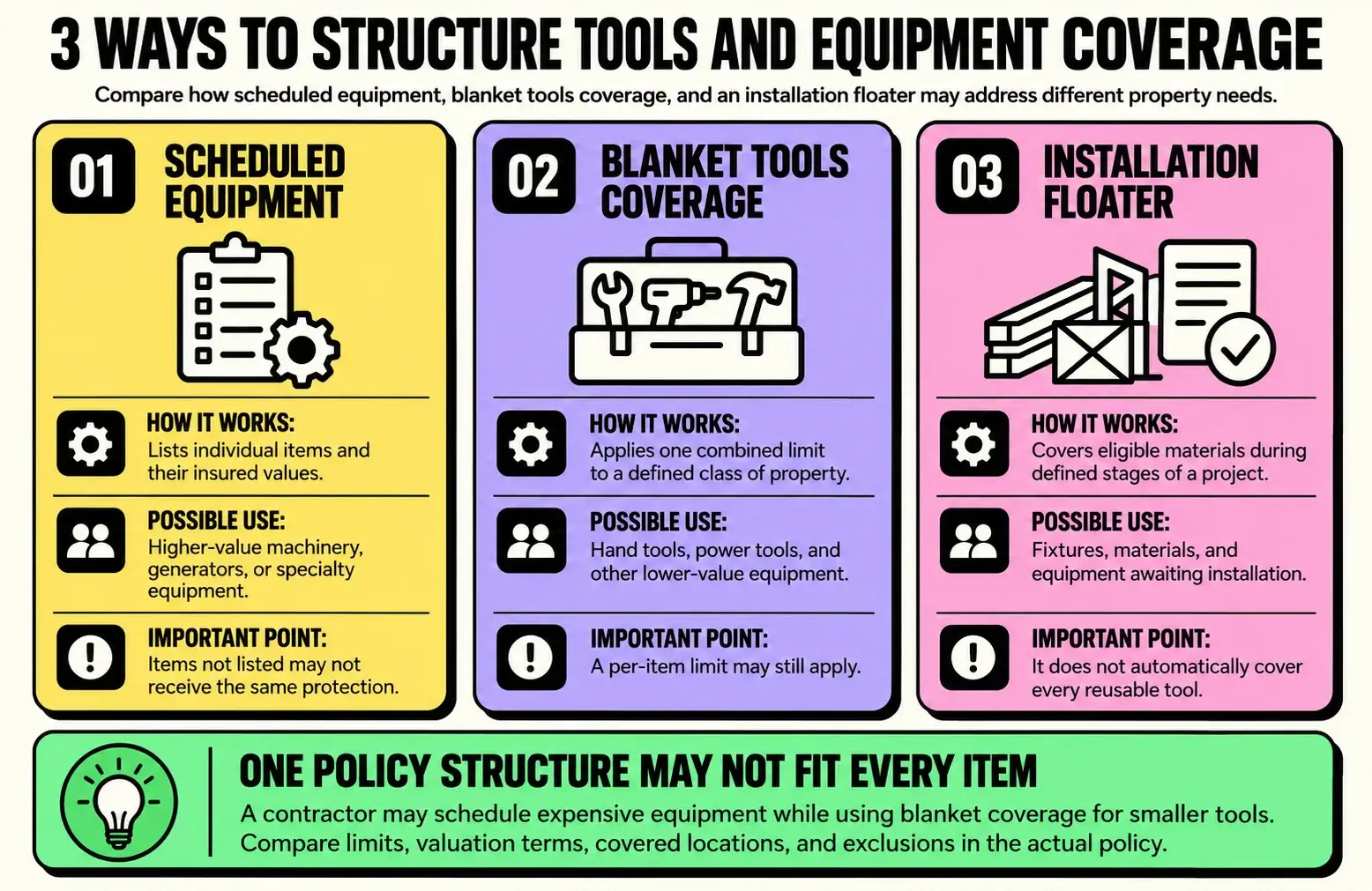
| Coverage structure | How it generally works | Possible use |
| Scheduled equipment | Lists individual items and their insured values | Higher-value machinery, generators, or specialty equipment |
| Blanket tools coverage | Applies one combined limit to a defined class of property | Hand tools, power tools, and other lower-value equipment |
| Installation floater | Covers eligible materials intended for installation during defined stages of a project | Fixtures, materials, and equipment awaiting installation |
A business may schedule its most expensive equipment while using a blanket limit for numerous smaller tools. However, blanket coverage can still include a maximum payable amount for any one item. Equipment worth more than that per-item limit may need to be scheduled separately. An installation floater serves another purpose. It can cover eligible materials during transit, temporary storage, and installation, subject to the form’s starting and ending points. It should not automatically be treated as coverage for every reusable tool owned by the contractor.
How Inland Marine Differs From Other Business Policies
Several policies may apply to a contractor’s operations, but they insure different exposures.
Commercial auto insurance addresses vehicle liability and, when selected, physical damage to the insured vehicle. Tools or equipment carried as cargo are not automatically covered simply because the vehicle has commercial auto insurance.
General liability insurance generally responds to covered third-party bodily injury or property damage claims. It does not ordinarily insure the contractor’s own tools against theft or accidental damage.
Equipment breakdown insurance is designed for specified mechanical, electrical, or pressure-system breakdown exposures. It is different from a tools floater that may respond to covered transit damage or theft.
Motor truck cargo coverage generally addresses a carrier’s responsibility for customers’ goods being transported. A contractor moving its own tools presents a different exposure.
These distinctions should be reviewed together because one incident can involve more than one policy. A vehicle collision, for example, could damage the truck and the equipment inside it, with different coverage potentially applying to each.
Exclusions and Conditions to Review
According to The Hartford’s inland marine overview, common exclusions can include normal wear and tear, deterioration, mechanical breakdown, employee dishonesty, intentional acts, vehicles, and certain property that has not been properly scheduled.
A tools and equipment form may also contain important conditions involving:
- Theft from an unattended vehicle or trailer
- Required signs of forced entry
- Unexplained disappearance or inventory shortages
- Property owned by employees or subcontractors
- Rented, leased, or borrowed equipment
- Waterborne transportation
- Territorial limits
- Maximum amounts for individual items
- Protective devices or storage requirements
These provisions vary. A policy described as broad or open-perils coverage still does not cover every cause of loss. Businesses should review the complete form instead of relying only on a coverage label or summary.
Choosing Limits and Valuation
Begin with a current inventory showing each item’s description, serial number, purchase date, ownership status, and estimated value. Photographs, receipts, rental agreements, and appraisals can make the records more useful during underwriting and after a loss. Next, identify the largest concentration of equipment likely to be in one vehicle, trailer, storage area, or job site. A total inventory value alone may not reveal the amount exposed to one event. Valuation also matters. Replacement cost may pay according to the cost of replacing covered property, subject to the policy terms. Actual cash value may account for depreciation. Agreed-value provisions and coinsurance requirements can create additional differences. The policy should be checked for how losses are valued and whether replacement must occur before the full replacement-cost amount becomes payable.
Preparing for an Inland Marine Quote
Before requesting proposals, gather:
- A current equipment inventory and schedule
- Values for owned, rented, leased, or borrowed property
- The maximum value carried in one vehicle or kept at one job site
- Typical operating and travel areas
- Overnight storage arrangements
- Locks, alarms, GPS devices, and other security measures
- Prior tool or equipment losses
- Desired deductibles and valuation method
Benni Agency lists inland marine and equipment coverage among the solutions available through its Business & Commercial Insurance service. A coverage review should compare proposed terms with the business’s existing property, auto, liability, and crime policies to identify overlaps and unresolved gaps. Coverage remains subject to underwriting and the issued policy’s limits, conditions, exclusions, and endorsements. This article provides general information and is not legal advice or a guarantee that a particular loss will be covered.