Commercial umbrella insurance adds liability limits above certain underlying business policies. The difficult part is not understanding what it does; it is choosing a limit that matches your contracts, operations, assets, and potential claim severity. For a North Charleston business, the right number can change as you add vehicles, locations, equipment, employees, or larger customer contracts. This guide explains how umbrella limits work, what to review before selecting one, and which assumptions can leave a business with less protection than expected.
Key Takeaways
- Commercial umbrella insurance adds liability capacity above scheduled underlying policies; it does not replace them.
- Contract, lease, and lender requirements can establish a practical minimum limit.
- Vehicle use, public access, jobsite work, and other high-severity exposures deserve extra attention.
- Umbrella and excess liability are related, but policy wording determines how broad the added protection actually is.
- Recheck limits when operations, contracts, locations, vehicles, or underlying policies change.
What Commercial Umbrella Insurance Actually Does
A commercial umbrella policy is an additional layer of liability insurance. It may sit above general liability, commercial auto liability, and employers liability when those policies are listed as underlying insurance and all policy requirements are met.
For example, if a covered commercial auto claim exceeds the auto policy’s applicable liability limit, an umbrella policy may pay covered amounts above that limit, up to the umbrella’s own applicable limit. The exact response depends on the underlying policy, umbrella form, exclusions, endorsements, and scheduled limits.
According to The Hartford’s commercial umbrella overview, umbrella coverage can extend certain liability limits and does not extend every business policy. Commercial property, for example, is not simply increased by buying an umbrella.
What It May Not Cover
Do not treat an umbrella as a catch-all. Professional liability, cyber liability, employment practices liability, damage to your own property, intentional acts, and other exposures may require separate coverage or separate excess limits. Policy forms differ, so exclusions should be checked against the actual quote and specimen or issued policy.
Commercial Umbrella vs. Excess Liability
The terms are sometimes used loosely, but they should not automatically be treated as identical. An excess liability policy may be written to follow the terms of a particular underlying policy. A true umbrella form may provide broader protection in some situations, subject to its own exclusions and retention.
The practical question is not the label alone. Ask which underlying policies are scheduled, whether the form follows the underlying coverage or has broader provisions, what exclusions apply, and whether a self-insured retention applies to any covered claim not paid by underlying insurance. Travelers’ commercial umbrella and excess liability guidance also emphasizes reviewing underlying liability limits and the specific risks being covered.
How Commercial Umbrella Limits Work
Commercial umbrella coverage often starts at $1 million and is commonly offered in $1 million increments, although available limits and underwriting rules vary by insurer and business risk.
The umbrella carrier normally requires specific underlying policies and minimum liability limits. Those requirements appear in the policy’s schedule of underlying insurance or related documents. If a required underlying policy is canceled, reduced, or changed without coordinating the umbrella, the business can create an unexpected gap or retained exposure.
That is why limit selection should begin with the full liability program, not the umbrella quote by itself.
How to Decide What Limit Fits Your Business
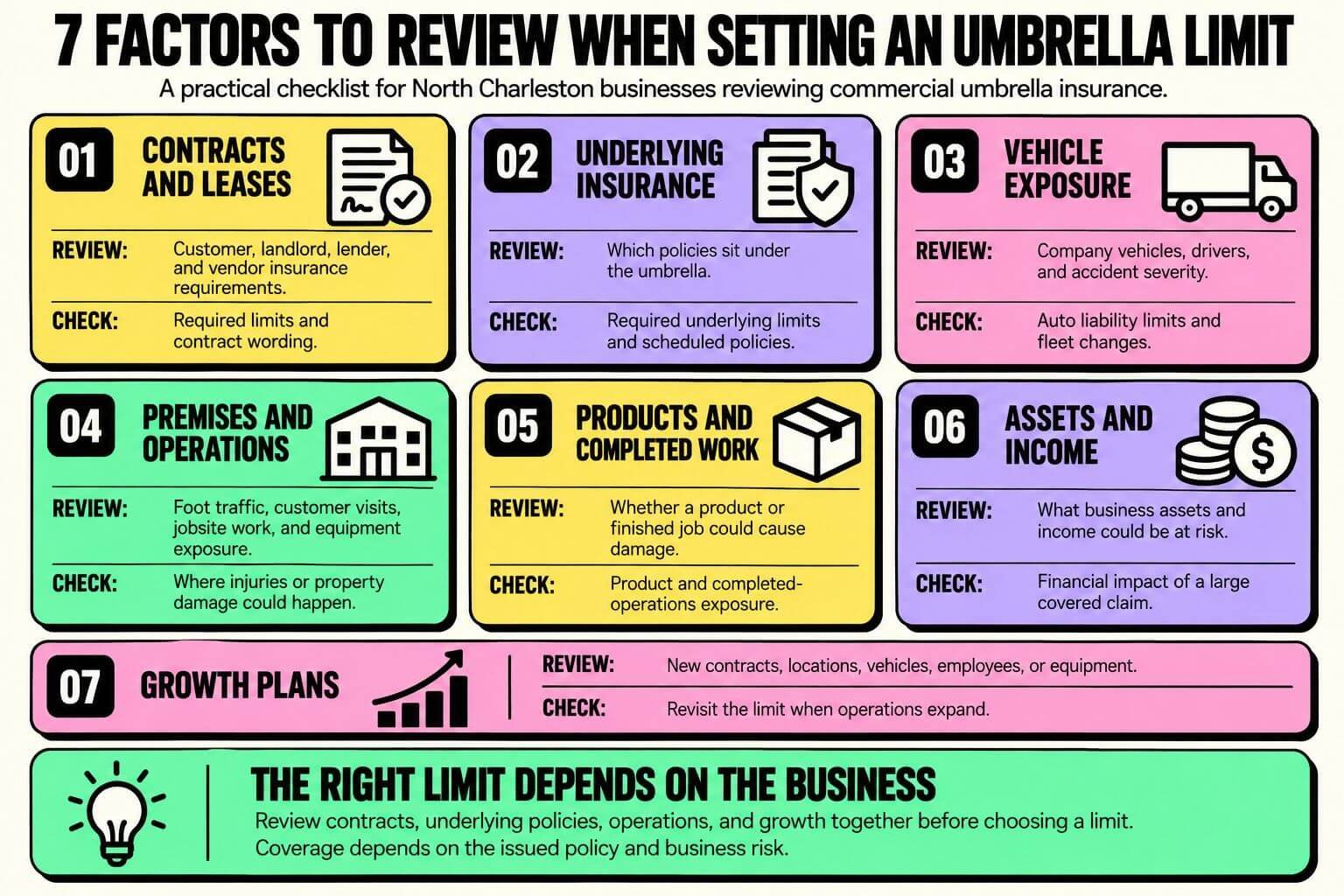
There is no universal limit that is right for every North Charleston business. A better approach is to work through the exposures that could determine how much liability capacity you need.
| Review area | Questions to ask |
| Contracts and leases | What liability limits do customers, landlords, lenders, vendors, or project owners require? |
| Underlying insurance | Which policies will sit under the umbrella, and do their limits satisfy the umbrella carrier’s requirements? |
| Vehicle exposure | How many vehicles are used, who drives them, and how severe could a multi-vehicle or pedestrian accident become? |
| Premises and operations | Does the public visit your location? Do employees work at customer sites or around heavy equipment? |
| Products and completed work | Could a product, completed job, or installation cause serious bodily injury or property damage? |
| Assets and income | What financial resources could be exposed if a covered judgment exceeds available insurance? |
| Growth plans | Are you adding contracts, locations, vehicles, employees, equipment, or new operations during the policy term? |
North Charleston has significant port, transportation, logistics, warehousing, and manufacturing activity. That does not mean every local business has the same risk. It does mean businesses connected to vehicles, cargo movement, industrial operations, or customer contracts should pay close attention to how those exposures affect both underlying liability coverage and the umbrella limit.
A professional office with little public interaction may reach a different conclusion than a contractor, warehouse, manufacturer, restaurant, or fleet operator. The decision should come from the actual operation and policy structure, not a generic industry table.
What Commercial Umbrella Insurance Costs
Umbrella premiums vary by insurer, industry, business size, selected limit, underlying coverage, and the exposures being insured. A company with multiple commercial vehicles or higher-hazard operations may be priced differently from an office-based business, even when both request the same umbrella limit.
For that reason, national average premiums are not a reliable North Charleston quote. Compare proposals using the same requested limit and confirm that the underlying requirements, exclusions, scheduled policies, and retention terms are comparable before focusing on price.
Common Mistakes When Choosing a Limit
One mistake is buying only enough coverage to satisfy today’s contract and never revisiting the decision. A business may later add vehicles, sign a larger customer agreement, open another location, or take on work with different liability requirements.
Another is assuming every liability policy automatically sits under the umbrella. Check the schedule. Professional liability, cyber, EPLI, and other policies may need their own excess coverage.
Businesses should also avoid reducing an underlying limit without checking the umbrella requirements first. A change that looks harmless on one policy can affect how the overall liability program responds.
Finally, do not assume a higher umbrella limit fixes a coverage gap. More limit does not help if the type of claim is excluded.
Reviewing Coverage With a Broker
A useful umbrella review should connect contracts, underlying policies, operational exposures, and growth plans. For North Charleston employers and business owners, Benni Agency’s North Charleston business and commercial insurance page provides a broader view of the commercial coverages that may need to work together.
Before binding coverage, ask for confirmation of the umbrella limit, underlying requirements, scheduled policies, major exclusions, coverage territory, and any self-insured retention. If a contract requires a particular limit or wording, compare the insurance requirement with the proposed policy rather than assuming the certificate alone resolves the issue.
This article is general educational information, not legal, tax, HR, or individualized insurance advice. Coverage depends on the issued policy and the facts of the claim.