For a Mount Pleasant business, the deductible shown first on a commercial property policy may not be the one that applies after a tropical storm or hurricane. A policy can use a separate hurricane, named storm, or wind/hail deductible, and that amount may be calculated as a percentage of the applicable property limit. The practical question is not simply, “What is my deductible?” It is, “Which deductible applies to this event, what limit is it based on, and how much would the business need to absorb?”
Key Takeaways
- A named storm deductible and a wind/hail deductible have different triggers.
- Percentage deductibles are calculated from the policy basis stated in the endorsement, not from the repair bill.
- South Carolina requires clear notices and examples when covered property policies include separate storm deductibles.
- Flood and storm surge require a separate coverage review from wind damage.
- Wind Pool eligibility depends on the property’s exact location, not simply a Mount Pleasant mailing address.
What Coastal Property Deductibles Mean
“Coastal property deductible” is informal shorthand for deductibles connected to hurricane, named storm, wind, or hail losses. It is not one standardized deductible. A policy may include an all other perils deductible plus one or more separate storm-related provisions. The declarations page and endorsements determine which applies. The trigger matters as much as the amount. A named storm deductible follows the policy’s named-storm definition. A wind/hail deductible may apply even when no storm receives an official name. Some policies combine terms, while others use separate endorsements.
| Deductible | Typical trigger | Possible calculation |
| All other perils | Covered losses not assigned another deductible | Stated dollar amount |
| Named storm | A qualifying officially named tropical weather event | Percentage or stated dollar amount |
| Wind/hail | Covered wind or hail loss, whether the storm is named or not | Percentage or stated dollar amount |
How a Percentage Deductible Works
A percentage deductible is generally tied to the property value or limit identified in the policy, not the claim amount. The basis can vary when a policy covers multiple buildings, uses blanket limits, or applies different limits by location.Consider a building with an applicable insured value of $750,000. If the policy applies a 3% named storm deductible to that value, the deductible would be:
$750,000 × 3% = $22,500
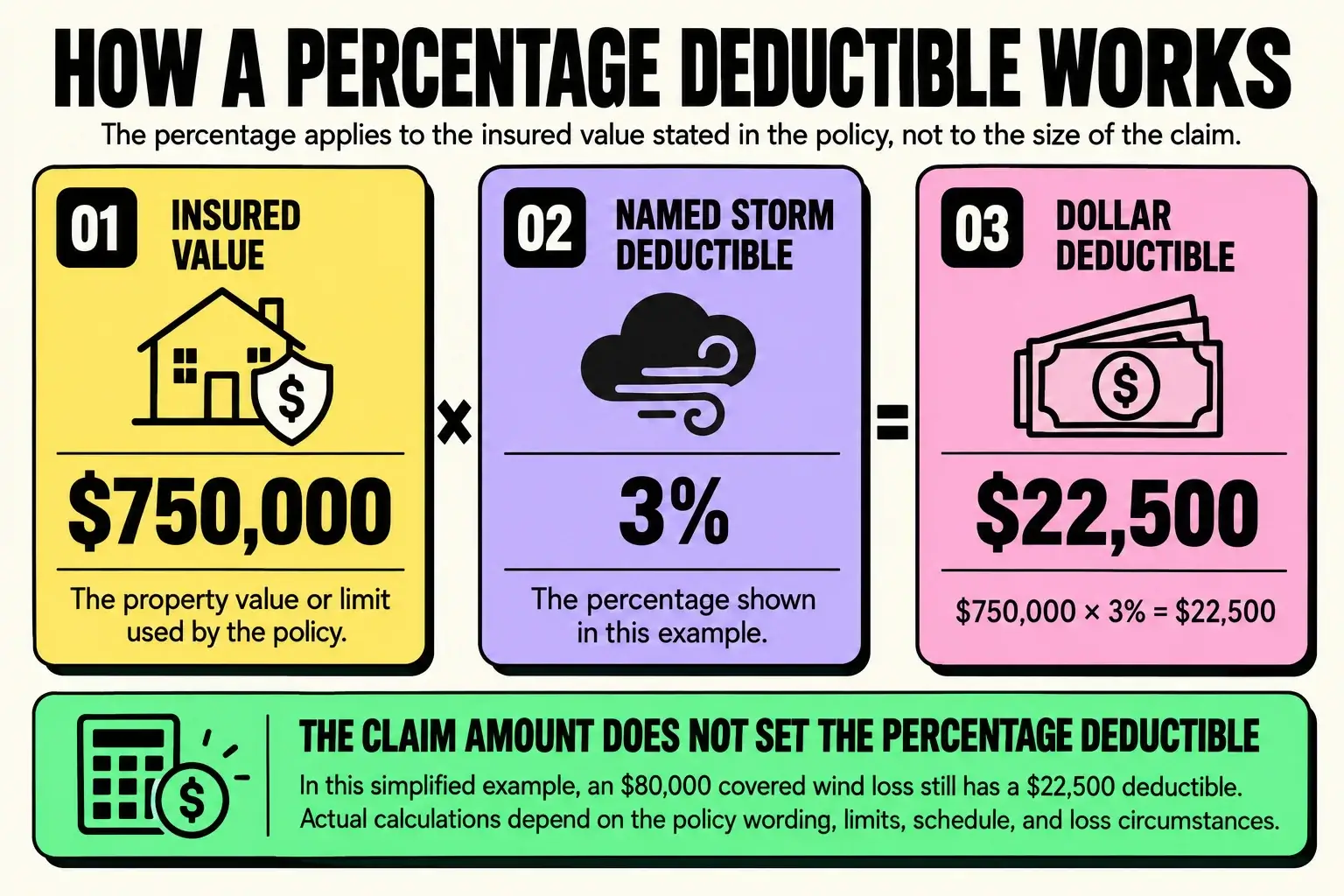
If covered wind damage were assessed at $80,000, the deductible would still be $22,500 under that simplified example. The percentage is not 3% of the $80,000 loss. This example is educational only; a real calculation depends on the policy’s wording, limits, schedule, and loss circumstances.
South Carolina’s Storm-Deductible Disclosure Rule
South Carolina Regulation 69-56 applies to personal and commercial property policies that include a hurricane, named storm, or wind/hail deductible. It defines a named storm as a hurricane, tropical storm, or tropical depression named, designated, or identified by the National Weather Service or National Hurricane Center. A media-named winter storm does not meet that definition. The regulation requires an insurer issuing or renewing a policy with one of these deductibles to provide an example using a $100,000 policy value and explain the triggering event.
It also requires a prominent notice on the policy and declarations page. If an insurer adds the deductible or increases it at renewal, the named insured must sign or initial an acknowledgment after reviewing the example. The disclosure does not replace the contract. Policy language controls how the deductible applies to a claim.
Why Wind and Flood Need Separate Reviews
Wind-driven damage and flooding can occur during the same storm, but they are not the same cause of loss. Standard commercial property forms generally exclude flood. Flood coverage may be purchased through the National Flood Insurance Program (NFIP) or a private insurer, subject to the terms and availability of the selected policy. The NFIP’s business coverage guidance states that building and contents coverage are purchased separately, each with its own deductible, and each is available up to $500,000 for eligible business policies.
The NFIP also generally imposes a 30-day waiting period, with specific exceptions. Compare the commercial property and flood policies side by side. Check how each defines flood and wind, which property is insured, whether contents are included, and what deductibles and limits apply. If property values exceed NFIP limits, ask whether private or excess flood options are available.
Mount Pleasant and the South Carolina Wind Pool
The South Carolina Wind and Hail Underwriting Association, often called the Wind Pool, is a residual-market option for eligible residential and commercial properties in designated coastal territory when wind and hail insurance cannot be obtained through the standard market. The statutory coastal territory includes specifically described portions of Charleston County. It does not automatically include every address in the county or every property with “Mount Pleasant” in its mailing address. Check eligibility using the exact location and current association guidance. Wind Pool coverage does not replace the rest of a commercial property program.
A Deductible Review Before Renewal
Use the current declarations page, endorsements, and statement of values to answer these questions:
- Which deductibles apply to all other perils, hurricane, named storm, wind, and hail?
- What event activates each storm deductible, and when does that trigger begin and end?
- Is the deductible a dollar amount or a percentage, and what limit or value is used?
- Does it apply per occurrence, per building, per location, or another way?
- Are building and business personal property treated differently?
- Is flood coverage in force, and what are its separate limits, deductibles, and waiting period?
- Could the business fund the largest applicable deductible without disrupting operations?
Also compare the deductible with business income and extra expense coverage. Those coverages may help with eligible income loss or added operating costs after a covered event, but they do not erase the property deductible. Limits, waiting periods, and coverage conditions must be reviewed separately.
Plan for the Dollar Amount, Not the Percentage
A percentage can look manageable until it is converted into cash. Recalculate the amount at every renewal because changes to insured values can increase the deductible even when the percentage stays the same. If one location has several buildings or the policy uses blanket limits, ask for a written explanation of how the deductible would be calculated in a realistic loss scenario. Some insurers may offer different deductible options, subject to underwriting and pricing. Compare the premium difference with the amount the organization could reasonably fund after a loss.
The lowest premium is not automatically the best choice if the resulting deductible would strain cash flow. Businesses that want to review storm deductibles in the context of their full insurance program can learn more about business and commercial insurance through Benni Agency. For the broader local service relationship, see Benni Agency’s Mount Pleasant insurance and employee benefits page.