When tools, a trailer, or heavy equipment disappears, the first few hours can affect both recovery efforts and the insurance claim. Contractors need to protect the scene, create a reliable record, notify the right parties, and follow the deadlines in the applicable policy.
This checklist explains what to do after equipment theft in Summerville, what records an insurer may request, and which coverage details deserve attention. Actual coverage depends on the policy language, endorsements, schedules, deductibles, exclusions, and facts of the loss.
Key Takeaways
- Protect the scene, document visible evidence, and report the theft to the appropriate law-enforcement agency promptly.
- Notify the insurer or agent as soon as practical and follow the policy’s notice, documentation, and proof-of-loss requirements.
- A detailed equipment inventory can help establish ownership, identity, condition, and value when supporting a theft claim.
- Commercial auto, general liability, commercial property, crime, and inland marine coverage address different risks and should not be assumed to cover every theft.
- Review scheduled items, blanket limits, valuation, deductibles, locations, security conditions, and rented or leased equipment before a loss occurs.
Start With Safety, Evidence, and a Police Report
Do not confront a suspected thief or enter an unsafe area. If the theft is still in progress or anyone is in danger, call 911. Otherwise, protect the site without disturbing avoidable evidence. Photograph damaged locks, cut fencing, tire marks, empty storage areas, surveillance equipment, and anything else that may help establish what happened. Write down when the property was last seen, when the loss was discovered, who had access, and what is missing. Preserve camera footage, access-control records, GPS information, telematics records, gate logs, and relevant messages before those records are overwritten.
Report the theft to the law-enforcement agency with jurisdiction over the property. For an incident within town limits, use the Summerville Police Department. For a location outside town limits, confirm whether the Dorchester County Sheriff’s Office or another municipal agency has jurisdiction. Obtain the incident or case number and ask how to provide serial numbers, photographs, GPS information, or other identifying details found later. Contractors may also consider National Equipment Register theft reporting after making the appropriate police report.
Report the Insurance Claim Promptly
Review the policy’s claim-reporting instructions and notify the insurer or agent as soon as practical. Do not wait until every receipt, serial number, or replacement estimate has been located. Provide the facts currently known, explain which documents are still being gathered, and ask where additional material should be submitted. Record the claim number, adjuster’s contact information, date and method of notice, and every requested deadline. Keep copies of emails, forms, inventories, estimates, photographs, and attachments. If the insurer requests an examination under oath, recorded statement, inspection, proof of loss, or another formal submission, read the request carefully and consider professional advice when anything is unclear.
What South Carolina’s Proof-of-Loss Rule Means
A proof of loss is generally a signed statement describing the loss and the amount claimed. It is different from the initial notice informing the insurer that a theft occurred. The policy may establish a deadline and specify the information that must be included. Under South Carolina Code § 38-59-10, when an insurer requires a written proof of loss, it must furnish the blank form.
If the insurer does not provide that form within 20 days after receiving notice of the loss, the claimant may satisfy the policy’s proof-of-loss requirement by submitting written proof covering the occurrence, character, and extent of the loss within the period fixed by the policy. This statute does not establish one universal deadline for every contractor-equipment theft claim. Confirm the deadline and required format in the policy and the insurer’s written instructions.
Build an Item-by-Item Theft File
Create a separate record for each missing item. The goal is to connect the property you owned, leased, rented, or were responsible for with the item reported to law enforcement and the value submitted to the insurer. Support ownership or responsibility with purchase invoices, financing records, rental or lease agreements, canceled checks, card statements, or other available records.
Include photographs taken before the theft, maintenance and inspection records, GPS or telematics information, and the date and location where the equipment was last seen. Replacement quotes or repair estimates can also help support value. Keep the police report number and any National Equipment Register information with the same item file. Avoid guessing at serial numbers, dates, or values. If something is uncertain, identify it as an estimate and explain how you calculated it.
Which Policy Might Respond to Stolen Equipment?
The answer depends on what was stolen, who owned it, where it was located, and how the policy was written. Coverage cannot be determined from the policy name alone.
Contractors’ Equipment or Tools Coverage
Contractors’ equipment coverage is commonly written on an inland marine form because tools and equipment move between job sites, storage locations, and vehicles. A policy may individually schedule high-value machinery, use a blanket limit for smaller tools, or use both approaches. Review the covered causes of loss, territory, unattended-vehicle conditions, security requirements, valuation method, coinsurance, deductibles, and sublimits.
Commercial Auto Coverage
Commercial auto may cover theft of a scheduled vehicle when comprehensive or another applicable physical-damage coverage has been selected. It should not automatically be treated as coverage for tools, materials, or equipment carried inside or on the vehicle. Benni Agency’s guide to commercial auto coverage in Summerville explains why the vehicle and the property carried in it may require separate coverage review.
Commercial Property, BOP, and Crime Coverage
Commercial property insurance or a Business Owners Policy may cover certain business property at described premises, but off-premises property, mobile equipment, property in transit, and outdoor property can have separate limits or exclusions. Crime coverage also serves a different purpose. Employee dishonesty and theft committed by an outside party are distinct exposures, so crime coverage should not be treated as a substitute for contractors’ equipment insurance. A coordinated review of business and commercial insurance options can help identify which policy is intended to address vehicles, fixed-location property, mobile equipment, customer property, and employee-related crime losses.
Special Issues for Rented, Leased, or Financed Equipment
Do not assume equipment is covered simply because the contractor is financially responsible for it. Rental and lease agreements may shift the risk of theft, require prompt notice, establish a valuation method, or require continued rental payments while the property is missing. A contractor’s policy may include borrowed or rented equipment only up to a separate limit and subject to specific conditions.
Notify the owner or finance company when the agreement requires it. Give the insurer the contract, equipment description, value, and any certificate or loss-payee information. Also ask how the policy treats continuing rental charges, loss-of-use charges, or contractual penalties. Those amounts may be handled differently from the physical loss of the equipment itself.
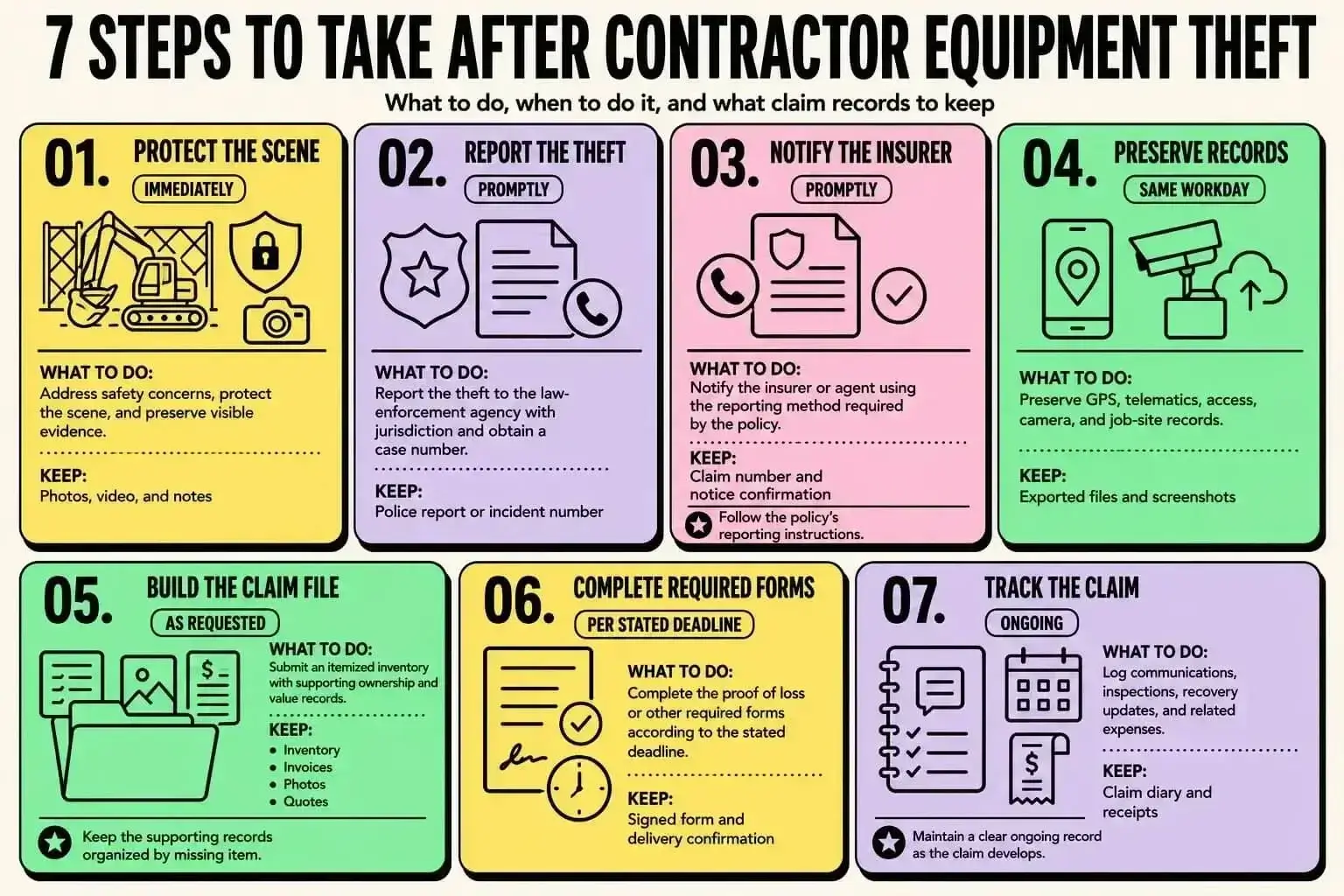
One-Page Equipment Theft Claim Checklist
| Timing | Action | Record to Keep |
| Immediately | Address safety concerns, protect the scene, and preserve visible evidence. | Photos, video, notes |
| Promptly | Report the theft to the agency with jurisdiction and obtain a case number. | Police report or incident number |
| Promptly | Notify the insurer or agent using the policy’s reporting method. | Claim number and notice confirmation |
| Same workday | Preserve GPS, telematics, access, camera, and job-site records. | Exported files and screenshots |
| As requested | Submit an itemized inventory and supporting ownership and value records. | Inventory, invoices, photos, quotes |
| Per stated deadline | Complete the proof of loss or other required forms. | Signed form and delivery confirmation |
| Ongoing | Log communications, inspections, recovery updates, and related expenses. | Claim diary and receipts |
Claim Problems a Contractor Can Prevent
A delay or coverage dispute can have many causes, and only the insurer can make the final coverage determination. Contractors can still reduce avoidable confusion by checking whether the missing item matches the serial number and description shown on the policy schedule. The claimed location, equipment use, and ownership should also match the information used to underwrite the policy. A blanket tools limit or per-item sublimit may be lower than the value claimed, while the policy’s valuation method may differ from the amount expected after a loss.
Notice, proof-of-loss, inspection, and documentation deadlines should be followed carefully. Rented, leased, borrowed, or newly acquired equipment may have separate limits or reporting requirements. If the insurer denies all or part of the claim, request the decision and the policy provisions supporting it in writing. A contractor who disagrees with the decision may wish to consult qualified legal or claims professionals.
Prepare Before the Next Loss
Maintain a current equipment register and reconcile it with the policy schedule at renewal and after major purchases. Benni Agency’s article on documenting business property values provides a related framework for invoices, photographs, and valuation records. Store serial numbers, purchase documentation, and photographs somewhere away from the job site. Confirm whether high-value equipment must be individually scheduled and compare the highest value that could be located at one job site, inside one vehicle, or at one storage location with the applicable policy limits.
Review GPS tracking, fencing, lighting, key control, immobilizers, and overnight-storage practices. Keep clear records showing who may use equipment, where it may be stored, and how transfers between crews are documented. Coverage for rented, leased, borrowed, newly acquired, or employee-owned property should also be reviewed before a loss. Security measures can help deter theft and improve recovery efforts, but they do not guarantee coverage, a premium credit, or claim payment. Any insurer credit or policy condition must be confirmed directly with the carrier.
A Local Coverage Review Should Stay Policy-Specific
The useful local question is not whether every Summerville contractor needs the same insurance. The better question is whether the contractor’s current equipment, job-site locations, vehicles, storage practices, and contracts match the coverage actually purchased. Benni Agency can help review insurance options for Summerville businesses and identify questions to raise with the insurer before equipment is stolen. Coverage recommendations should always be based on current policy forms, endorsements, operations, values, and actual equipment exposures.