General liability insurance can help with many third-party injury and property-damage claims, but it does not serve as a complete commercial insurance program. Charleston business owners should compare the policy’s exclusions, limits, endorsements, and listed operations with what the business actually does today. A gap can surface during a renewal, contract request, licensing review, or claim.
The useful question is not simply whether general liability insurance is valuable. It is whether the policy matches the people, property, vehicles, professional work, data, and alcohol-related activities connected to your operations. This guide is for Charleston business owners, operations leaders, and finance teams who want a practical policy-review checklist.
Key Takeaways
- General liability primarily addresses certain third-party bodily injury, property damage, and personal or advertising injury claims, not every risk a business faces.
- Employee injuries, professional mistakes, auto liability, cyber incidents, and damage to the business’s own property may require separate policies or coverage reviews.
- Charleston businesses that serve alcohol should verify current South Carolina liquor liability requirements based on their license and operating hours.
- A coverage gap can also come from limits, endorsements, deductibles, or contract requirements that no longer match the business’s operations.
- The best renewal review starts with current facts about operations, employees, vehicles, property, contracts, data, and licenses before discussing specific insurance products.
What General Liability Is Meant to Cover
Commercial general liability, or CGL, insurance focuses on covered third-party allegations involving bodily injury, property damage, and certain personal or advertising injuries. The exact insuring agreement, exclusions, endorsements, limits, and facts of a claim determine whether a policy responds. A CGL policy does not cover every loss connected to a company simply because an incident happened at a business location. Benni Agency’s guide to what general liability covers explains the standard role of this coverage. This article focuses on the next part of the review: identifying exposures that may need another policy, an endorsement, a limit review, or a compliance check.
Coverage Gaps That Need a Separate Review
Most potential gaps fall into one of two categories: either the loss belongs under a different line of insurance, or the CGL limits and policy terms do not match the exposure. The following are common review points, not automatic coverage recommendations.
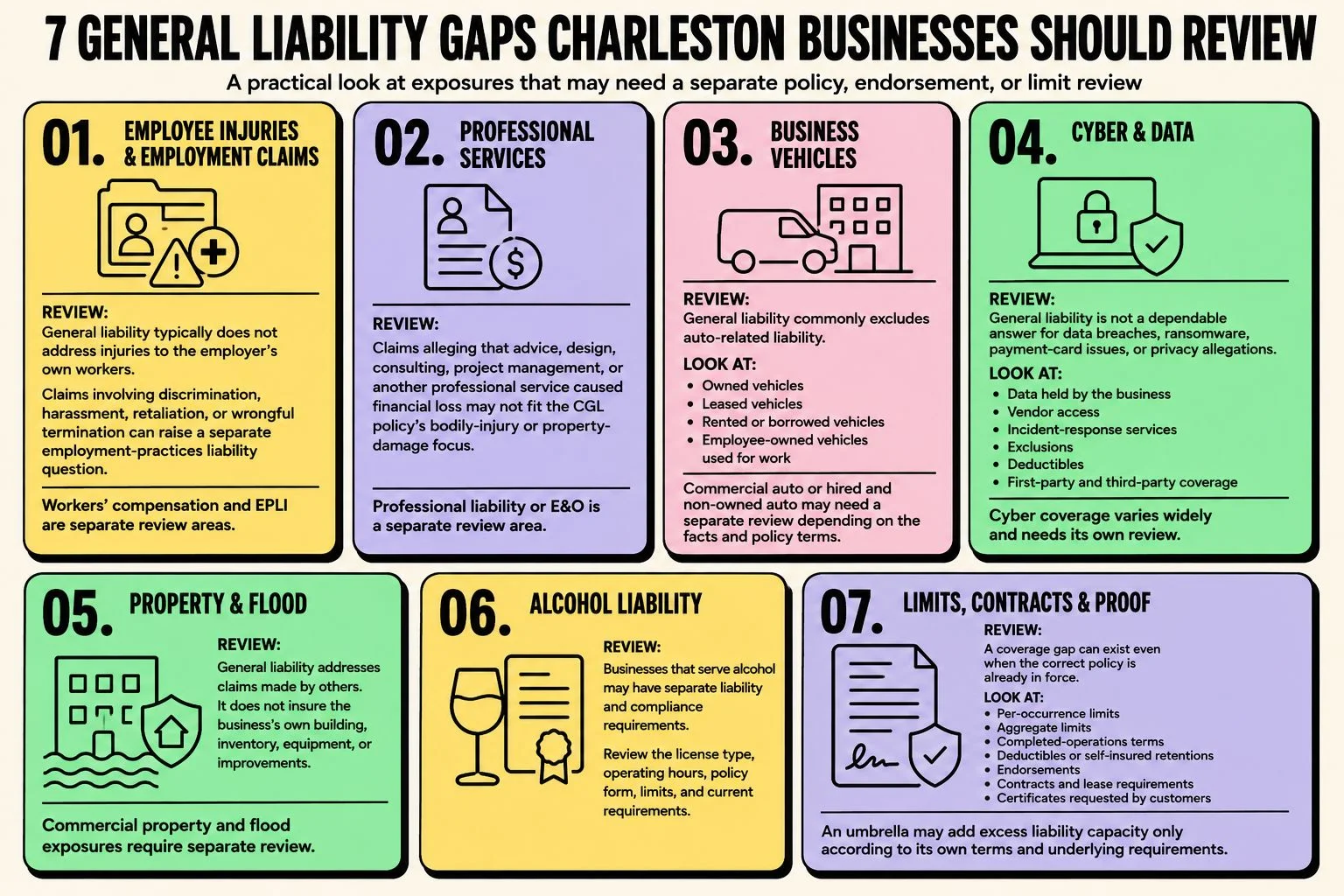
Employee Injuries and Employment Claims
CGL policies typically do not address injuries to an employer’s own workers. According to the South Carolina Workers’ Compensation Commission, businesses that regularly employ four or more employees in South Carolina generally must maintain workers’ compensation coverage, subject to listed exemptions and fact-specific circumstances. Part-time employees and family members count toward the employee total.
Employment-related allegations require a different review. Claims involving discrimination, harassment, retaliation, or wrongful termination can raise an employment practices liability insurance, or EPLI, question. Workers’ compensation and EPLI address different exposures, so neither should be assumed to fall automatically under a general liability policy.
Professional Services and Financial Loss
A client may allege that advice, design work, consulting, project management, or another professional service caused a financial loss. That type of claim may not fit the bodily-injury or property-damage focus of a CGL policy. Professional liability, also called errors and omissions insurance, or E&O, is a separate review area. Before assuming general liability addresses professional work, review client contracts and describe the services the business actually provides.
Business Vehicles and Driving Activity
CGL policies commonly exclude auto-related liability. Review every vehicle owned, leased, rented, borrowed, or regularly used for work. That includes employee-owned vehicles used for:
- Deliveries
- Sales visits
- Customer meetings
- Job-site travel
- Business errands
Commercial auto insurance and hired and non-owned auto coverage may become relevant depending on the vehicles, drivers, business use, policy eligibility, and carrier requirements. A personal auto policy should not be treated as a substitute for commercial coverage without reviewing its terms and the actual driving activity.
Cyber Incidents and Electronic Data
A general liability policy should not be treated as a dependable answer for a data breach, ransomware event, payment-card incident, or privacy allegation. Cyber insurance varies considerably between policies. A review should consider:
- The type of customer and employee data stored
- Vendor and third-party access
- Incident-response services
- Policy exclusions
- Deductibles or retentions
- First-party coverage
- Third-party liability coverage
Insurance is only one part of managing cyber risk. The Cybersecurity and Infrastructure Security Agency provides business cybersecurity resources covering safeguards such as multifactor authentication, backups, software updates, phishing awareness, and data protection.
Your Property and Flood Damage
General liability primarily addresses covered claims made by other parties. It does not serve as property insurance for a business’s own building, inventory, equipment, furniture, or improvements.
Those exposures require a separate commercial property review.
Flood also needs separate attention. The South Carolina Department of Insurance explains in its guidance on flood insurance for businesses that commercial property policies, commercial package policies, and Business Owners Policies generally do not include flood coverage.
A business should review its property address, flood exposure, lender requirements, building and contents values, and actual policy terms rather than assuming flood is included.
Alcohol-Related Liability
Alcohol service can create both a liability exposure and a compliance requirement. South Carolina businesses that sell alcoholic beverages for on-premises consumption and remain open after 5 p.m. should verify the current liquor liability insurance requirements with the South Carolina Department of Revenue. Applicable requirements can depend on the license or permit, operating hours, aggregate and per-occurrence limits, and qualifying mitigation factors. Before renewal or a special event, confirm:
- The actual license or permit type
- Hours of alcohol service
- Current liquor liability coverage
- Required aggregate and per-occurrence limits
- Any applicable mitigation factors
- Whether a general liability policy includes an appropriate liquor liability endorsement
Do not assume that ordinary CGL coverage automatically satisfies alcohol-related insurance requirements.
Limits, Contracts, and Proof of Insurance
A coverage gap can exist even when the correct type of policy is already in force. Review the:
- Per-occurrence limit
- General aggregate limit
- Products-completed operations terms
- Deductibles
- Self-insured retentions
- Additional insured endorsements
- Contractual requirements
- Certificates of insurance
Compare those provisions with signed client contracts, leases, vendor agreements, and certificate requirements. An umbrella or excess liability policy may provide additional liability capacity over eligible underlying insurance. However, the umbrella’s own terms, exclusions, attachment points, and underlying insurance requirements still need to be reviewed.
Charleston Relevance Should Be Verified, Not Assumed
Charleston does not create one standard set of liability limits or a single local insurance price. Local relevance comes from the facts of the individual business, including its address, property exposure, lease, customer contracts, alcohol license, work performed, employee responsibilities, and vehicle use. For example, a company with no alcohol service does not have the same Department of Revenue review as a licensed venue that serves alcohol after 5 p.m. A business that does not own property also has a different property review from a building owner or tenant that has funded substantial improvements.
For property questions, use the actual address and current policy documents instead of assumptions based only on the city. For alcohol questions, review the actual license and operating details. For contractual requirements, read the written insurance provisions before issuing certificates or changing coverage. Charleston employers who want to understand how these individual exposures can fit within a broader program can also review Benni Agency’s business insurance in Charleston resources. This keeps the review tied to the company’s real operations instead of treating every Charleston business as if it has the same risks.
A Renewal Checklist for General Liability Gaps
Before renewing, gather the current declarations pages, endorsements, applications, loss information, active contracts, and any significant operational updates. Then review:
- Operations: Have services, products, job duties, locations, subcontractor relationships, or business activities changed?
- People: Do employee injuries, employment practices, or professional-services claims require a separate insurance discussion?
- Vehicles: Which vehicles and drivers are used for work, including owned, hired, rented, borrowed, and employee-owned vehicles?
- Property and data: What buildings, equipment, inventory, customer information, employee data, and other assets need protection?
- Alcohol and contracts: Does an alcohol license, special event, lease, vendor agreement, or customer contract establish insurance requirements?
- Limits: Do the current limits, deductibles, endorsements, and underlying requirements match the business’s present exposures and written obligations?
This type of review is especially useful after major operational changes rather than waiting until a claim reveals an outdated assumption.
Keep the Review Informational Before It Becomes a Purchase Decision
A useful coverage review should start with facts, not a list of insurance products. Document the business activities, property interests, vehicles, contracts, data practices, employees, professional services, and licenses. Then compare those details with the existing policy language and insurer requirements.
That process can reveal whether an exclusion applies, whether a separate policy deserves discussion, whether a limit needs attention, or whether the current coverage remains appropriate. For a broader insurance-program discussion, review Benni Agency’s commercial insurance coverage options. A licensed insurance professional can help interpret current policy documents and obtain carrier-specific options without treating this article as individualized insurance, legal, or tax advice.
3 thoughts on “Charleston General Liability Gaps Businesses Can Miss”
Comments are closed.