Several Charleston insurance agencies may show you similar plans and prices, but that does not mean they will provide the same level of support. To choose the right agency, compare its benefits experience, service team, technology, compensation, communication, and ability to help after enrollment.
The cheapest proposal can become costly if HR is left fixing errors or employees cannot understand their coverage. This guide is for Charleston business owners and HR leaders who want to compare agencies fairly, avoid weak service, and choose with more confidence.
Key Takeaways
- Define your benefits problems and priorities before requesting proposals.
- Verify South Carolina licensing and experience with employers similar to yours.
- Compare the account team, year-round service, technology, and employee communication.
- Ask how the agency is paid and which services or technology costs are included.
- Give every agency the same information and questions.
- Charleston knowledge helps, but reliable service matters more than a local address alone.
Start With What Your Business Actually Needs
Do not begin by asking which agency has the lowest quote. Start by identifying what your company needs to fix. A 12-person business offering health coverage for the first time will have different concerns than a 150-person employer managing payroll integrations, multiple locations, and a larger enrollment process. Your company’s size, growth plans, workforce, and internal resources should shape the search. Before meeting with an agency, write down the problems you are dealing with now. These may include:
- Rising renewal costs
- Slow responses from your current agency
- Confusing employee enrollment
- Too much manual eligibility work
- Low participation in available benefits
- Poor communication during open enrollment
- Limited plan choices
- Upcoming hiring or expansion
- Difficulty supporting employees in different locations
Prepare your current plan documents, contribution amounts, renewal date, employee census, and any service issues you want addressed. Giving each agency the same information will make the comparison much more useful.
Check Licensing and Relevant Benefits Experience
An insurance license confirms that an agency or producer is authorized to conduct insurance business. It does not tell you whether the team understands your company or has handled similar benefit challenges. You need to check both.
Verify the Agency’s South Carolina License
Ask which agency and individual producers will work on your account. You can then verify their licensing through the South Carolina Department of Insurance. Also ask whether any other specialists will be involved, such as compliance staff, enrollment support, benefits administrators, or account managers. You should know who is responsible for each part of the relationship before you sign an agreement.
Ask About Similar Employers
Experience should be relevant to your situation, not simply measured in years. Ask whether the agency has supported employers with a similar:
- Number of employees
- Industry
- Budget
- Benefits structure
- Geographic footprint
- Hourly or salaried workforce
- Growth stage
- Administrative capacity
A company with seasonal employees may need a different enrollment and communication approach than a professional services firm with a stable salaried workforce. A growing company may need technology and processes that can handle more employees without adding hours of manual work. Ask for specific examples. The agency should be able to explain the types of problems it has handled without sharing another client’s private information.
Compare the Agency’s Year-Round Service
Open enrollment is only one part of managing employee benefits. Many of the most frustrating problems happen during the rest of the year. Employees lose ID cards. New hires need coverage. Dependents must be added or removed. Payroll deductions need corrections. Someone has a carrier or claim issue. HR needs help explaining a benefit. A reliable agency should explain how it handles these situations before you become a client.
Find Out Who Handles the Account
The person leading the sales meeting may not be the person helping your HR team later. Ask:
- Who will be our main contact?
- Is there a backup contact?
- Who handles eligibility and billing problems?
- Who supports employees with benefit questions?
- How quickly does the team normally respond?
- How many employer accounts does the service team manage?
- Which issues are handled by the agency, and which go directly to the carrier?
Look for clear responsibilities. Vague answers during the sales process may turn into confusion once the plan is active.
Ask What Happens After Enrollment
The agency should provide support throughout the plan year, not disappear once elections are complete. Year-round service may include:
- New-hire enrollment
- Eligibility changes
- Qualifying life events
- Billing support
- Carrier issue escalation
- Employee questions
- Benefits administration
- Compliance reminders
- Renewal preparation
Ask when renewal planning begins and what the review includes. A good renewal process should not consist of forwarding a spreadsheet a few weeks before the deadline. The team should help you review costs, participation, employee feedback, plan performance, and any changes that could improve the next plan year.
Review Plan Strategy, Technology, and Communication
An agency should do more than collect carrier quotes. It should help you understand which options fit your workforce, budget, and ability to manage the plan. That requires a close look at strategy, technology, and employee communication.
Look Beyond the First Quote
Price matters, but the lowest premium does not always produce the best result. A less expensive option may have a narrow provider network, high employee costs, weak participation, or added administrative work. A richer plan may be difficult to sustain if employer contributions rise sharply at the next renewal. Ask the agency to explain:
- Why it recommends each option
- Which trade-offs the employer and employees would accept
- How employer contributions could be structured
- Whether voluntary benefits could fill useful gaps
- How the plan may affect recruiting and retention
- What administrative work the plan creates
- Which other funding or coverage approaches were considered
Traditional group coverage may remain the right choice. Some employers may also need to review group health plan alternatives, including an Individual Coverage Health Reimbursement Arrangement, commonly called an ICHRA. ICHRA can give some employers more control over contributions while allowing employees to select individual coverage. It is not the right fit for every workforce. Geographic spread, employee education, affordability, available individual plans, and administrative readiness all affect whether it makes sense. Be cautious when an agency recommends the same answer to every employer before reviewing the company’s data.
Test the Technology Before Committing
Technology should reduce manual work, not create another system that HR has to manage alone. Ask the agency to show you how its process works. Do not settle for screenshots or a list of software features. Review how the agency handles:
- Digital enrollment
- New-hire onboarding
- Eligibility changes
- Payroll deductions
- HRIS or payroll connections
- Reporting
- Employee access
- Plan documents
- Life-event changes
- Implementation and training
Find out who sets up the system, enters the data, checks for errors, and supports the connection with payroll. The original article correctly emphasized that digital enrollment should not replace personal service. It should remove repetitive work so the service team can focus on questions and problems that need human attention.
Review Employee Communication Support
Employees cannot value benefits they do not understand. Ask what the agency provides before and during enrollment. Support may include employee meetings, decision guides, plan comparisons, recorded explanations, one-on-one help, and clear instructions for using each benefit. The agency should explain costs and trade-offs in plain language. Employees usually want practical answers:
- What will come out of each paycheck?
- Can I keep my doctors?
- What does the deductible apply to?
- How much will family coverage cost?
- What happens if I need frequent care?
- Who can help if I have a problem?
Strong benefits education can reduce rushed decisions, repeated HR questions, and confusion after enrollment.
Ask How the Agency Is Paid
You should understand how the agency earns money and which services are included. Employee benefits agencies may receive carrier commissions, charge employer-paid fees, bill separately for consulting or technology, or use a combination of these approaches. Ask direct questions:
- How is the agency compensated?
- Does compensation change based on the carrier or product?
- Are consulting fees charged separately?
- Is benefits technology included?
- Are there setup or implementation charges?
- Which year-round services are included?
- Could any services create an additional fee?
Commission-based compensation is not automatically a problem. The concern is a lack of transparency. The agency should be willing to explain its compensation clearly and in writing. That will help you compare the full relationship rather than focusing only on the insurance premium.
Check References and Compare Every Agency Fairly
A polished presentation does not show you how the agency performs after the sale. Ask for evidence that helps you understand the working relationship. Depending on your company’s needs, you might request:
- References from similar employers
- A sample renewal timeline
- Sample enrollment materials
- An implementation checklist
- An example employee communication plan
- An anonymized account-service example
- A description of the agency’s escalation process
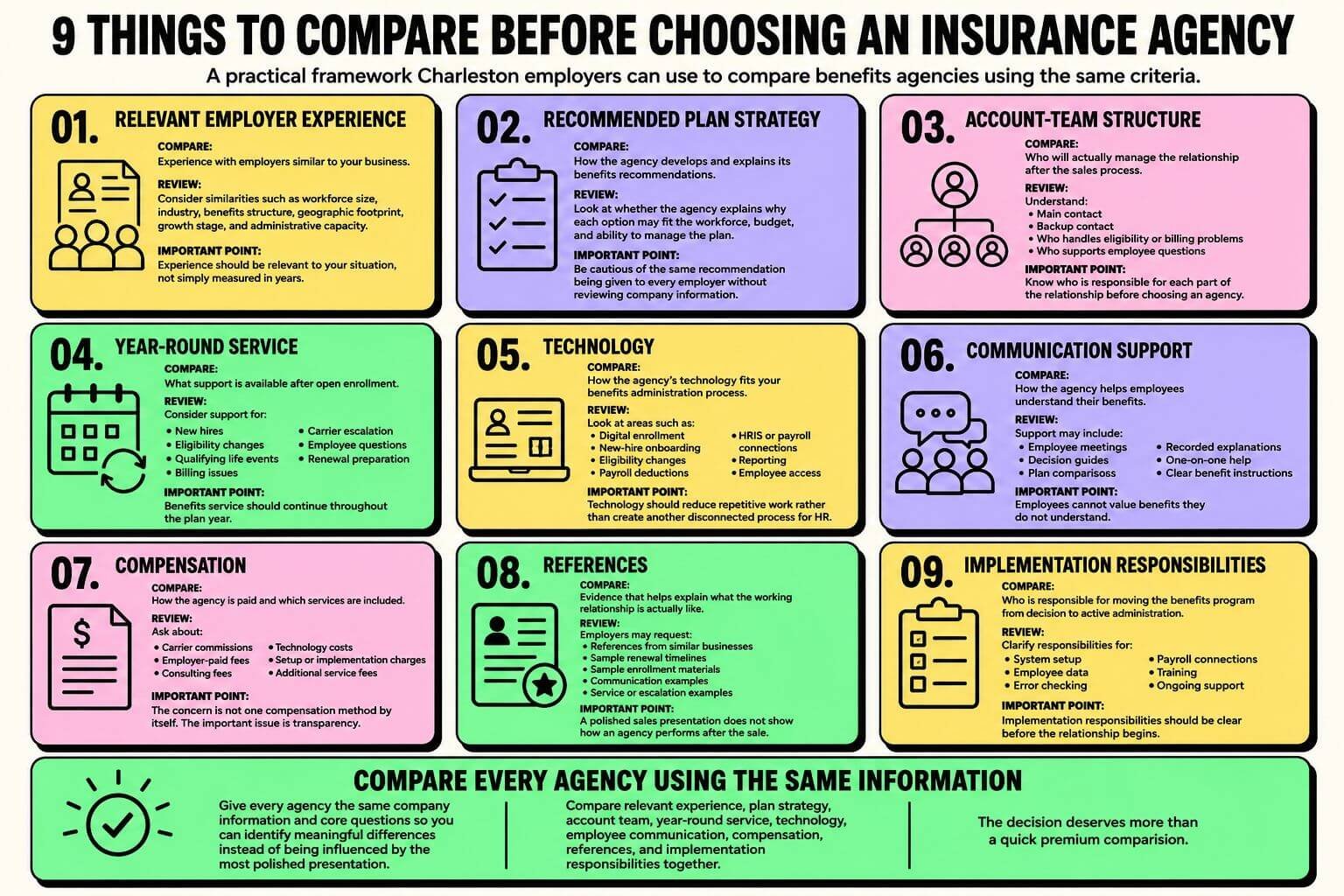
When speaking with a reference, ask about responsiveness, accuracy, implementation, employee support, and how the agency handled a difficult issue. Give every agency the same company information and core questions. A simple comparison sheet can help you review:
- Relevant employer experience
- Recommended plan strategy
- Account-team structure
- Year-round service
- Technology
- Communication support
- Compensation
- References
- Implementation responsibilities
This makes it easier to identify meaningful differences instead of being influenced by the most polished presentation.
Watch for These Warning Signs
Pay attention when an agency:
- Recommends a plan before reviewing your workforce and current coverage
- Avoids explaining its compensation
- Cannot identify the service team
- Gives vague answers about support after enrollment
- Relies heavily on one carrier or one benefits approach
- Promises guaranteed savings
- Cannot provide references or sample work
- Pressures you to make a quick decision
- Talks about technology but cannot demonstrate the process
- Leaves implementation responsibilities unclear
One warning sign does not always mean the agency is a poor choice. It does mean you should ask more questions. You are choosing a team that may work with your HR department, payroll process, employees, and insurance carriers throughout the year. That decision deserves more than a quick premium comparison.
Why Charleston Business Context Still Matters
Charleston-area employers work across hospitality, healthcare, manufacturing, professional services, technology, transportation, tourism, and other industries. Their benefits needs can vary widely based on work schedules, employee locations, turnover, hiring pressure, and company size. The Charleston Regional Development Alliance reports that regional employment grew 27.8% from 2014 through 2024. Population grew 19.6% during the same period. As employers grow and compete for workers, benefits administration and employee communication can become harder to manage without clear processes.
Regional experience may help an agency understand employers operating across Charleston, North Charleston, Mount Pleasant, Goose Creek, Summerville, and nearby communities. Still, a local address does not guarantee good service. Ask whether the agency combines local knowledge with strong systems, relevant experience, and reliable account support. Employers researching available options can also review Benni Agency’s Charleston benefits services, including health coverage, voluntary benefits, administration, and employee support.
Need a Clearer Way to Compare Your Options?
Choosing an insurance agency becomes easier when you know what needs to improve. Before meeting with agencies, write down the problems your team faces now. These might include slow service, confusing enrollment, limited plan guidance, rising costs, or too much manual work.
Give each candidate the same information and ask the same questions. Compare who will manage the account, what the agency handles after enrollment, how employees receive help, which technology is included, and how the agency is paid. Benni Agency can help Charleston-area employers review their current benefits setup and identify issues that deserve closer attention. That does not mean changing agencies or plans before the situation has been reviewed.