Two benefits brokers can bring you similar carrier quotes and still provide very different levels of service. For a Summerville employer, choosing the right broker means looking past the first proposal and asking who will handle planning, enrollment, employee questions, administration, and problems during the year. You also need to know how recommendations are made and how the broker is paid.
Business owners and HR leaders can use this article to compare brokers, uncover potential service issues before renewal, and find a partner that meets their organization’s needs.
Key Takeaways
- Define the benefits, service, and administration problems you need the broker to solve before comparing proposals.
- Compare the assigned account team and year-round support, not just carrier options or premiums.
- Ask how the broker evaluates employer costs, employee needs, provider access, and administrative work.
- Request a clear explanation of broker compensation, technology fees, included services, and responsibilities.
- Verify South Carolina licensing, relevant references, and whether the broker understands Summerville-area employers.
Start With the Problems You Need the Broker to Solve
Before you request proposals, make a clear list of what isn’t working with your current benefits program. Otherwise, each broker may focus on the easiest part of the conversation, such as finding a lower premium. Your list might include:
- Unpredictable renewal increases
- Employee complaints about deductibles or payroll deductions
- Limited access to preferred doctors
- Prescription coverage problems
- Slow billing or eligibility corrections
- Confusing enrollment materials
- Too much manual work for HR
- Little communication outside renewal season
- Benefits that no longer fit your hiring needs
Also note what’s already working. You may have a plan employees understand, a carrier relationship worth keeping, or an enrollment process that runs smoothly. This gives each broker the same starting point. It also makes proposals easier to compare because you can judge whether each recommendation addresses your actual problems.
Compare the Broker’s Team and Service Model
A proposal may show plan options, rates, and technology. It may not tell you who will perform the work after you sign. Ask the broker to explain the full service model. You should know:
- Who leads benefits planning
- Who prepares the renewal comparison
- Who manages open enrollment
- Who answers everyday employer questions
- Who helps employees with coverage problems
- How unresolved carrier issues are tracked
- What happens between enrollment periods
- Who steps in when your main contact is unavailable
Ask for these responsibilities in writing. A clear team chart or service calendar is more useful than a general promise that the agency offers full support.
Who Will Manage the Account?
The person presenting the proposal may not be the person who manages your account. You could later be assigned to an account manager, service representative, implementation specialist, or separate employee-support team. Ask to meet the people who will handle the relationship before you make a decision. Useful questions include:
- Who will be our main contact?
- How much experience does that person have?
- Who leads renewal meetings?
- Who handles employee problems?
- Who supports enrollment and implementation?
- How quickly should we expect a response?
- How are open issues documented?
A strong sales presentation doesn’t guarantee a strong service experience. The assigned team and its daily process will have a greater effect on your HR staff once the relationship begins.
What Support Continues After Enrollment?
Benefits work doesn’t stop when employees finish enrolling. During the year, your company may need help with:
- New hires and terminations
- Eligibility changes
- Enrollment corrections
- Billing questions
- Missing coverage
- Carrier escalations
- Benefit documents
- Employee education
- Life event changes
This support matters for small and midsize companies where an office manager, controller, or small HR team may already handle several other responsibilities. A broker cannot control every claim or carrier decision. The broker should still help identify the correct contact, explain the problem, follow up, and keep your team informed. Ask how these cases are tracked. Employees shouldn’t be sent from one phone number to another without knowing who is helping them.
Review How the Broker Evaluates Better Benefits
Better benefits don’t always mean lower premiums. A less expensive plan may create higher deductibles, limited provider access, or more work for your internal team. Before making a recommendation, the broker should review:
- Current plans and renewal terms
- Employer and employee contributions
- Enrollment patterns
- Employee questions and complaints
- Provider and prescription needs
- Claims or utilization information when available
- Billing and administration problems
- Budget and hiring plans
- The company’s main benefits priorities
Pay attention to the questions the broker asks. A proposal created before the broker understands your workforce may solve the wrong problem. You should also expect a written comparison. It should explain the costs, trade-offs, risks, administrative requirements, and reason each option is being considered.
Plan, Funding, and Employee Cost Trade-Offs
The broker may compare traditional fully insured coverage, level-funded plans, voluntary benefits, or an ICHRA. The right options depend on your workforce, budget, size, and ability to manage the arrangement. For each option, ask about:
- Employer contributions
- Employee payroll deductions
- Deductibles and copays
- Out-of-pocket limits
- Prescription costs
- Provider networks
- Budget predictability
- Administrative requirements
- Main risks or disadvantages
The lowest employer premium may still leave employees with costs they cannot comfortably manage. A broad-looking network may also exclude doctors or facilities employees regularly use. The broker should explain both the employer and employee side of the decision. That may also include reviewing tax-advantaged accounts when they fit the plan and employee needs. Be cautious if every employer receives the same recommendation. A useful proposal explains why the option fits your company rather than treating one funding method as the answer for everyone.
Administration and Technology
Benefits technology should reduce work for your team. It shouldn’t create another place where HR must enter the same employee information. When a broker recommends benefits administration technology, ask:
- Who configures the platform?
- Who checks plan and eligibility data?
- Does it connect with payroll or your HR system?
- Who trains your team?
- Who corrects setup errors?
- Will employees receive support?
- Are there separate platform or implementation fees?
- Who owns the relationship with the technology provider?
Ask to see how the system works before agreeing to it. A short demonstration can show whether the platform fits your current process or adds steps your team doesn’t need. Technology can help with enrollment, reporting, document delivery, and employee access. Its value depends on the setup, support, and accuracy behind it.
Ask About Compensation and Accountability
Employers should understand how a broker is paid and which services are included. Payment may involve carrier commissions, consulting fees, service fees, technology charges, or payments connected to other products and vendors. One payment structure isn’t automatically better than another. What matters is whether it is clearly explained. Ask the broker:
- How is your agency paid?
- Does compensation vary by carrier or product?
- Are there separate consulting or technology fees?
- Which services are included?
- Could outside vendor charges apply?
- Will compensation be explained in writing?
Then ask how the agency measures its own service. A broker should be able to describe:
- How often your company will receive updates
- When renewal planning begins
- Which reports or comparisons will be provided
- How deadlines are tracked
- How unresolved problems are reviewed
- How the relationship is evaluated during the year
Written responsibilities give both sides something clear to follow. They also make it easier to identify a service problem before it affects enrollment or renewal.
Check Local Knowledge, Licensing, and References
A local address can make meetings easier, but it doesn’t prove that a broker understands your company or will provide reliable service. Ask how the broker’s local knowledge affects the advice you receive. A broker serving Summerville should be prepared to discuss regional hiring conditions, employee needs, provider access, company growth, and the types of support local employers often require.
The U.S. Census Bureau estimated Summerville’s population at 53,177 in 2025, up 4.6% from its 2020 population estimate base. In a growing community, employers should ask whether a broker can adjust benefits planning, employee communication, and administration as the workforce changes.
You should also verify the agency and the individuals advising your company. The South Carolina Department of Insurance provides public search tools for insurance agencies, companies, and individual license holders. References can provide another useful check. Ask to speak with employers that are similar in:
- Company size
- Industry
- Workforce structure
- Number of locations
- Benefits administration needs
Instead of asking whether the reference is happy, ask specific questions. Did the broker communicate clearly? Did renewal planning start on time? Were employee problems followed through? Did the assigned team match what was promised during the sales process?
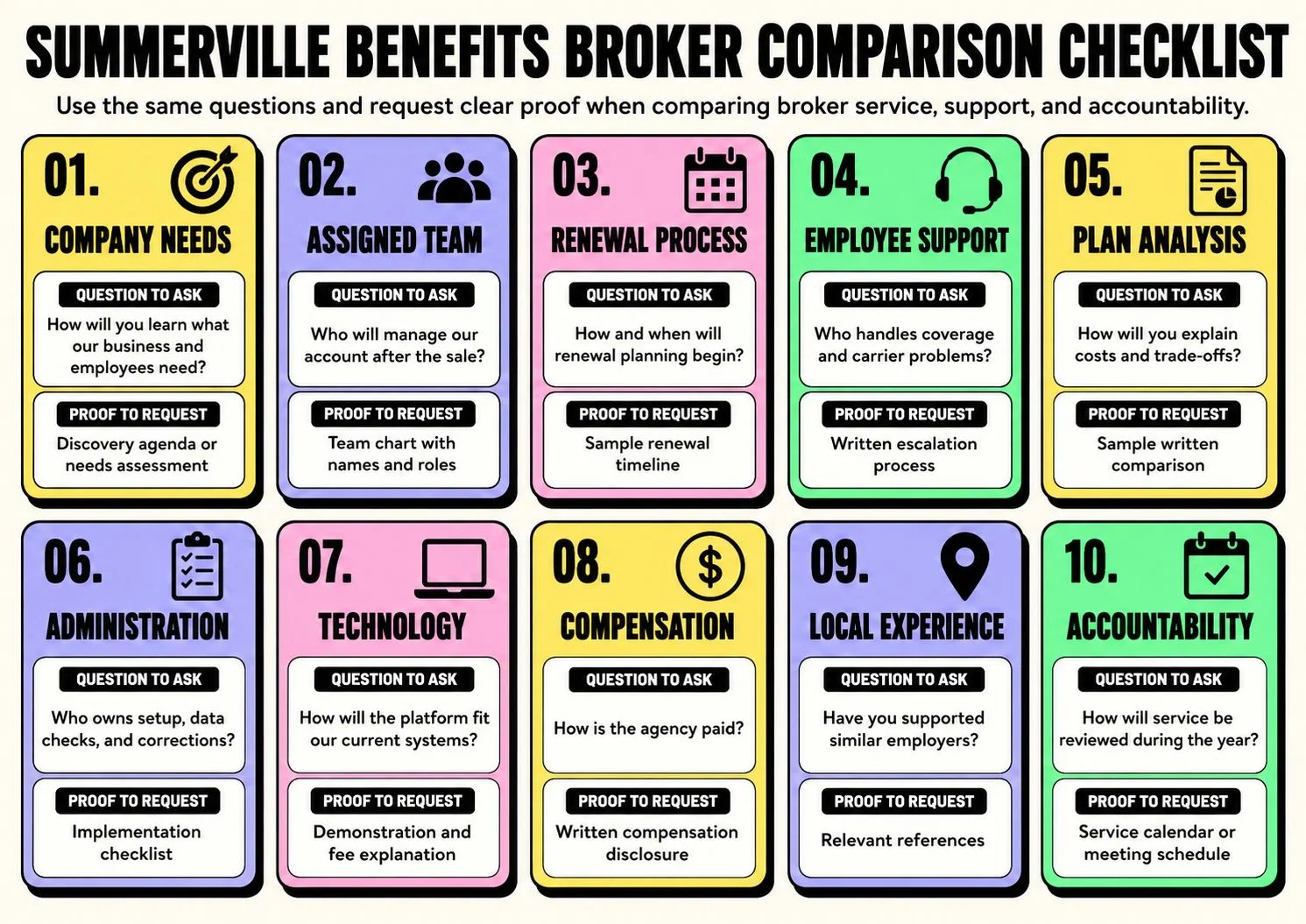
Use a Simple Broker Comparison Checklist
You don’t need a complicated scoring system. Use the same questions for every broker and request proof where possible.
Evaluation Area | Question to Ask | Proof to Request |
Company needs | How will you learn what our business and employees need? | Discovery agenda or needs assessment |
Assigned team | Who will manage our account after the sale? | Team chart with names and roles |
Renewal process | How and when will renewal planning begin? | Sample renewal timeline |
Employee support | Who handles coverage and carrier problems? | Written escalation process |
Plan analysis | How will you explain costs and trade-offs? | Sample written comparison |
Administration | Who owns setup, data checks, and corrections? | Implementation checklist |
Technology | How will the platform fit our current systems? | Demonstration and fee explanation |
Compensation | How is the agency paid? | Written compensation disclosure |
Local experience | Have you supported similar employers? | Relevant references |
Accountability | How will service be reviewed during the year? | Service calendar or meeting schedule |
Compare the answers, not just the presentation. A broker may offer impressive technology or a long list of services, but those features won’t help if responsibilities remain unclear. Look for answers that are direct and specific. Vague promises during the selection process often stay vague after the relationship begins.
Not Sure Whether Your Current Broker Measures Up?
Before deciding whether to keep your current broker or compare new options, review the work being done throughout the year. Do you know who owns employee questions, billing problems, enrollment corrections, and carrier follow-up? Are plan recommendations explained clearly, including the cost and administrative trade-offs? Does your team receive useful communication outside renewal season?
One weak area doesn’t always mean you need to replace the broker or change plans. Start by listing the service gaps, asking who will address them, and requesting a clear timeline. That gives your team a fair way to judge whether the current relationship can improve. Benni Agency helps local employers review these practical service questions before renewal. You can explore its Summerville benefits support to compare the approach with the responsibilities you expect from your current broker. A simple review now can help you enter the next renewal with clearer expectations and fewer unanswered questions.