Commercial crime insurance can address direct financial losses caused by employee theft, forgery, computer fraud, fraudulent transfers, and related dishonest acts. Protection depends on the insuring agreements, definitions, exclusions, limits, and endorsements. For Charleston employers, the practical task is to identify who can access money or property, how transfers are approved, and where crime coverage must coordinate with other policies. This guide explains the main coverage areas and the questions to review before buying or renewing.
Key Takeaways
- Commercial crime insurance is usually built from separate insuring agreements rather than one universal package.
- Employee theft, forgery, computer fraud, funds transfer fraud, and social engineering may require distinct coverage grants.
- Cyber liability, commercial property, and employment practices liability insurance address different losses and should not be treated as substitutes.
- Policy definitions, sublimits, exclusions, and the discovery trigger can materially change how a claim is handled.
- An ERISA fidelity bond protects an employee benefit plan and is separate from commercial crime insurance for the employer.
What Commercial Crime Insurance Covers
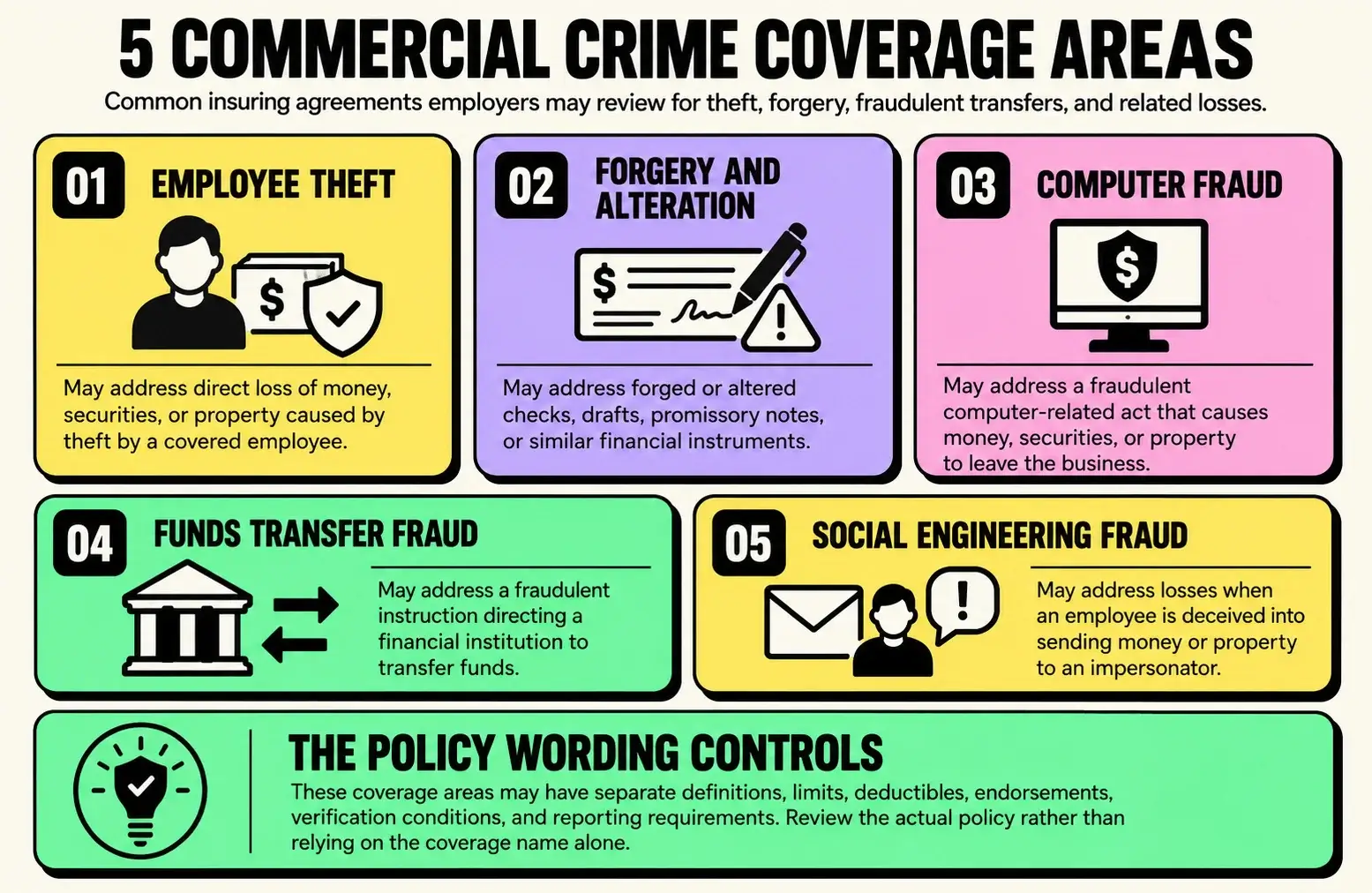
Commercial crime policies can combine several insurance agreements. Travelers fidelity and crime guidance identifies employee dishonesty, forgery or alteration, money and securities, computer fraud, funds transfer fraud, and social engineering. A specific policy may include only some of these protections.
Employee Theft
Employee theft coverage generally addresses direct loss of money, securities, or other property caused by theft or dishonest acts by a covered employee. The definition of employee matters. Temporary workers, leased personnel, volunteers, owners, and independent contractors may not be treated the same way under every form.
Forgery and Alteration
This coverage commonly applies to loss involving forged or altered checks, drafts, promissory notes, or similar instruments. Businesses should confirm which instruments qualify and whether related investigation expenses are covered.
Computer Fraud and Funds Transfer Fraud
Computer fraud generally concerns a fraudulent computer-related act that causes money, securities, or property to leave the business. Funds transfer fraud generally involves a fraudulent instruction directing a financial institution to transfer funds. The precise wording matters because a voluntary payment made by an employee may not meet either definition.
Social Engineering Fraud
Social engineering occurs when someone impersonates an executive, vendor, client, or other trusted party and persuades an employee to send money or property. Coverage may require an endorsement and may carry a separate sublimit, deductible, verification condition, or reporting requirement.
Money, Securities, and Client Property
Crime coverage may address theft, disappearance, or destruction of money and securities on the premises or in transit. A business responsible for client property should ask whether third-party crime coverage is required by contract.
What Crime Insurance Usually Does Not Replace
Crime coverage should be compared with neighboring policies because the same incident can involve several kinds of loss.
| Coverage | Generally addresses | Important boundary |
| Commercial crime | Employee theft, forgery, fraudulent transfers, and other selected crime losses | Depends on the purchased insuring agreements and policy definitions |
| Cyber liability | Data breach response, privacy liability, ransomware, and network interruption under the policy | May not cover direct theft of money in every scenario |
| Commercial property | Covered physical loss to buildings, contents, inventory, or equipment | Employee dishonesty is often limited or excluded |
| EPLI | Employment-related claims such as discrimination, harassment, retaliation, or wrongful termination | Does not insure the employer’s theft or fraud loss |
Unexplained inventory shortages, accounting errors, indirect lost income, and late-reported losses may fall outside coverage. Actual exclusions and conditions control, so review the issued form rather than relying on a coverage label.
Loss-Sustained vs. Discovery Coverage
A loss-sustained form generally focuses on when the dishonest act or loss occurred and requires discovery within the time allowed by the policy. A discovery form generally focuses on when the insured discovers the loss, subject to conditions such as a retroactive date. This distinction matters when changing carriers or forms because fraud may continue before detection. Compare expiring and replacement policies for prior-loss provisions, discovery periods, retroactive dates, and possible gaps.
ERISA Fidelity Bonds Are Separate
Commercial crime insurance is generally a voluntary business coverage decision. A separate federal requirement may apply when people handle assets of an employee benefit plan covered by the Employee Retirement Income Security Act. The U.S. Department of Labor’s ERISA bonding guidance explains that each plan official generally must be bonded for at least 10% of the funds handled, subject to a $1,000 minimum and a $500,000 maximum per plan. The maximum generally rises to $1 million for a plan that holds employer securities. An ERISA fidelity bond protects the plan against loss from fraud or dishonesty by covered persons. It does not replace commercial crime insurance, fiduciary liability insurance, or cyber liability insurance. Employers should confirm bonding obligations for their specific plan and the people who handle plan assets.
How to Estimate an Appropriate Crime Limit
No single limit works for every organization. Start with the largest plausible amount that could leave before controls detect it, then test the proposed policy against that exposure. Review:
- Bank balances, payment sizes, cash, securities, inventory, and client property accessible to employees
- Who can create vendors, change payment instructions, approve transfers, or reconcile accounts
- The maximum transfer one person or a colluding group could authorize
- Contractual requirements for employee dishonesty or third-party crime coverage
- Separate social engineering, computer fraud, and funds transfer sublimits
- Deductibles, waiting or reporting requirements, and proof-of-loss obligations
Internal controls still matter. Dual authorization, independent callbacks, separated financial duties, access reviews, and account reconciliation can reduce the chance that one person can complete and conceal a loss.
Questions to Ask Before Buying or Renewing
Two policies with the same overall limit can respond differently. Ask:
- Which crime-insuring agreements are included, and which are optional?
- How does the policy define employee, computer fraud, fraudulent instruction, and social engineering?
- Are owners, temporary staff, volunteers, and contractors covered?
- What sublimits or deductibles apply to fraudulent transfers and social engineering?
- Does the form use a loss-sustained or discovery trigger?
- What must be reported, to whom, and within what period after discovery?
- How do crime, cyber, property, and banking protections coordinate?
Charleston employers comparing these answers can place crime coverage within a broader business and commercial insurance program. The goal is to understand what each policy is intended to cover and where definitions or limits do not line up.
Building Coverage Into a Charleston Insurance Program
The right structure depends on operations, controls, contracts, property handled, and transaction size. Crime coverage may be added by endorsement, included in a commercial package, or purchased separately. Terms vary by carrier. Benni Agency’s Charleston insurance and employee benefits page provides the local service context for employers reviewing commercial coverage. Before making a decision, compare quotes and specimen forms, then review the issued policy with a licensed insurance professional. This article provides general information, not individualized legal, tax, or insurance advice.