Flood risk in Mount Pleasant is not limited to a building sitting directly on the water. The Town identifies both localized flooding from drainage problems and storm-related flooding from rising water and storm surge. For a business, the bigger insurance problem is often not knowing where standard commercial property coverage ends and separate flood coverage begins. This guide explains the gaps worth reviewing before hurricane season, renewal, a lease signing, or a property purchase.
Key Takeaways
- Standard commercial property coverage and business owners policies generally do not cover flood damage.
- National Flood Insurance Program (NFIP) commercial limits are separate for buildings and contents, with up to $500,000 available for each.
- NFIP coverage does not include business interruption or loss-of-use income protection.
- Tenants still need to review coverage for inventory, equipment, furniture, and improvements they own or are responsible for.
- New NFIP coverage usually has a 30-day waiting period, so buying after a storm is approaching can be too late.
Why Flood Risk in Mount Pleasant Deserves a Separate Review
The Town of Mount Pleasant’s flood guidance identifies two local flood hazards: localized flooding tied to drainage conditions and flooding from rising water during tropical storms and hurricanes. The Town also participates in FEMA’s National Flood Insurance Program and Community Rating System.
Flood zone, elevation, construction, occupancy, contents values, lease terms, and lender requirements can all change what a business needs to review.
Gap 1: Assuming a BOP or Commercial Property Policy Covers Flood
The South Carolina Department of Insurance states that commercial property coverage, including a commercial package policy or business owners policy (BOP), does not include flood coverage. Flood insurance is purchased separately through the NFIP or a private flood insurer.
The cause of water damage matters. A burst pipe may fall under property coverage, while rising water, storm surge, or surface water entering from outside is generally treated differently. Review the actual exclusions and endorsements rather than relying on a coverage summary.
Gap 2: Having Property Coverage but No Income Protection
A flood can damage more than walls, equipment, or inventory. It can also stop revenue while payroll, rent, loan payments, and other expenses continue.
NFIP commercial flood coverage does not cover financial losses caused by business interruption or loss of use. Standard business-income coverage also commonly depends on a covered cause of loss under the property policy. If flood is excluded there, the income loss may not be covered either.
Some private flood policies may offer business-income or extra-expense options, subject to underwriting and policy terms. Ask about waiting periods, limits, and covered triggers.
Gap 3: NFIP Limits May Be Lower Than the Property Exposure
FEMA’s NFIP commercial coverage provides up to $500,000 for a non-residential building and up to $500,000 for business contents. These are separate coverages with separate limits and deductibles.
NFIP commercial building and contents losses are generally valued on an actual cash value basis, so depreciation can reduce the payment compared with the cost of buying new replacement property.
For a business with a building, equipment, inventory, or tenant improvements worth more than those limits, ask whether private or excess flood coverage should be evaluated.
Gap 4: Tenants Assuming the Landlord’s Coverage Protects Their Property
A landlord’s policy does not automatically insure a tenant’s inventory, furniture, equipment, or other business property. Lease language can also assign responsibility for improvements, betterments, and insurance requirements.
Review the lease and your own property schedule. Confirm who is responsible for the building, build-outs, contents, and any required flood coverage.
Gap 5: Overlooking Property the NFIP Does Not Cover
FEMA identifies business interruption, most vehicles, currency and valuable papers, and many items outside the insured building among losses or property the NFIP does not cover.
That means a complete review should look beyond the flood policy. Commercial auto, equipment, cyber/data-recovery planning, or another policy may address part of the exposure, but only if its terms apply.
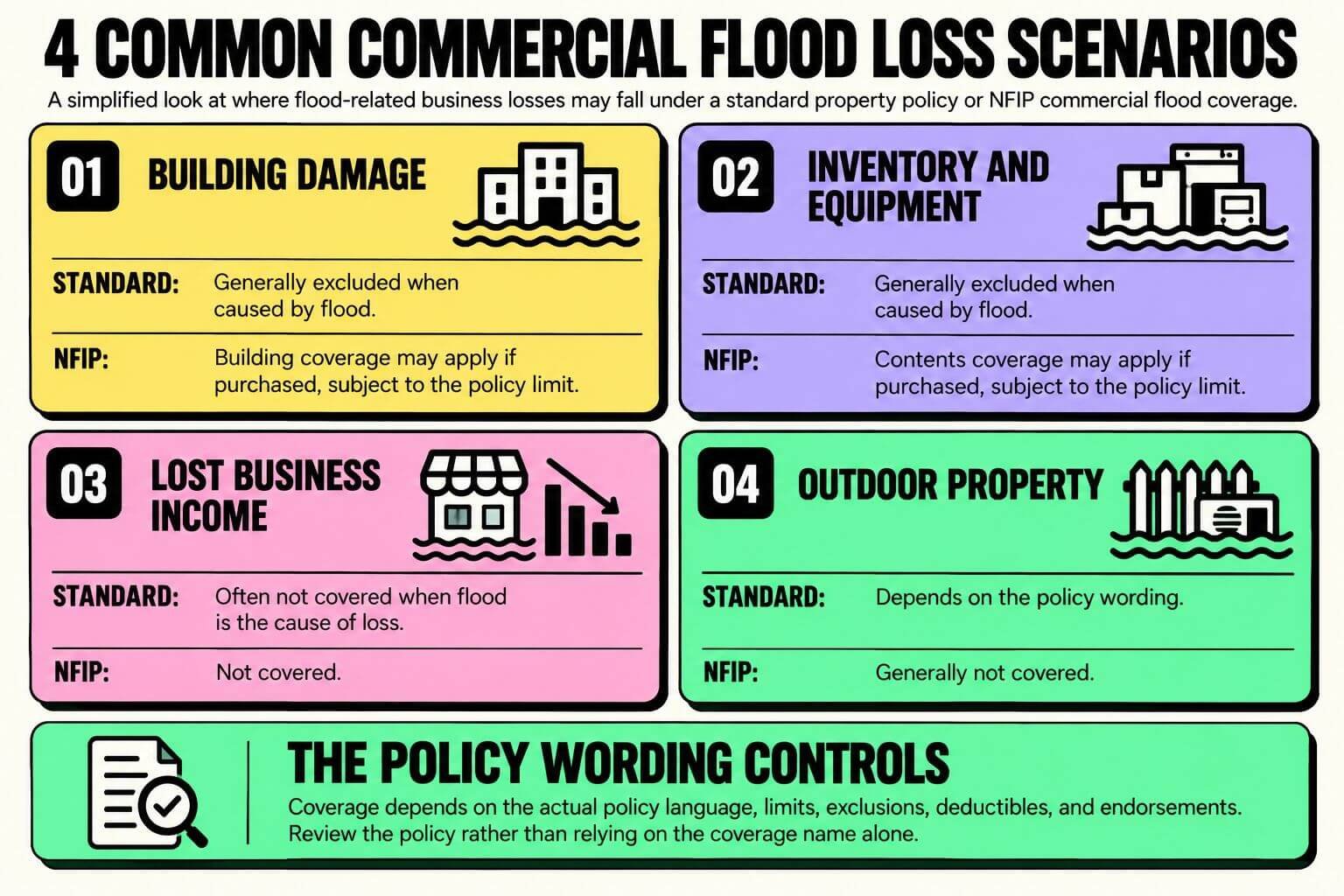
How Common Flood Losses Fit Together
| Loss scenario | Standard property/BOP | NFIP commercial flood |
| Rising water or storm surge damages the building | Generally excluded | Building coverage, if purchased, up to the policy limit |
| Inventory or equipment is damaged by flood | Generally excluded | Contents coverage, if purchased, up to the policy limit |
| Revenue is lost while the business is closed | Often not covered when flood is the cause | Not covered |
| Fence, patio, walkway, or other outdoor property is damaged | Depends on the policy | Generally not covered |
Treat this as a discussion starter, not a coverage determination. Actual policy wording controls.
Gap 6: Buying Coverage Too Late
NFIP flood insurance normally has a 30-day waiting period before coverage begins, with limited exceptions. A business that starts shopping only when a named storm is approaching may not be able to put new NFIP coverage in force for that event.
Build flood insurance into the normal renewal calendar, property-purchase process, and lease review.
Gap 7: Treating Disaster Assistance as Insurance
Disaster assistance is not a substitute for coverage. FEMA states that disaster relief for businesses is limited, while Small Business Administration disaster loans depend on an eligible declared disaster and must be repaid.
A continuity plan should account for insurance, cash reserves, financing, vendors, and emergency procedures.
Gap 8: Ignoring the Workforce Side of a Closure
A temporary shutdown can create questions about scheduling, pay, remote work, leave, and benefit eligibility. Those answers can depend on plan documents, employer policies, carrier rules, and applicable law.
Create a short communication plan before storm season. Identify who contacts employees, who makes closure decisions, where payroll and benefit records are backed up, and which advisors need to be involved.
A Practical Commercial Flood Insurance Checklist
Before renewal or storm season:
- Confirm the flood zone and available elevation information for each location.
- Read the flood and water exclusions in the commercial property or BOP forms.
- Compare building and contents values with NFIP limits.
- Confirm whether lost income or extra expense after a flood is insured anywhere.
- Review lease responsibilities and tenant improvements.
- Identify equipment, outdoor property, records, and vehicles that may fall outside flood coverage.
- Check waiting periods and target effective dates early.
- Photograph inventory and major equipment and keep records backed up offsite.
The South Carolina Department of Insurance also recommends reviewing flood coverage separately from standard commercial property insurance.
When a Broker Review Can Help
Flood gaps often sit between property coverage, a flood policy, a lease, business-income coverage, and a continuity plan. A coordinated review can help surface questions before a claim does.
Benni Agency works with South Carolina employers on business and commercial insurance. Mount Pleasant businesses can learn more about Benni Agency’s local insurance and employee-benefits support or review its insurance-broker services when they want help comparing coverage questions and renewal decisions.
One thought on “Mount Pleasant Flood Insurance Gaps Businesses Often Miss”
Comments are closed.