A general liability policy can protect a business from many common third-party claims, but it usually does not replace professional liability coverage. If your company gives advice, designs solutions, manages projects, handles client information, or performs specialized services, the bigger question is whether your policies match the risks your business actually creates. For Summerville owners, that means checking professional liability alongside employment, benefits, contract, and policy-timing exposures rather than assuming one “liability” policy covers everything.
Key Takeaways
- General liability and professional liability address different types of claims, so one should not be assumed to replace the other.
- Employment practices liability insurance (EPLI) addresses employee and applicant claims that typically fall outside general liability.
- An ERISA fidelity bond and fiduciary liability insurance serve different purposes; one does not automatically replace the other.
- Claims-made policies require careful attention to reporting rules, retroactive dates, and coverage continuity.
- Hiring, new contracts, additional locations, new services, and benefit-plan changes are good reasons to review liability coverage.
What Professional Liability Insurance Is Designed to Address
Professional liability insurance, often called errors and omissions (E&O) insurance, is designed for allegations that a professional service, recommendation, mistake, or omission caused a client financial harm. Depending on the profession and policy, claims may involve alleged negligence, missed deadlines, incorrect advice, inaccurate specifications, or failure to perform services as expected.
Coverage is policy-specific. Definitions, exclusions, defense provisions, deductibles or retentions, limits, and reporting requirements can vary substantially. That is why a business should review the actual policy wording instead of relying on the label “professional liability.”
General liability is different. It generally focuses on third-party bodily injury, property damage, and certain personal or advertising injury claims. A professional-services allegation may require E&O coverage instead. Businesses with both physical operations and professional-service exposure may need both types of coverage, depending on their activities and contracts.
Five Liability Gaps Worth Checking
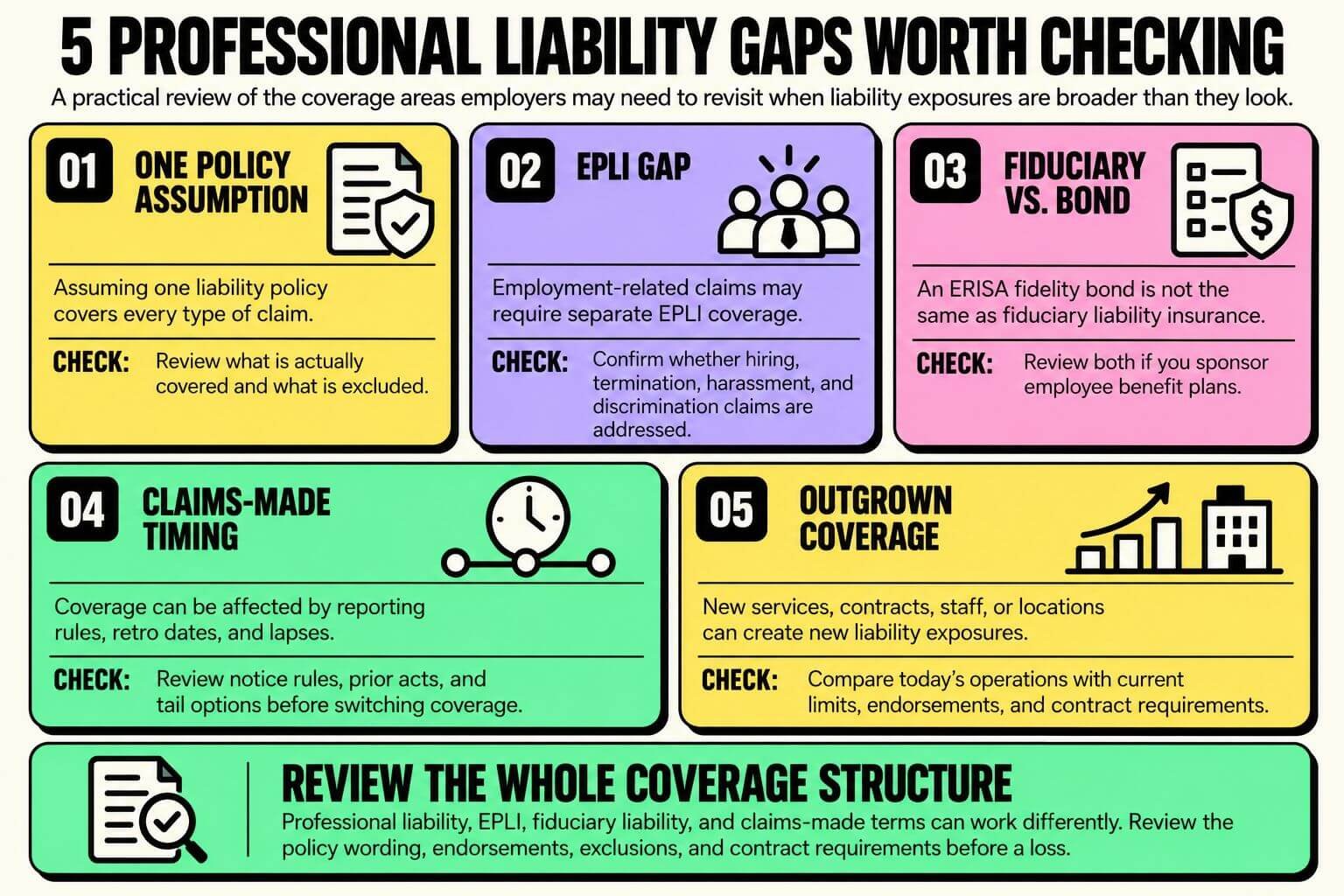
1. Treating “Liability Insurance” as One Policy
The first gap is structural: a business buys general liability or a business owner’s policy and assumes it covers every lawsuit. It usually does not.
A company that advises clients, prepares technical work, manages projects, designs systems, or provides specialized services should ask whether professional-service claims are covered separately. The answer depends on the business, insurer, endorsements, and policy language.
A practical review should start with two questions: What kinds of claims does the policy affirmatively cover, and what exclusions could remove coverage for the work the company actually performs?
2. Missing Employment Practices Liability
Professional liability protects against client-facing professional mistakes. It does not substitute for employment practices liability insurance.
EPLI is designed for certain claims involving employees or applicants, such as alleged discrimination, harassment, retaliation, or wrongful termination. Exact coverage varies by policy, and some employment-related allegations may be excluded or handled differently.
This becomes especially important as a business adds employees, formalizes management roles, or changes hiring and termination practices. The goal is not to assume every employer needs the same policy structure. It is to confirm whether employment-related claims are addressed anywhere in the current insurance program.
3. Confusing Fiduciary Liability With an ERISA Fidelity Bond
Businesses that sponsor certain employee benefit plans can also face a separate category of risk.
The U.S. Department of Labor explains that an ERISA fidelity bond protects a plan against losses from fraud or dishonesty by people who handle plan funds or property. Fiduciary liability insurance is different and is not required by ERISA’s fidelity-bond rules. It is generally intended to address certain losses tied to alleged breaches of fiduciary responsibility, subject to policy terms and applicable law.
That distinction matters because an employer may have a required bond and still have a separate fiduciary exposure. Employers should also avoid confusing fiduciary liability with employee benefits liability (EBL), which focuses on certain administrative errors. Benni Agency has a separate guide to employee benefits liability insurance for that narrower issue. For the federal distinction between fidelity bonding and fiduciary insurance, see the U.S. Department of Labor’s ERISA bonding guidance.
4. Losing Coverage Through Claims-Made Timing
Many professional liability, EPLI, and fiduciary liability policies are written on a claims-made basis, but the exact trigger varies by policy.
A claims-made policy can create problems if a business changes carriers, allows coverage to lapse, changes a retroactive date, or fails to report a claim or potential claim within required timeframes. Extended reporting or “tail” options may be available in some situations, but terms differ.
Before replacing or canceling a claims-made policy, check the retroactive date, prior-acts wording, notice requirements, pending or known-circumstances provisions, and any extended reporting options. Do not assume the new policy automatically preserves the same protection for earlier work.
5. Letting Operations Outgrow the Insurance Program
Coverage can become outdated even when no policy has technically lapsed. New services, larger contracts, additional employees, new locations, benefit plans, or changes in client requirements can create exposures that were not present when the policy was purchased.
Contract requirements deserve particular attention. A client, landlord, lender, or vendor may require specific coverage types, limits, endorsements, or certificates. Meeting a contract requirement does not automatically mean the business is adequately insured, but failing to review the requirement can create avoidable problems.
Why the Review Matters in Summerville
Local relevance should come from real business conditions, not assumptions about what Summerville companies “usually” need. One useful benchmark is the scale of employment in the surrounding county. The U.S. Bureau of Labor Statistics reported 41,712 covered jobs across 3,723 establishments in Dorchester County in the fourth quarter of 2025.
Those numbers do not prove any specific business needs a particular policy. They do show that Summerville operates within a substantial employer market. As an individual company hires, adds services, takes larger contracts, or expands its benefits program, its risk profile can change quickly.
Businesses that want local help can review Benni Agency’s Summerville business insurance and benefits resources. For broader commercial coverage review, the insurance broker service page explains how Benni Agency approaches business insurance across South Carolina. The local employment figures are available from the U.S. Bureau of Labor Statistics.
A Practical Coverage-Gap Review
A useful review is less about buying more policies and more about matching existing coverage to current operations. Start with the declarations, forms, endorsements, and exclusions for each policy.
Check whether professional services are covered or excluded. Confirm whether employment-practices and fiduciary exposures are addressed. Review retroactive dates and reporting requirements on claims-made policies. Compare current limits and endorsements with major contracts. Then identify operational changes since the last renewal, including new employees, services, locations, clients, technology, or benefit plans.
Because coverage depends on policy wording and the facts of a claim, a broker or qualified coverage professional can help interpret how the policies work together. Legal or ERISA questions may also require appropriate legal or benefits counsel.