Contractors in Mount Pleasant may need to satisfy several different insurance and licensing requirements before starting a project. Some requirements come from South Carolina law or licensing rules, while others come from owners, general contractors, lenders, or specific agreements. This guide separates those categories so you can review the right documents before bidding, signing a contract, or renewing coverage.
Key Takeaways
- South Carolina requires a general or mechanical contractor license for regulated commercial construction when the total cost of construction is greater than $10,000.
- Workers’ compensation generally applies when an employer regularly has four or more employees, but contractor and subcontractor situations can create additional obligations.
- General liability, builder’s risk, professional liability, umbrella, and other coverages may be required by a contract even when no single statewide minimum applies.
- A certificate of insurance is evidence of coverage; it does not by itself change policy terms or create additional-insured status.
- Review insurance requirements before bidding so limits, endorsements, subcontractor documents, and project-specific coverage can be addressed early.
Start With Your South Carolina Contractor License
Insurance decisions should begin with your license classification and the type of work you perform. The South Carolina Contractor’s Licensing Board states that a general or mechanical contractor license is required for regulated commercial construction when the total cost of construction is greater than $10,000.
Your license group also affects the maximum project size you may bid and perform. South Carolina uses financial requirements, including working capital, net worth, or an eligible surety bond, to determine group limits. A surety bond used for licensing is not the same thing as liability insurance. It is a financial guarantee tied to the licensing requirement.
Before a new project, confirm that your classification and group fit the work and contract value. Residential work follows a separate licensing framework through the South Carolina Residential Builders Commission.
Contractor Insurance Coverage to Review
There is no single policy package that fits every contractor. These are the main coverages to evaluate against your operation and contract.
General Liability Insurance
Commercial general liability insurance can respond to covered third-party bodily injury, property damage, and certain personal or advertising injury claims.
Do not assume a familiar limit will satisfy every job. The contract should tell you the required per-occurrence and aggregate limits and whether additional-insured status, primary and noncontributory wording, completed-operations coverage, or a waiver of subrogation is requested.
Workers’ Compensation Insurance
South Carolina generally requires workers’ compensation when an employer regularly employs four or more workers. Part-time workers count, and exceptions can apply. The South Carolina Workers’ Compensation Commission also explains that a general contractor can be liable for statutory employees when a subcontractor does not maintain required coverage.
That makes workers’ compensation a subcontractor issue as well as an employee-count issue. A general contractor may require a subcontractor with fewer than four employees to maintain coverage as a condition of working on the project.
Commercial Auto Insurance
If vehicles are titled, insured, or used for business operations, review whether your auto coverage matches that use. Work trucks, vans, trailers, hired vehicles, and employees using personal vehicles for business can create different exposures.
Do not assume a personal auto policy automatically covers contractor operations. The correct structure depends on the vehicles, ownership, drivers, business use, and actual policy terms.
Builder’s Risk Insurance
Builder’s risk is designed to cover covered property during construction, such as the structure and certain materials intended to become part of the project. The owner, lender, or contract may specify who must purchase the policy.
Before work starts, confirm who is responsible for coverage, when coverage begins and ends, what property is included, and how the policy handles project-specific hazards or exclusions.
Tools and Equipment Coverage
Contractors frequently move tools and equipment between a shop, vehicle, storage location, and jobsite. Inland marine or contractor’s equipment coverage may protect eligible property in situations where a standard property policy does not.
Review scheduled equipment, rented equipment, limits, deductibles, theft conditions, and transit coverage rather than assuming every tool is protected everywhere.
Professional Liability Insurance
Professional liability, or errors and omissions coverage, may be relevant when a contractor provides design, consulting, specifications, engineering-related input, or other professional services. Design-build contracts deserve particular attention because responsibility can extend beyond physical construction.
Umbrella or Excess Liability
A commercial umbrella or excess policy may provide additional limits above certain underlying liability policies. It can be useful when a contract requires limits above what your primary policies provide.
Confirm which underlying policies are actually scheduled beneath the umbrella or excess coverage and whether the contract’s requirements are satisfied by the combined structure.
Do Not Treat a Certificate of Insurance as the Whole Policy
A certificate of insurance, commonly called a COI, is useful for confirming basic policy information such as insurer, policy dates, coverage types, and limits. It does not replace the actual policy.
If a contract requires your business to be an additional insured on a subcontractor’s policy, verify that the required policy provision or endorsement is in place. A notation on the certificate alone does not change coverage. The same principle applies to requested waivers or other contract-specific insurance conditions.
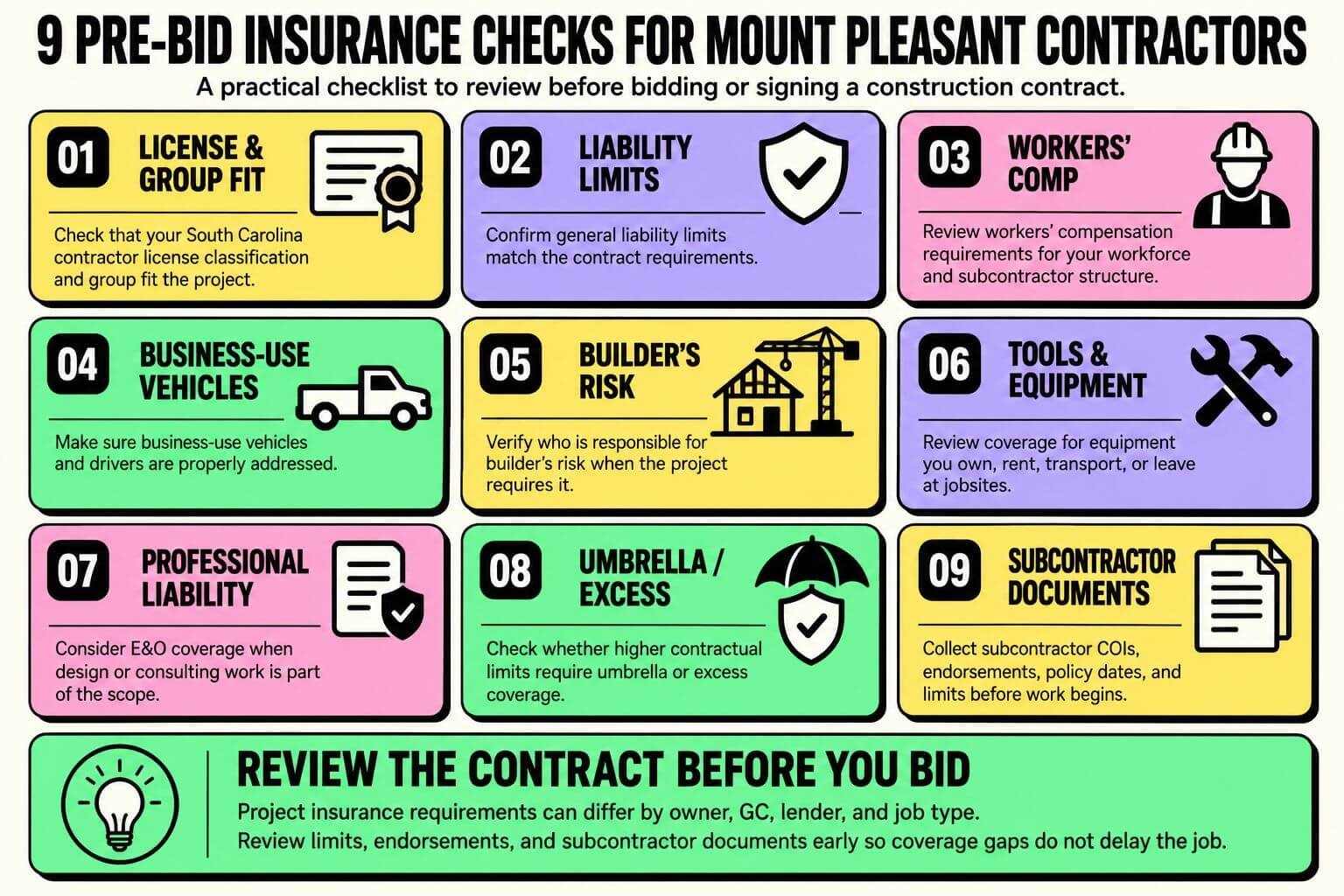
Pre-Bid Insurance Checklist
Before submitting a bid or signing a construction contract, verify:
- Your contractor license classification and group fit the project.
- Required general liability limits match the contract.
- Workers’ compensation requirements have been reviewed for your workforce and subcontractor structure.
- Business-use vehicles and drivers are correctly addressed.
- The contract identifies who is responsible for builder’s risk when applicable.
- Tools and equipment coverage reflects what you own, rent, transport, or leave at jobsites.
- Professional liability has been considered when design or consulting work is part of your scope.
- Umbrella or excess limits align with higher contractual requirements.
- Subcontractor COIs, endorsements, policy dates, and limits are documented before work begins.
Reviewing Coverage for a Mount Pleasant Contracting Business
A contractor’s insurance program can change as projects get larger, employees are added, vehicles change, or subcontractor use increases. That is why a renewal-only review can miss changes that happen during the year.
If your business is evaluating its broader insurance program, Benni Agency’s insurance broker services explain the commercial coverages the agency helps South Carolina employers evaluate. Contractors looking specifically at local support can also review Benni Agency’s Mount Pleasant insurance services. A licensed insurance professional can help compare the contract, current policies, endorsements, and operational exposures.
One thought on “Mount Pleasant Contractor Insurance Must-Have Checklist”
Comments are closed.