A customer slips near an entrance, trips over a display, or is struck by merchandise that falls from a shelf. For a Charleston retailer, any of these incidents can lead to an injury report, insurance claim, or lawsuit. But an injury on store property does not automatically make the retailer responsible. Liability usually turns on what caused the hazard, what the business knew or reasonably should have known, how it responded, and the retailer’s insurance policy. This guide explains those issues in practical terms.
Key Takeaways
- A customer injury does not automatically make a Charleston retailer liable; negligence and the facts surrounding the hazard matter.
- South Carolina premises-liability claims often focus on whether the store created a dangerous condition or had actual or constructive notice of it.
- A customer’s own negligence can reduce recovery and may bar recovery if it is greater than the defendant’s negligence.
- General liability coverage may respond to covered third-party bodily-injury claims, defense costs, settlements, or judgments, subject to policy terms and limits.
- Inspection records, incident documentation, prompt carrier notice, and regular coverage reviews can help a retailer manage customer-injury exposure.
What Counts as a Customer Injury Claim in a Retail Store?
A customer injury claim generally begins when a shopper or visitor alleges that an unsafe condition connected to the business caused an injury. Common retail examples include:
- Wet floors, loose mats, cords, or uneven walking surfaces
- Falling merchandise, shelving, signs, or displays
- Broken stairs, railings, doors, chairs, or other fixtures
- Hazards in parking areas, entrances, or walkways controlled by the business
- Poor lighting or other conditions that may make a hazard harder to see
The legal question is not simply whether someone was hurt. It is whether the retailer failed to use reasonable care and whether that failure caused the injury.
How South Carolina Premises Liability Law Applies to Retailers
South Carolina courts generally treat retail customers as business invitees. Retailers owe invitees a duty to exercise reasonable and ordinary care and keep customer areas reasonably safe. For claims involving a dangerous condition, South Carolina courts have said an injured customer generally must show either that the retailer created the condition or had actual or constructive knowledge of it and failed to remedy it. Constructive notice can become an issue when a hazard existed long enough that a reasonable inspection should have discovered it. The South Carolina Supreme Court has applied this framework in store-premises cases such as Wintersteen v. Food Lion.
A retailer is not automatically responsible for every accident. Open and obvious conditions can also affect the analysis, although the result depends on the facts and whether the business should reasonably have anticipated harm. South Carolina follows modified comparative negligence. A plaintiff can recover when their negligence is not greater than the defendant’s, but an award is reduced by the plaintiff’s percentage of fault. If the plaintiff’s negligence is greater, recovery can be barred. South Carolina law also generally provides a three-year limitations period for actions involving injury to a person, although exceptions may apply. Retailers facing an actual claim should rely on legal counsel for deadline analysis. See S.C. Code § 15-3-530.
Retail Injury Risks Charleston Stores Should Review
The useful approach is to review the conditions of the actual store instead of assuming every Charleston retailer faces the same hazards. Depending on the premises and operations, a retailer may need to watch:
- Entryways where customers can track in rainwater
- Sidewalk-adjacent displays or signs
- Older floors, stairs, thresholds, or lighting
- High-traffic aisles and seasonal merchandising
- Parking areas and exterior walkways under the retailer’s control
These are operating considerations, not proof of liability. Lease terms, property-control responsibilities, maintenance arrangements, and the facts of an accident can all matter.
How General Liability Insurance May Respond
Commercial general liability insurance is designed to address certain third-party bodily-injury and property-damage claims arising from business operations. For an eligible smaller retailer, liability coverage may also be packaged with property and business-income coverage in a Business Owners Policy, or BOP. For a covered customer-injury claim, the policy may help with defense expenses and covered settlements or judgments, subject to limits, exclusions, conditions, and policy language.
Many policies also include medical payments coverage that may pay certain medical expenses for a person injured on the premises without requiring a determination of fault, up to the applicable limit. Coverage should never be assumed from the policy name alone. A retailer should review its declarations, limits, exclusions, endorsements, listed operations, premises, and claims-reporting requirements. Businesses comparing broader commercial coverage can also review Benni Agency’s article on general liability gaps Charleston businesses can miss.
Practical Steps to Reduce Customer Injury Risk
Routine risk management cannot prevent every accident, but it can make hazards easier to identify and create a clearer record of the store’s response. Useful practices include:
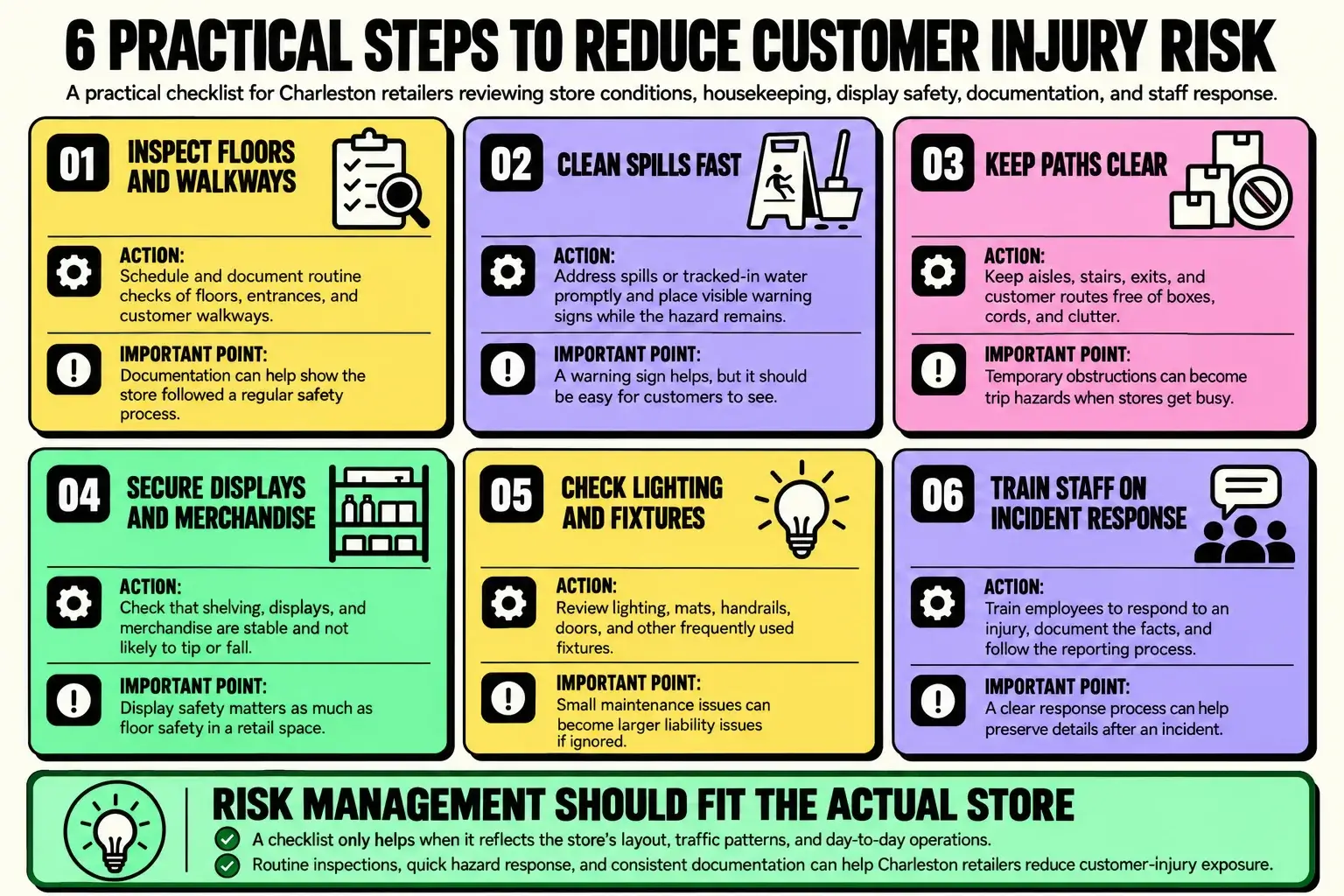
- Scheduling and documenting floor and walkway inspections
- Cleaning spills promptly and using visible warnings while a hazard remains
- Keeping aisles, stairs, exits, and customer walkways clear
- Securing shelving, displays, and merchandise
- Checking lighting, mats, handrails, and frequently used fixtures
- Training employees on incident reporting procedures
The process should match the store’s actual layout and operations rather than rely on a generic checklist.
What to Do When a Customer Is Injured in Your Store
A consistent incident process can help preserve facts and support the insurance claim process.
- Attend to the injured person and request emergency medical help when appropriate.
- Document the scene with photographs before conditions change, when safe to do so.
- Complete an incident report with factual observations rather than assumptions about fault.
- Record witness names and contact information when available.
- Preserve relevant records, including inspection logs or available video, according to company procedures and legal guidance.
- Notify the insurance carrier or agent promptly under the policy’s reporting requirements.
Retail employees should avoid making promises about coverage, payment, or legal responsibility. Claim decisions depend on the facts and policy language.
Reviewing Coverage for a Charleston Retail Operation
Customer injuries are one reason retailers should periodically compare general liability coverage with the way the store currently operates. A move, renovation, added location, or new display format can create exposures that were not considered when the policy was first written. Benni Agency’s Charleston insurance and commercial coverage page outlines commercial insurance options for local businesses. Retailers comparing package structures can also review the Charleston BOP vs. CPP comparison. The goal of a coverage review is not to assume every possible claim is covered. It is to compare current exposures with the actual policy terms, limits, exclusions, and endorsements.