Choosing voluntary benefits can feel tricky when you want to support employees without adding another major employer-paid cost. For Summerville employers, the benefits that usually work best are the ones employees understand, can afford, and can connect to real needs like routine care, family protection, income loss, accidents, or hospital costs.
This guide is for Summerville employers who want to choose voluntary benefits with a clear purpose, explain them simply, and avoid adding plans employees ignore.
Key Takeaways
- The most effective voluntary benefits are easy for employees to understand, value, and use.
- Dental, vision, life, disability, accident, critical illness, and hospital indemnity coverage are often strong starting points.
- A focused benefits lineup usually performs better than a long list of optional plans.
- Summerville employers should tailor benefits to their workforce instead of copying a generic package.
- Voluntary benefits work best when enrollment is straightforward and clearly explained.
- These benefits should complement the core health plan, not replace it.
What Makes a Voluntary Benefit Actually Work?
A voluntary benefit works when it solves a real problem for employees without creating unnecessary complexity for the employer.
That may sound simple, but this is where many benefit packages fall short. A plan can look appealing on paper and still fail if employees do not understand it, do not see its value, or cannot picture when they would use it.
A strong voluntary benefit typically does five things:
- It fills a clear gap in the existing benefits package.
- It is easy to explain during enrollment.
- The cost feels reasonable to employees.
- It aligns with the type of workforce you have.
- It can be managed smoothly through payroll and administration.
This is why more options are not always better. A smaller, well-chosen set of benefits often performs better than a long list that employees ignore.
Which Voluntary Benefits Usually Work Best?
The right voluntary benefits depend on your team, but some options tend to perform well because they are easy to understand and tied to common concerns. For many employers, the strongest starting points include dental, vision, life, disability, accident, critical illness, and hospital indemnity coverage. The key is to avoid treating these as a checklist. Each benefit should serve a clear purpose.
Dental, Vision, and Life Insurance
For many employees, dental, vision, and life coverage are familiar and easy to understand. That makes them a strong foundation for a voluntary benefits package.
Dental and vision plans connect to routine care, family needs, and predictable expenses. Life insurance is also straightforward, offering a way for employees to protect their families financially. These benefits tend to work well across different types of teams because they are not limited by age, role, or income level.
Disability and Accident Coverage
Disability and accident coverage can be especially valuable when employees depend heavily on their income or work in roles with higher physical risk.
This includes construction crews, healthcare workers, logistics teams, service staff, hospitality employees, and others who spend much of their day on their feet. If someone is injured or unable to work, financial strain can build quickly. That does not mean every employer needs the same plan. It means these benefits should be considered when the workforce faces income risk, physical risk, or limited savings.
Critical Illness and Hospital Indemnity
Critical illness and hospital indemnity coverage can help when the core health plan leaves employees exposed to higher out-of-pocket costs. These benefits do not replace health insurance. Instead, they help employees prepare for expenses tied to serious diagnoses, hospital stays, or major medical events.
They can be particularly useful for employees enrolled in high-deductible health plans who may not fully understand what they would owe in a worst-case scenario. The best way to present these benefits is simply as gap coverage, not as a complete solution.
Match the Benefits to the Workforce
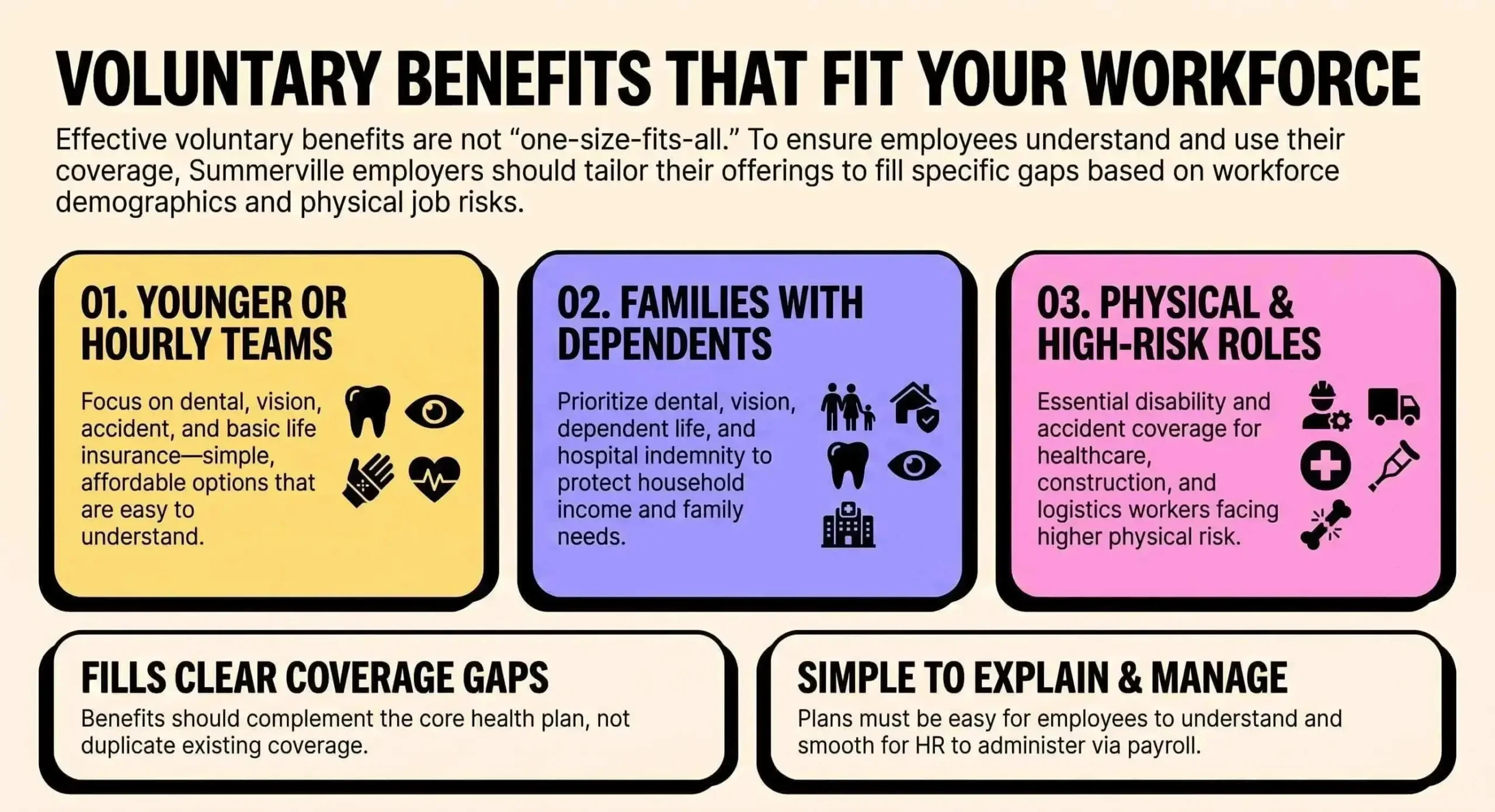
A voluntary benefits package should reflect the people who will actually use it. A restaurant team, a medical office, a construction company, and a professional services firm will likely need different benefit options. That is why copying another company’s package rarely works well.
Summerville has a diverse workforce. Data USA reports that the town had about 26.3K employed residents in 2024, with healthcare and social assistance, retail trade, and manufacturing among the largest industries. This mix makes it important to match benefits to real workforce needs.
Younger or Hourly Teams
Younger employees or hourly workers often prefer simple, affordable options they can understand quickly. Good starting points may include dental, vision, accident coverage, and basic life insurance. The goal is not to overwhelm them. It is to offer benefits that feel useful without requiring a long explanation.
Families and Employees With Dependents
Employees with families may approach benefits differently. They may place more value on dental and vision coverage, dependent life insurance, hospital indemnity, or benefits that help protect household income. For these employees, the value often comes from knowing their family has added protection if something unexpected happens. Clear examples can make a big difference. Employees should not have to guess how a benefit works or when it applies.
Physical, Healthcare, Logistics, and Construction Roles
For teams in physically demanding roles, disability and accident coverage may be especially important. This includes construction, warehousing, logistics, maintenance, field service, hospitality, and healthcare support roles. These employees may face higher day-to-day injury risk than office-based teams. A benefit is more effective when employees can clearly see how it connects to their work.
Why Summerville Employers Are Paying More Attention
Summerville continues to grow. The U.S. Census Bureau estimated the town’s population at 53,177 in July 2025, up 4.6% from April 2020. This growth helps explain why local employers are focusing more on how to stay competitive. For Summerville employers, benefits can play a key role in attracting and retaining employees.
Many businesses want to strengthen their offerings without significantly increasing fixed costs. Voluntary benefits can help by giving employees more choice while allowing employers to manage expenses.
However, this only works when the package is clear and focused. If employees see too many options or unclear plan details, participation may stay low. The goal is not to add benefits for the sake of it. It is to offer benefits employees can understand and use.
Common Mistakes That Keep Voluntary Benefits From Working
Voluntary benefits usually fail for practical reasons. The idea may be good, but the way the benefits are selected, explained, or managed can weaken the results.
Here are the most common mistakes to avoid:
- Offering too many options: When employees see a long list of choices, they may feel overwhelmed and choose nothing.
- Adding benefits without reviewing the current plan: Voluntary benefits should fill real gaps. They should not duplicate coverage employees already have.
- Using unclear explanations: Employees need to understand what each benefit does, who it is for, what it costs, and when it may help.
- Ignoring payroll and administration: A benefit is not working well if it creates confusion, extra cleanup, or ongoing questions for HR and payroll teams.
- Treating voluntary benefits like random add-ons: These benefits should support the full benefits strategy. They should not feel disconnected from the core health plan or employee needs.
A focused lineup, clear communication, and simple administration can make voluntary benefits much easier for employees to understand and use.
How to Build a Focused Voluntary Benefits Strategy
A strong voluntary benefits strategy does not need to be complicated. Start by reviewing your current benefits. Look at your medical plan, deductibles, life insurance, disability coverage, dental, vision, and any supplemental options.
Then ask a few practical questions:
- Where are employees most exposed?
- Which benefits do they already understand?
- Which benefits generate the most questions during enrollment?
- Which employee groups have different needs?
- Which options can payroll and HR manage easily?
Answering these questions can help you build a simpler, more effective lineup.
Review the Gaps in the Core Plan
Your core health plan should guide your decisions. If employees face high deductibles, hospital indemnity or critical illness coverage may help. If disability coverage is missing, income protection may be a gap. If employees ask about family protection, life insurance may need more attention. This approach helps avoid adding benefits that sound useful but do not address real needs.
Keep Enrollment Simple
Enrollment is where voluntary benefits either succeed or fail. Employees need clear, straightforward explanations. They should understand what each benefit does, what it does not cover, and why someone might choose it.
Simple examples can help. Instead of just naming a benefit, explain how it might be used in a real situation. The clearer the explanation, the easier it is for employees to make informed decisions.
Check the Payroll and Admin Fit
A voluntary benefit also needs to work behind the scenes. That means benefits administration should be easy for HR, payroll, and employees to manage.
Before adding a benefit, consider:
- How payroll deductions will be handled
- How enrollment changes will be processed
- Who employees will contact with questions
- How the benefit will be explained during enrollment
- Whether the plan adds unnecessary complexity
If a benefit creates ongoing administrative challenges, it may not be the right fit.
A Smarter Way to Review Your Benefits Lineup
Before adding another voluntary benefit, take time to review what you already offer. Which benefits do employees understand? Where are they still exposed to high out-of-pocket costs? Which plans generate the most questions? Which ones create extra administrative work?
This review often provides clearer direction than simply adding another product. For a Summerville business, the right voluntary benefits lineup should feel focused. It should support the core health plan, give employees meaningful choices, and remain manageable for HR and payroll.
Benni can help employers evaluate their current package, identify gaps, and decide which voluntary benefits are worth keeping, adding, or simplifying. A practical first step is reviewing your existing benefits before making changes.