Choosing a Charleston small business benefits broker can be difficult when every proposal looks similar, and every broker promises strong service. Look beyond premiums and carrier names. Compare the broker’s experience, compensation, employee support, technology, and year-round responsibilities before making a decision.
The right broker should understand your workforce before recommending a plan. This guide is for Charleston business owners and HR leaders who want to compare brokers clearly, avoid service problems, and choose support that fits how their company operates.
Key Takeaways
- Define your budget, workforce needs, renewal date, and current service problems before comparing brokers.
- Verify South Carolina licensing and ask about experience with businesses similar to yours.
- Compare employee support, administration, technology, and renewal planning, not just premiums.
- Ask for a clear explanation of commissions, fees, and services that cost extra.
- Use the same questions and scoring criteria for every broker you interview.
- Confirm the service team, responsibilities, and response expectations in writing.
Start With Your Company’s Benefits Needs
A useful broker conversation should begin with your business, not a spreadsheet of plans. Before meeting with brokers, prepare a basic picture of your current benefits program and the problems you want to solve. This gives each broker the same information and makes their recommendations easier to compare. Gather details such as:
- Your number of eligible employees
- Where your employees live and work
- Current plans and contribution amounts
- Your renewal date
- Recent rate increases
- Employee questions or complaints
- Enrollment and billing problems
- Hiring and retention goals
- Payroll or HR systems
- The amount of internal HR support available
A 20-person construction company may need something different from a professional services firm or a hospitality business with variable staffing. The broker should adjust the recommendations to your workforce rather than scale down a package built for a much larger employer. The Charleston region’s labor force grew by nearly 67,000 people between 2018 and the end of 2024, according to the Charleston Metro Chamber. Employment increased by more than 61,000 during the same period, showing continued growth alongside real competition for workers. Your benefits goals should reflect that competition. Are you trying to recruit skilled employees, reduce turnover, control costs, or make benefits easier to administer? A broker needs that context before discussing plans.
Check the Broker’s Experience and Qualifications
A confident presentation does not prove that a broker can support your company after the sale. Check the broker’s qualifications, relevant experience, and service history before reviewing plan recommendations.
Verify Licensing and Relevant Experience
Start by confirming that the person handling your account holds the appropriate South Carolina insurance license. The South Carolina Department of Insurance provides a public license lookup that employers can use to verify individual producers. Licensing is only the starting point. Ask whether the broker regularly works with businesses that resemble yours. Useful questions include:
- What size employers do you usually support?
- Have you worked with companies in our industry?
- Do you understand businesses with limited HR staff?
- Can you support employees in several locations?
- Which plan and funding structures do you regularly handle?
- Who will manage our account after implementation?
A broker may have years of experience but limited experience with small employers. Relevant experience matters more than a broad claim about time in the industry.
Ask for References From Similar Employers
Ask for references from clients with a similar number of employees, workforce structure, or administrative setup. Do not ask only whether the reference likes the broker. Ask practical questions:
- Does the broker prepare early for renewal?
- How quickly does the service team respond?
- Do employees receive help with claims and billing problems?
- Does the broker explain difficult decisions clearly?
- Were implementation responsibilities handled as promised?
- Did the service change after the account was won?
References are most useful when you ask about the parts of the relationship that are difficult to judge during a sales meeting.
Compare More Than Premiums and Plan Quotes
Premiums matter, but the lowest initial rate does not always produce the best outcome. A lower-cost plan may include narrower provider networks, higher employee cost sharing, or administrative requirements that create more work for your team. Compare the total effect on the business and employees, not only the amount shown on the first page of a proposal.
Review Plan and Funding Options
A broker should be able to explain more than one possible approach. Depending on your company, that may include:
- Traditional fully insured group coverage
- Level-funded options where appropriate
- An ICHRA
- Dental and vision coverage
- Life and disability insurance
- Accident, critical illness, and hospital indemnity plans
- Voluntary benefits paid partly or fully by employees
The broker should explain the tradeoffs of each option in plain language. Ask how the recommendation affects employer costs, employee costs, provider access, administration, and future renewals. Be cautious when a broker recommends the same arrangement to every company. An ICHRA may fit one employer well and create unnecessary complications for another. The same is true for level funding, high-deductible plans, or large voluntary-benefit menus. More products do not automatically create a better benefits package. The options should solve a clear workforce or financial need.
Compare the Full Service Model
The plan is only one part of the broker relationship. You also need to know what support is included after enrollment. Compare how each broker handles:
- Open enrollment
- New-hire enrollment
- Eligibility changes
- Employee education
- Claims and billing questions
- Carrier communication
- Payroll coordination
- Compliance reminders
- Reporting
- Renewal preparation
- Terminations and qualifying events
Ask whether your employees will contact the broker, the carrier, or your internal team when problems arise. Technology can reduce manual work, but only when it fits your existing process. A broker offering benefits administration should explain how the system connects with enrollment, payroll, onboarding, and reporting. Do not accept a vague promise that a platform will make everything easier. Ask who sets it up, who maintains employee records, and who fixes errors.
Ask How the Broker Is Paid
You should understand how the broker is compensated before signing an agreement. Benefits brokers may receive carrier commissions, employer-paid consulting fees, technology charges, enrollment fees, or a combination of payment sources. Other carrier or vendor compensation may also apply. Ask each broker to explain:
- The commissions connected to the recommended plans
- Any direct employer fees
- Technology or platform costs
- Enrollment charges
- Fees for compliance or administration services
- Services included in the standard arrangement
- Situations that could create an additional charge
One compensation method is not automatically better than another. The main issue is transparency. You should be able to see what you are paying for and compare the full cost of each proposal. A broker who avoids reasonable compensation questions makes it harder for you to judge the recommendation fairly.
Use the Same Questions for Every Broker
Broker interviews become less useful when every candidate receives different questions. Create one list and use it during every meeting. This keeps the comparison focused on service and capability rather than presentation style. Ask questions such as:
- Who will manage our account throughout the year?
- What happens if our main contact is unavailable?
- How do you help employees with claims and billing problems?
- How do you prepare clients for renewal?
- How are you compensated?
- Which services require an additional fee?
- What technology platforms do you support?
- How will implementation work?
- How do you help with employee communication?
- Can you provide references from similar employers?
After each meeting, score the broker in the same areas:
- Relevant experience
- Plan knowledge
- Service team
- Employee support
- Administration
- Technology
- Compensation transparency
- Communication
- References
- Implementation process
A simple scorecard prevents a polished presentation or an attractive first-year premium from outweighing service problems that may appear later.
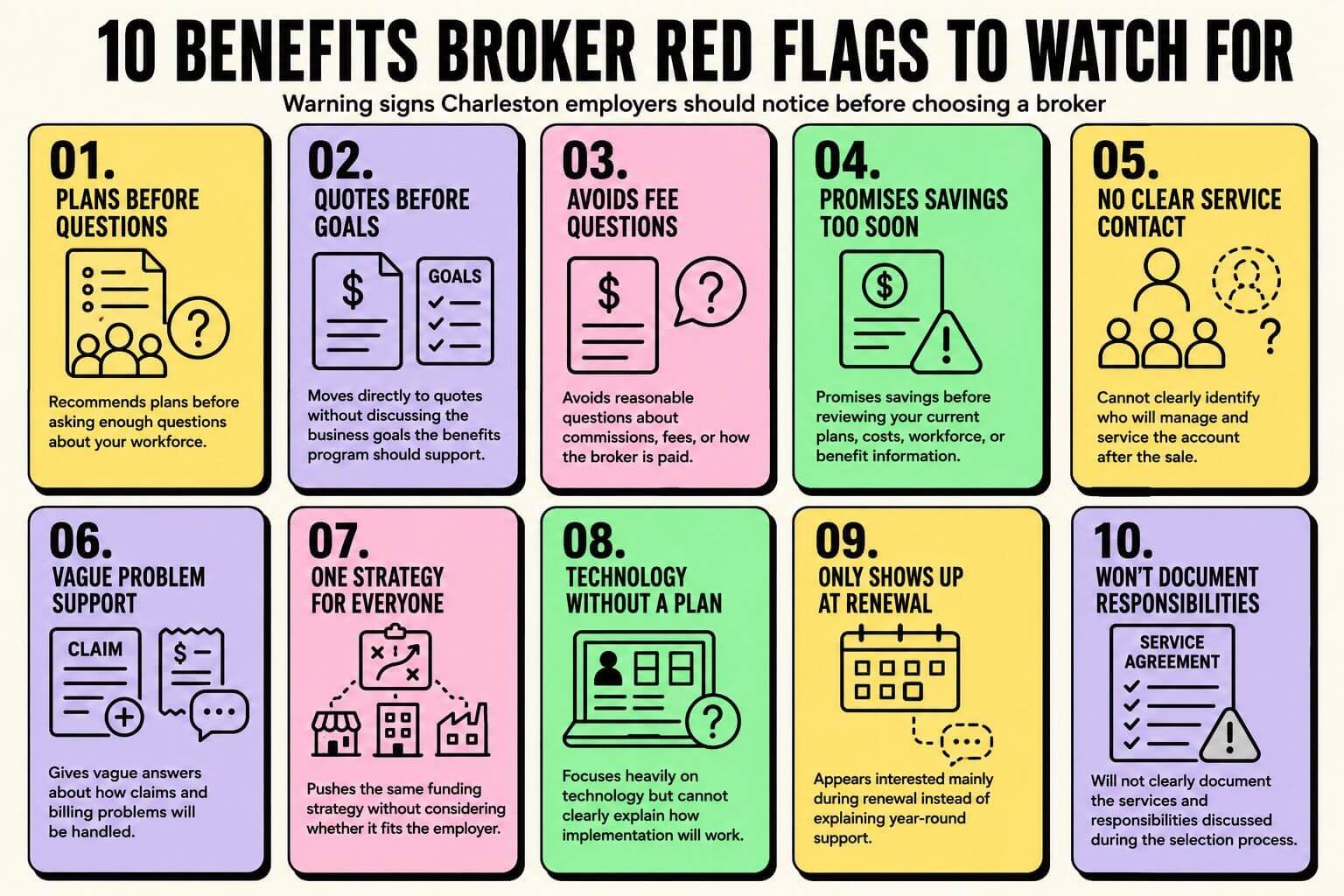
Watch for These Broker Red Flags
Some problems become visible before you appoint the broker. Pay attention when a broker:
- Recommends plans before asking about your workforce
- Moves directly to quotes without discussing business goals
- Avoids questions about commissions or fees
- Promises savings without reviewing your current information
- Cannot identify who will service the account
- Gives vague answers about claims and billing support
- Pushes one funding strategy for every employer
- Focuses heavily on technology but cannot explain implementation
- Appears interested only in the renewal period
- Will not document service responsibilities
Also be careful with promises that sound too certain. A broker cannot control every carrier decision, healthcare cost increase, or future renewal result. A credible broker should be comfortable discussing limits and tradeoffs. You need clear reasoning, not a guarantee that every future problem will disappear.
Consider the Charleston Workforce You Need to Support
Local knowledge can help, but a Charleston address alone does not prove that a broker is the right choice. The broker should understand how your employees work and where they receive care. Charleston-area companies may have employees spread across Charleston, Berkeley, and Dorchester counties. Others may employ shift-based, seasonal, mobile, remote, or variable-hour workers. Those details can affect:
- Provider-network access
- Eligibility rules
- Contribution strategy
- Enrollment timing
- Employee communication
- Benefit participation
- Administrative workload
A hospitality team may need enrollment support that works around changing schedules. A professional services company may place more weight on recruitment, dependent coverage, and digital access. A construction or logistics company may need clear mobile communication and practical income-protection options. A broker providing Charleston benefits support should understand more than local carrier names. The broker should consider where employees live, how they work, which provider networks they use, and how benefits information will reach them.
Confirm the Service Agreement Before Making a Decision
Before appointing a broker, confirm the main responsibilities in writing. The agreement or service outline should identify:
- Your account-management contacts
- Expected response times
- Services included throughout the year
- Employee-support responsibilities
- Implementation tasks
- Renewal-planning responsibilities
- Compensation and additional fees
- Technology costs
- Reporting support
- Meeting frequency
- Compliance-related support
Ask what your company must continue handling internally. For example, the broker may help with enrollment and carrier questions while your team remains responsible for sending timely eligibility information. Clear responsibilities reduce confusion later. They also give you a fair way to assess whether the broker is providing the service discussed during the selection process. Do not rely only on verbal promises such as “we handle everything.” Ask what “everything” includes and who will do the work.
Not Sure Whether Your Current Broker Still Fits?
Choosing a new benefits broker does not always mean rebuilding your entire program. Sometimes the first step is reviewing whether your current arrangement still supports your company’s needs. Look at how early your broker begins preparing for renewal, how quickly employee questions are handled, and whether your team receives help with enrollment, eligibility changes, claims, and billing issues. You should also understand how the broker is paid, what services are included, and who is responsible for your account after the plans are selected.
A structured review can help you separate plan problems from service problems. It may confirm that your current broker is still a good fit, or it may show where additional support is needed. Benni Agency works with Charleston-area employers that want a clearer view of their current benefits strategy, administrative process, and broker service model. A benefits review can give you a practical starting point before you decide whether changing brokers makes sense.