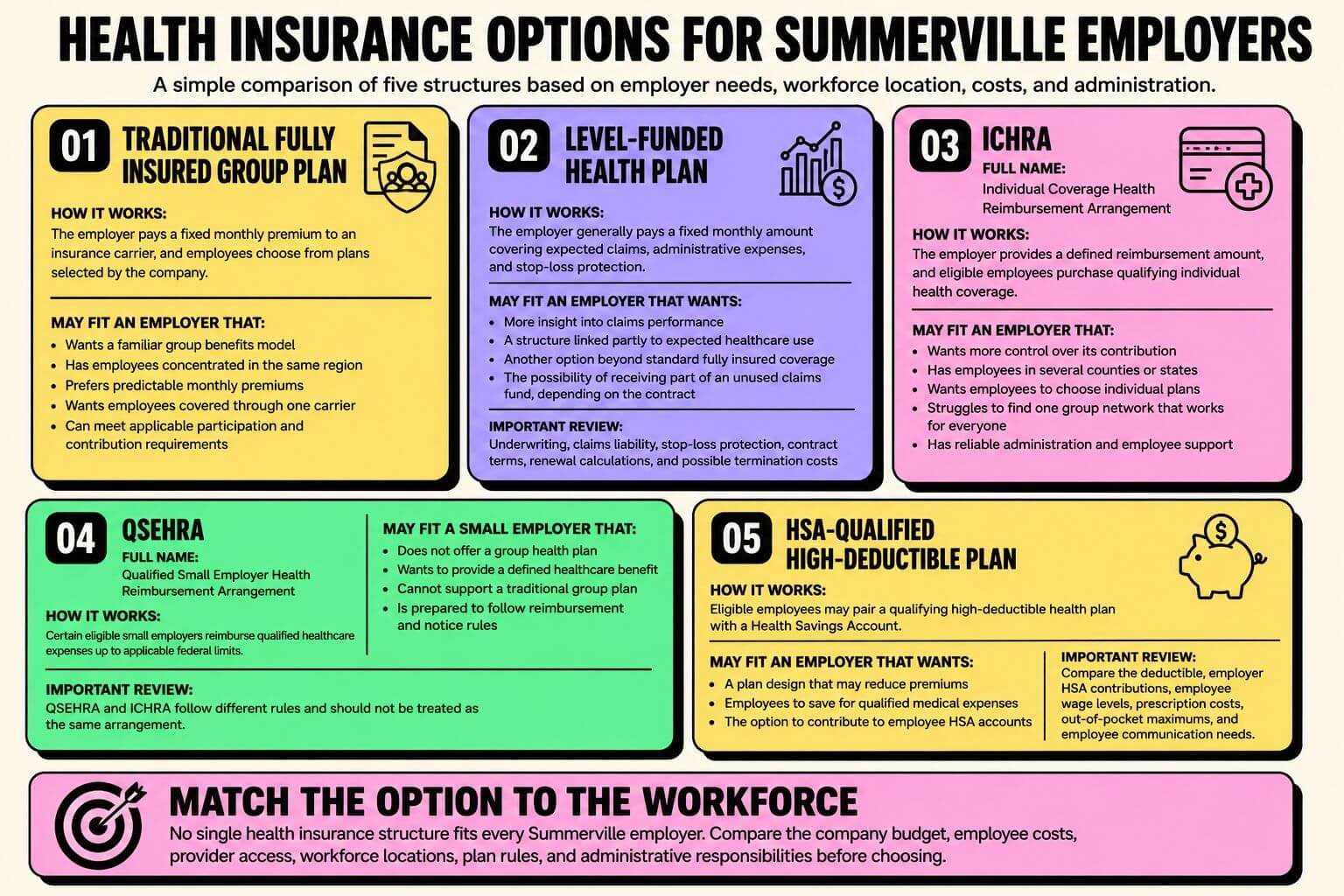
Choosing health insurance can become frustrating when renewal costs rise, employees struggle with provider access, or the plan creates more work for your HR team. Summerville employers can compare traditional fully insured coverage, level-funded plans, ICHRA, QSEHRA, and different plan designs such as an HSA-qualified high-deductible plan.
The right choice depends on your budget, workforce locations, employee needs, and ability to manage the plan. Summerville business owners and HR leaders can use this article to compare employee benefits options and make well-informed decisions.
Key Takeaways
- Traditional fully insured plans may fit employers that want a familiar group structure and have employees concentrated in or near Summerville.
- Level-funded plans may suit qualifying groups looking for another funding structure, but underwriting, claims, and contract terms need careful review.
- ICHRA gives employers a set contribution while employees choose individual coverage, which may help companies with workers in different locations.
- QSEHRA may fit eligible small employers that do not offer a group health plan, subject to federal requirements.
- The lowest premium is not always the best value. Employee contributions, deductibles, prescriptions, provider access, and administration also matter.
- Dental, vision, life, disability, and voluntary benefits can strengthen the package, but they do not replace major medical coverage.
Which Health Insurance Options Fit Summerville Employers?
There isn’t one plan structure that works for every company. A small local contractor, a professional office with 30 employees, and a remote company with workers in several states may need very different benefits. Start by understanding what each option does and where it may fit.
Traditional Fully Insured Group Plans
With a fully insured plan, the employer pays a fixed monthly premium to an insurance carrier. Employees usually choose from one or more plans selected by the company. This structure may fit an employer that:
- Wants a familiar group benefits model
- Has employees concentrated in the same region
- Prefers predictable monthly premiums
- Wants employees covered through one carrier
- Can meet applicable participation and contribution requirements
South Carolina’s small-group market generally serves employers with 2 to 50 employees. Carrier requirements can still vary, so employers should confirm participation, contribution, and eligibility rules before enrolling. A traditional plan may be easy for employees to recognize, but familiarity doesn’t guarantee affordability. Employers should examine employee payroll deductions, dependent costs, deductibles, provider networks, and renewal history before deciding that the current plan still works.
Level-Funded Health Plans
A level-funded plan combines features of fully insured and self-funded coverage. The employer generally pays a fixed monthly amount covering expected claims, administrative expenses, and stop-loss protection. Level funding may appeal to a qualifying employer that wants:
- More insight into claims performance
- A funding structure linked partly to expected healthcare use
- The possibility of receiving part of an unused claims fund, depending on the contract
- Another option beyond standard fully insured coverage
It also comes with more details to review. Underwriting, claims liability, stop-loss coverage, contract terms, renewal calculations, and possible termination costs can all affect the result. A low initial rate shouldn’t be the only reason to choose level funding. Employers need to understand what happens when claims are higher than expected and how the carrier handles any unused claims funding.
Individual Coverage HRA
An Individual Coverage Health Reimbursement Arrangement, or ICHRA, allows an employer to provide a defined reimbursement amount instead of offering one traditional group medical plan. Eligible employees use that allowance to purchase qualifying individual coverage. ICHRA may fit an employer that:
- Wants more control over its contribution
- Has employees in several counties or states
- Wants employees to choose their own individual plans
- Struggles to find one group network that works for everyone
- Has reliable administration and employee support available
The employer sets the allowance, but employees still need help understanding plan choices, provider networks, premiums, prescriptions, and enrollment deadlines. Employers also need to follow rules involving employee classes, notices, reimbursements, and documentation. The ICHRA fit guide explains the broader advantages and possible tradeoffs. Before implementation, use an ICHRA compliance checklist to review the required setup and ongoing responsibilities.
QSEHRA for Eligible Small Employers
A Qualified Small Employer Health Reimbursement Arrangement, or QSEHRA, allows certain employers with fewer than 50 full-time employees to reimburse eligible healthcare expenses up to federal limits. A QSEHRA may fit a small employer that:
- Does not offer a group health plan
- Wants to provide a defined healthcare benefit
- Cannot support a traditional group plan
- Is prepared to follow reimbursement and notice rules
An employer generally cannot offer a group health plan alongside a QSEHRA. The arrangement also has annual contribution limits and eligibility requirements that should be checked before the plan year begins. This option may work well for some small businesses, but it should not be treated as a simplified version of ICHRA. The two arrangements follow different rules.
High-Deductible Plans Paired With an HSA
A high-deductible health plan may be offered through a traditional group arrangement or another qualifying coverage structure. Eligible employees can pair the plan with a Health Savings Account. An HSA allows employees to save money for qualified medical expenses. Employers may also contribute to employee accounts. This approach may help reduce premiums, but employees generally take on more cost before the plan begins paying for many services. Employers should consider whether workers can reasonably manage the deductible. Before choosing this design, compare:
- The annual deductible
- Employer HSA contributions
- Employee wage levels
- Expected prescription costs
- Out-of-pocket maximums
- How clearly the plan will be explained
A plan may be HSA-qualified without being a comfortable financial fit for every workforce.
How to Compare the Options Without Focusing Only on Premium
Premiums matter, but they don’t show the full cost of a health plan. A plan with a lower employer rate can still create expensive payroll deductions, high deductibles, limited provider access, or more work for your internal team. Use the same comparison points for every option so you can see the real tradeoffs.
Compare the Full Cost for the Company and Employees
Start with what the company pays, then look at what employees may pay throughout the year. Review:
- Employer monthly contributions
- Employee payroll deductions
- Spouse and dependent contributions
- Deductibles
- Copayments and coinsurance
- Prescription costs
- Out-of-pocket maximums
- Administrative expenses
Dependent coverage deserves particular attention. A company may offer affordable employee-only coverage while family coverage remains difficult for many workers to use. Avoid judging a plan by the employer premium alone. A useful plan should balance the company’s budget with realistic employee costs.
Check Networks, Prescriptions, and Employee Locations
Provider access can matter as much as price. Ask which doctors, hospitals, specialists, and pharmacies employees currently use. For a Summerville employer, that may include providers throughout Dorchester, Berkeley, and Charleston counties. Companies with remote workers need to look beyond the local network.
Check:
- Local hospitals and medical groups
- Primary-care and specialist availability
- Prescription formularies
- Out-of-area coverage
- Emergency coverage
- Employee and dependent locations
A plan with a strong Summerville-area network may work well for a local workforce but poorly for employees living elsewhere. ICHRA may offer more individual choice, though employees still need to confirm that their preferred providers and prescriptions are covered.
Review Administration, Technology, and Compliance
Health insurance involves more than enrollment. Employers also manage new hires, terminations, payroll deductions, qualifying life events, notices, carrier bills, and employee questions. Ask practical questions before choosing a structure:
- Who manages enrollment?
- How are payroll deductions updated?
- Who confirms employee eligibility?
- How are required notices delivered?
- Where are plan records stored?
- Who helps employees compare their choices?
- How are carrier bills checked against payroll?
The right benefits administration technology can reduce manual work and give employees one place to review their benefits. Technology still needs clear ownership and reliable support. A platform won’t fix an unclear process by itself.
Match the Plan to the Workforce You Actually Have
Summerville’s estimated population reached 53,177 in 2025, about 4.6% higher than its April 2020 estimate base, according to the U.S. Census Bureau. For local employers, that growth is a useful reminder that benefit needs can change as companies hire, add locations, and recruit across the wider Charleston region. Consider how different employer profiles may approach the decision.
- A small local business offering health benefits for the first time may feel more comfortable starting with a traditional group plan. If that option is too costly or difficult to manage, QSEHRA may be worth reviewing.
- For a company whose employees mostly live around Summerville, a traditional group plan may provide a workable local network. The employer should still check family premiums, deductibles, and provider access.
- A business with remote or multi-state employees may find that one group network does not work well for everyone. ICHRA can give employees more plan choice, but clear enrollment support is still essential.
- A growing company with a small HR team should think carefully about administration. Even a flexible plan can create problems if no one is responsible for eligibility, payroll updates, employee questions, and compliance.
The question isn’t simply which plan has the most features. It’s which option employees can understand, afford, and use without creating unnecessary work for the company.
Build a Medical Plan Into a Complete Benefits Package
Medical insurance is usually the foundation of an employee benefits program, but it isn’t the whole package. Employers may also consider:
- Dental insurance
- Vision coverage
- Group life insurance
- Short-term and long-term disability
- Accident insurance
- Critical illness coverage
- Hospital indemnity benefits
These options can help employees manage costs that a medical plan may not fully cover. Some voluntary benefits can also be employee-paid, allowing the company to expand choice without taking on the full premium. Keep the categories clear. Dental, vision, accident, and similar products can support the medical plan, but they don’t replace major medical coverage. Employers should first choose a workable medical structure. After that, they can decide which additional benefits respond to real employee needs.
Review the Fit Before Your Next Renewal
A useful health plan comparison starts with your actual workforce, not a generic quote. Before reviewing alternatives, gather your employee census, work locations, current contributions, dependent enrollment, preferred providers, common prescriptions, and any problems employees or HR experienced during the last plan year. This information can show whether the current structure still fits or whether another option deserves closer review. It also helps separate a genuinely useful change from an offer that simply has a lower starting premium.
Benni Agency can help employers compare traditional group, level-funded, and reimbursement-based options without assuming the same model fits every company. Businesses looking for local guidance can review its Summerville benefits support. A practical next step is to compare two or three suitable structures against the workforce, budget, and administrative capacity you already have.
2 thoughts on “Summerville Group Health Insurance Options for Employers”
Comments are closed.