Most employers do not start looking at benefits because they want more paperwork. They start because renewal costs jump, employees are confused, HR is buried in manual tasks, or leadership realizes the current benefits setup is not helping them hire and keep good people.
A Summerville insurance agency should help businesses solve those problems, not just hand over quotes. This article is for local employers and HR teams who want to understand what a stronger agency relationship should look like before the next renewal season.
Key Takeaways
- A Summerville insurance agency should help businesses manage benefits, not just compare quotes.
- The right agency starts with your workforce, budget, HR workload, and retention goals.
- Benefits strategy should explain trade-offs between cost, coverage, employee value, and administration.
- Technology should make enrollment, onboarding, payroll coordination, and reporting easier.
- Strong agency support should continue throughout the year, not only during renewal.
- Local knowledge matters, but it works best when paired with modern benefits administration.
What a Summerville Insurance Agency Should Do for Businesses
A strong agency should start with business objectives, not plan brochures. Premium matters. No employer wants to ignore cost. But cost is only one part of the decision. The better question is whether your benefits package supports your team, fits your budget, and can be managed without draining HR.
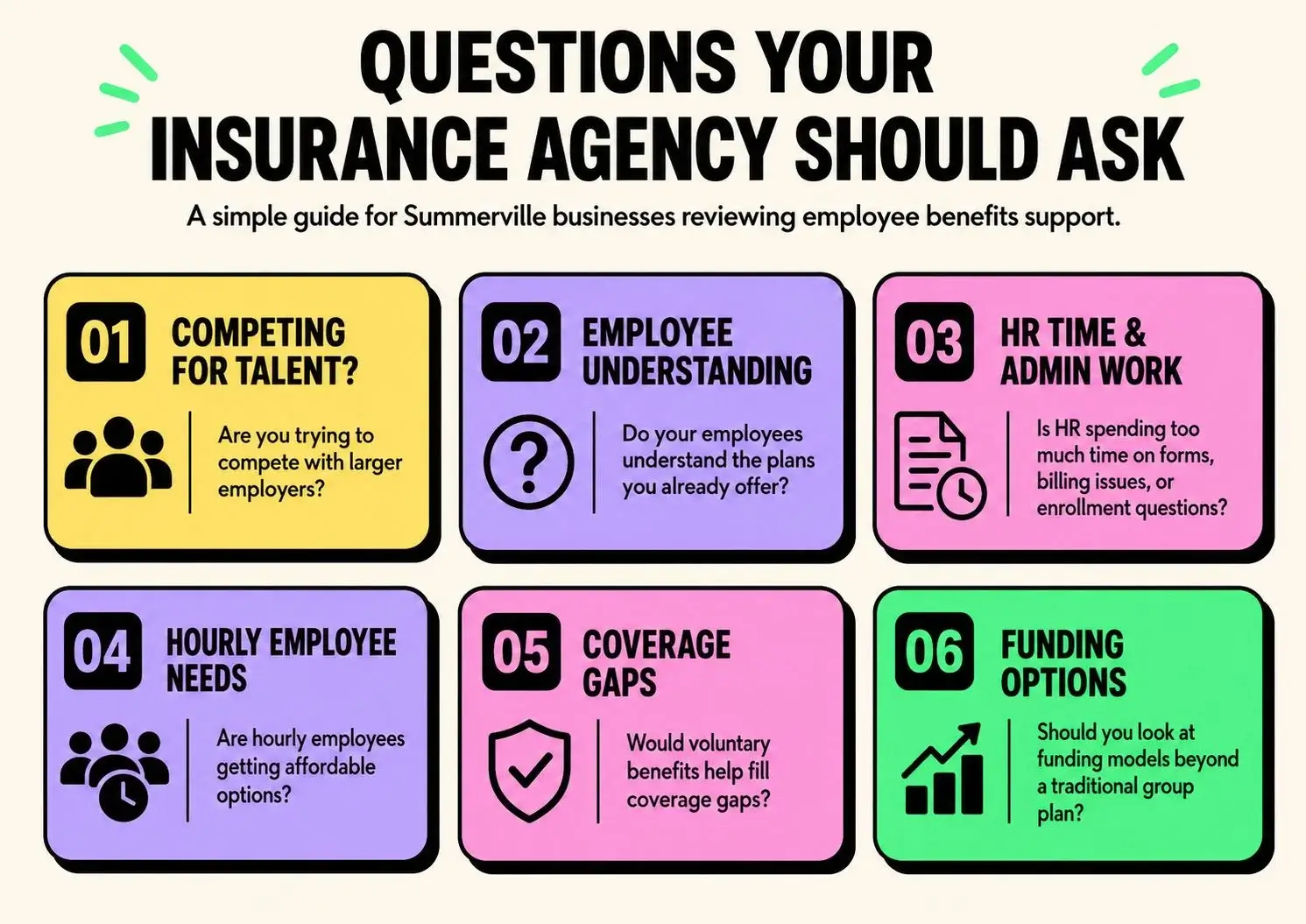
For Summerville businesses, the agency conversation should include questions like:
- Are you trying to compete with larger employers?
- Do your employees understand the plans you already offer?
- Is HR spending too much time on forms, billing issues, or enrollment questions?
- Are hourly employees getting affordable options?
- Would voluntary benefits help fill coverage gaps?
- Should you look at funding models beyond a traditional group plan?
Different employers need different levels of support. A 20-person company may need help with contribution strategy, enrollment, and compliance timing. A larger employer may need reporting, payroll coordination, onboarding workflows, and a cleaner way to manage several benefit lines. The goal is not to force every business into the same process. The goal is to build a benefits process that actually fits the company.
Benefits Strategy Comes Before Plan Shopping
This is where many agencies fall short. They sell insurance products, but they do not always help employers manage the operation around those products. That creates friction all year.
A better approach looks at the full benefits picture. Group health insurance may be the center of the conversation, but it should not be the only conversation. Dental, vision, life, disability, accident, critical illness, and hospital indemnity plans can all support employees when they are chosen with purpose. More benefits are not always better, though.
If the setup is confusing, employees may ignore the plans or pick the wrong options. If communication is weak, HR may get stuck answering the same questions again and again. If the agency only focuses on price, the employer may miss a smarter structure.
A good agency should help explain trade-offs such as:
- Lower premium vs. higher out-of-pocket exposure
- Employer contribution vs. employee affordability
- Traditional group health vs. ICHRA
- Fully insured plans vs. level-funded plans
- More plan choices vs. easier employee decision-making
Not every company should use an alternative model. Not every employer needs the same benefits mix. A credible advisor should be honest about where a solution works, where it creates extra work, and what the business will need to manage after enrollment.
Technology Should Make Benefits Easier to Run
If an agency still relies on scattered PDFs, long email chains, and manual updates, the employer pays for that inefficiency. Sometimes the cost shows up as payroll errors. Sometimes it shows up as frustrated employees. Sometimes it shows up as HR losing hours to work that should have been handled by a cleaner system.
A modern benefits process should make the basics easier:
- New hire enrollment
- Employee elections
- Dependent updates
- Payroll coordination
- Eligibility tracking
- Carrier communication
- Reporting
- Employee access to plan information
Technology does not replace service. It should make service better. The platform should handle repeatable work. The advisor should help with plan design, employee communication, compliance timing, and real problem-solving.
This matters even more for growing companies. A process that feels manageable at 15 employees can become messy at 50. At 100, it can become a serious HR burden. That is why benefits administration should be part of the agency conversation, not an afterthought.
Year-Round Support Matters More Than Renewal Season
Open enrollment gets most of the attention, but many benefits problems happen after enrollment is finished. Employees get hired midyear. Someone loses other coverage. A dependent eligibility issue comes up. A payroll feed breaks. A COBRA question lands on HR’s desk. Leadership starts thinking about next year’s compensation plan before renewal numbers are ready. A good agency should help with those moments.
Year-round support may include:
- Employee benefit questions
- New hire enrollment help
- Carrier issue follow-up
- Billing and eligibility support
- Employee communication
- Compliance timing reminders
- Renewal planning before the deadline gets close
- Review of benefit usage and participation
The value is simple. HR gets fewer fire drills. Employees get clearer answers. Leadership gets better information before decisions are rushed. If your agency mainly appears during renewal season, that is a sign the relationship may be too transactional.
Local Context Still Matters in Summerville
Local knowledge still matters, especially for businesses hiring in Summerville, Dorchester County, and the broader Charleston region.
Summerville employers are not hiring in a slow or isolated market. According to the U.S. Census Bureau, Dorchester County had an estimated 178,397 residents in 2025 and 2,861 employer establishments in 2023. That means local companies are competing for workers in a growing regional economy. Benefits play a role in that competition.
A local employer may be trying to keep hourly workers, attract office staff, support families, or compete with larger companies nearby. The right agency should understand that local pressure and help the employer build a benefits package that employees can understand and value. At the same time, local presence alone is not enough.
An agency can know the area and still use an outdated service model. Employers should expect both regional insight and modern execution. That combination matters more than a familiar logo or a long carrier list.
How to Tell If Your Current Agency Is Enough
A simple test is to look at what happens after the plan is sold. If your agency mostly appears at renewal, sends generic materials, and leaves your team to manage the rest, that is not a true benefits partnership. It is a transaction.
Here are some questions worth asking:
- Does your agency explain plan trade-offs clearly?
- Do they help employees understand their options?
- Do they support HR after open enrollment?
- Do they bring ideas before renewal pressure hits?
- Do they help compare funding models when they make sense?
- Do they make enrollment and administration easier?
- Do they understand your workforce, or only your premium history?
- Do they help you connect benefits to retention and hiring goals?
Fast replies are helpful, but speed is not the only standard. Judgment matters too. The best agencies simplify decisions. They explain what the numbers mean. They help employers avoid avoidable confusion. They also take ownership of the operational details that can quietly drain HR time.
Price shopping has a place. Nobody should pretend otherwise. But benefits are too connected to retention, compliance, employee trust, and workforce planning to be treated like a once-a-year quote exercise. A strong agency should help make benefits feel more manageable, more strategic, and more connected to business growth.
A Better Benefits Process Starts With Better Questions
A good benefits conversation should leave you with more clarity, not more confusion. Before the next renewal season, it is worth asking where your current process feels heavy. Are employees confused about their options? Is HR still chasing forms, fixing payroll issues, or answering the same questions again and again? Does your agency explain funding options and plan trade-offs clearly, or do they mostly show up with quotes near renewal?
Those questions matter because benefits affect more than premiums. They affect hiring, retention, employee trust, and the time your team spends managing avoidable problems.
Benni helps employers look at benefits as a full process, from strategy and plan selection to administration and employee support. The goal is not to add more complexity. It is to make the right decisions easier to manage all year. If your benefits process feels harder than it should, a simple review of what is working and what is not can be a useful next step.