When benefit renewals keep increasing, employees are left with unanswered questions, and your HR team is still buried in manual benefits tasks, it’s worth asking whether your broker is meeting your needs. A reliable Columbia benefits broker should make benefits easier to understand, administer, and improve throughout the year, not just during renewal season.
This guide will help Columbia employers evaluate their broker’s performance and determine whether it’s time for a more proactive benefits partner.
Key Takeaways
- A Columbia benefits broker should help with strategy, not just collect renewal quotes.
- Real broker value includes plan design, cost planning, employee education, compliance support, and benefits technology.
- Columbia employers have different workforce needs, so benefits should reflect the company’s size, budget, industry, and employees.
- ICHRA and voluntary benefits can be useful options, but only when they fit the employer’s goals.
- The best broker relationships continue year-round through open enrollment support, employee questions, reporting, and renewal planning.
What a Columbia Benefits Broker Should Actually Do
A good benefits broker should do more than bring you a few plan options once a year. They should help you understand what those options mean for your business, your budget, and your employees. That support may include:
- Reviewing group health plan options
- Comparing contribution strategies
- Explaining renewal changes
- Helping employees understand their benefits
- Supporting open enrollment
- Reviewing compliance needs
- Improving benefits administration
- Discussing options like ICHRA or voluntary benefits
The real value is in the guidance behind the plan. A broker should help you see what is working, what is causing confusion, and where your benefits package may need to change as your company grows. If your broker only appears when renewal numbers come in, you may not be getting the full value a broker relationship should provide.
Why One-Size-Fits-All Benefits Do Not Work for Columbia Employers
Columbia businesses do not all look the same. A small professional office, healthcare group, construction company, retail employer, school-related organization, and growing startup may all need different benefits strategies.
Central SC Alliance describes the Columbia region as home to manufacturers, distributors, IT companies, headquarters, startups, and support facilities. Its employer listings also show large local employers across government, healthcare, insurance, education, and retail. That matters because benefits needs change by workforce. For example:
- Hourly employees may care more about paycheck impact and simple enrollment.
- Professional teams may compare benefits closely when choosing between job offers.
- Multi-location teams may need easier benefits technology.
- Growing companies may need a plan that can scale without creating more HR work.
For Columbia employers, the right broker should understand these differences and avoid pushing the same plan design onto every company.
How a Broker Adds Value Beyond Shopping for Quotes
Getting quotes is part of the job, but it is not the whole job. A broker adds more value when they help you understand why one option may work better than another. That includes looking at:
- Premium changes
- Deductibles and out-of-pocket costs
- Provider networks
- Prescription coverage
- Employer contributions
- Employee affordability
- Plan participation
- Long-term cost trends
This matters because health benefits are expensive for both employers and employees. KFF reported that average annual employer-sponsored health insurance premiums in 2025 reached $9,325 for single coverage and $26,993 for family coverage. Those numbers are why broker strategy matters. If the only advice is “renew the current plan” or “move to the cheapest option,” the employer may miss better ways to manage cost and employee experience.
A stronger broker helps answer questions like:
- Should we adjust employer contributions?
- Are employees actually using the plan?
- Is the deductible too high for our workforce?
- Are there better network options?
- Would voluntary benefits help fill coverage gaps?
- Should we review ICHRA as an alternative?
The goal is not just to find a plan. The goal is to help the business make a decision that employees can understand, and the company can sustain.
Where Technology Fits Into the Broker Relationship
Benefits technology should make life easier for employers and employees. It should not feel like another system your team has to manage alone. The right benefits technology can help with:
- Online enrollment
- New hire onboarding
- Employee benefits access
- HRIS connections
- Reporting
- Compliance tracking
- Payroll or deduction workflows
- Open enrollment communication
This is especially helpful for employers who are still using spreadsheets, paper forms, email chains, or manual reminders. Technology does not replace broker guidance. It supports it. A good broker should help you choose tools that match your team’s workflow, then help employees understand where to go and what to do. That can reduce repeated questions, missed steps, and last-minute open enrollment stress.
When ICHRA or Voluntary Benefits May Make Sense
A broker should not recommend the same solution to every employer. Some companies may be best served by traditional group health insurance. Others may need a different structure. For some employers, an ICHRA strategy can help create more predictable budgeting. Instead of choosing one group health plan for everyone, the employer sets a defined allowance, and employees choose individual coverage that fits their needs.
That can be useful when:
- Group coverage has become too expensive
- Employee needs vary widely
- The company wants more budget control
- The employer wants to offer health benefits without managing a traditional group plan
Voluntary and supplemental options can also add value. A broker may recommend voluntary benefits when employees want more protection but the employer needs to control fixed costs. These options might include accident, critical illness, hospital indemnity, disability, life, dental, or vision coverage. The key is fit. ICHRA and voluntary benefits can be helpful, but they should be explained clearly and matched to the company’s workforce, budget, and goals.
What Year-Round Broker Support Should Look Like
A benefits broker should still be useful after renewal and open enrollment are finished. Year-round support may include:
- Helping employees with benefits questions
- Explaining plan changes before confusion grows
- Reviewing claims or carrier issues
- Supporting new hires during onboarding
- Checking whether employees understand available benefits
- Reviewing plan usage and participation
- Preparing earlier for the next renewal
- Helping HR reduce repeated admin work
This is where many employer-broker relationships fall short. The plan gets placed, open enrollment ends, and then the employer hears very little until the next renewal cycle. That leaves HR teams answering questions they may not feel prepared to answer. It can also leave employees frustrated because they do not know where to find information or who to ask. A strong broker relationship should make benefits feel easier to manage throughout the year, not just during the busiest few weeks.
How to Evaluate Whether Your Broker Is Adding Enough Value
If you are not sure whether your broker is doing enough, start with a few practical questions. Ask yourself:
- Do we understand why our renewal changed?
- Did our broker explain more than one strategy?
- Are employees getting clear benefits education?
- Is open enrollment organized and easy to follow?
- Are we using technology in a way that reduces HR work?
- Does our broker check in during the year?
- Have we reviewed ICHRA, voluntary benefits, or contribution options?
- Do we understand how our broker is compensated?
- Are we getting advice, or just quotes?
You do not need a broker who makes every decision for you. You need one who helps you see your options clearly and understand the tradeoffs. A broker who adds value should make benefits decisions feel less rushed, less confusing, and less reactive. If your team still feels alone every time benefits questions come up, that is a sign the relationship may need a closer look.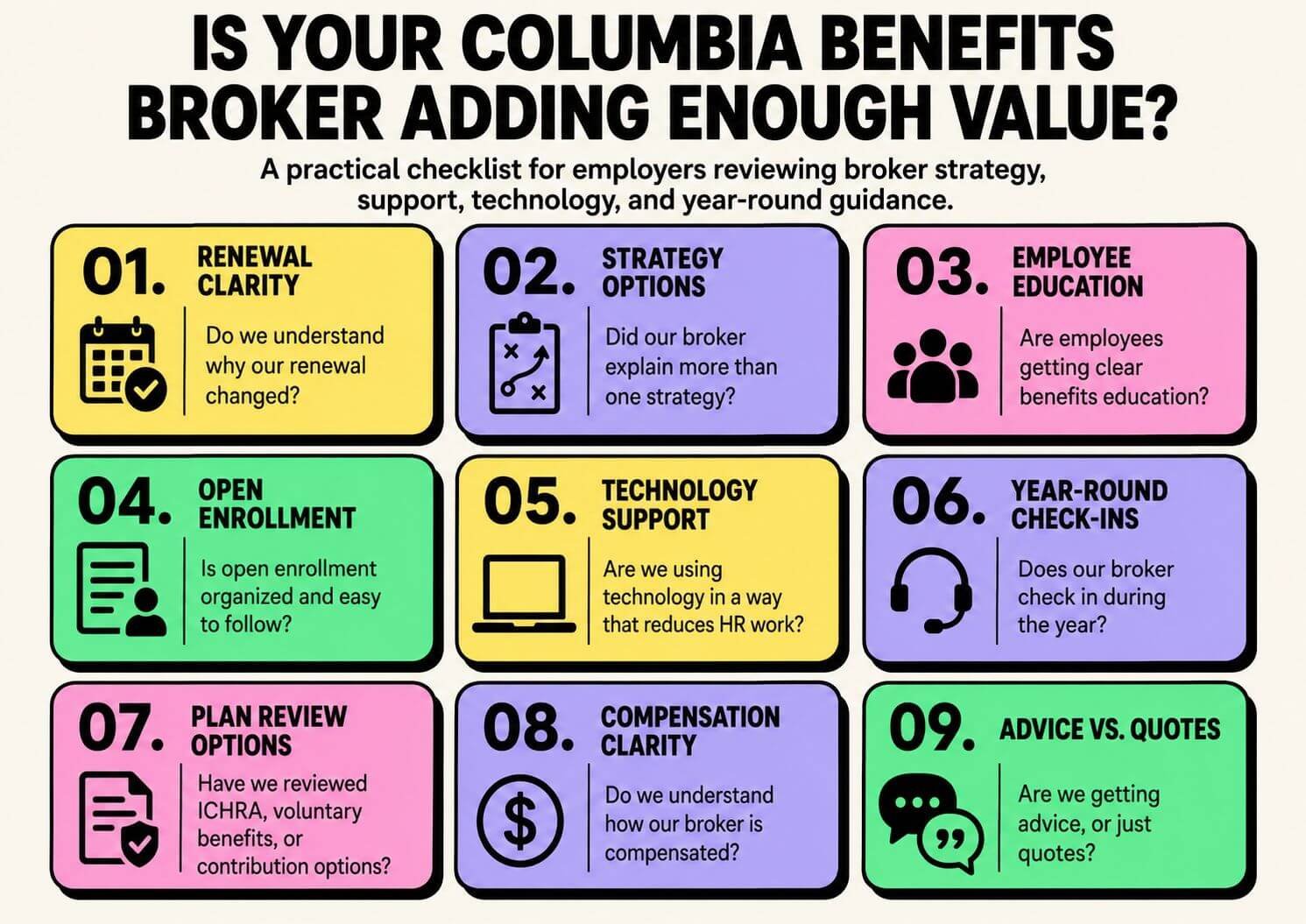
A Practical Next Step for Columbia Employers
Before changing plans or switching brokers, it helps to look at what your current benefits process is actually doing for your business. Are renewals explained clearly? Do employees understand their options? Is your team still handling too much enrollment, onboarding, or benefits paperwork manually? Are you seeing ideas beyond the same plan choices every year?
For Columbia employers, a useful broker conversation should connect cost, employee experience, compliance, technology, and long-term planning. That does not always mean making a major change. Sometimes it means cleaning up communication, comparing contribution options, reviewing ICHRA, or adding benefits that employees value. Benni can help employers review where their current benefits approach feels unclear, expensive, or hard to manage, then talk through practical next steps based on the company’s goals. A simple benefits review can help you see whether your current broker relationship is giving your Columbia team the support it needs.